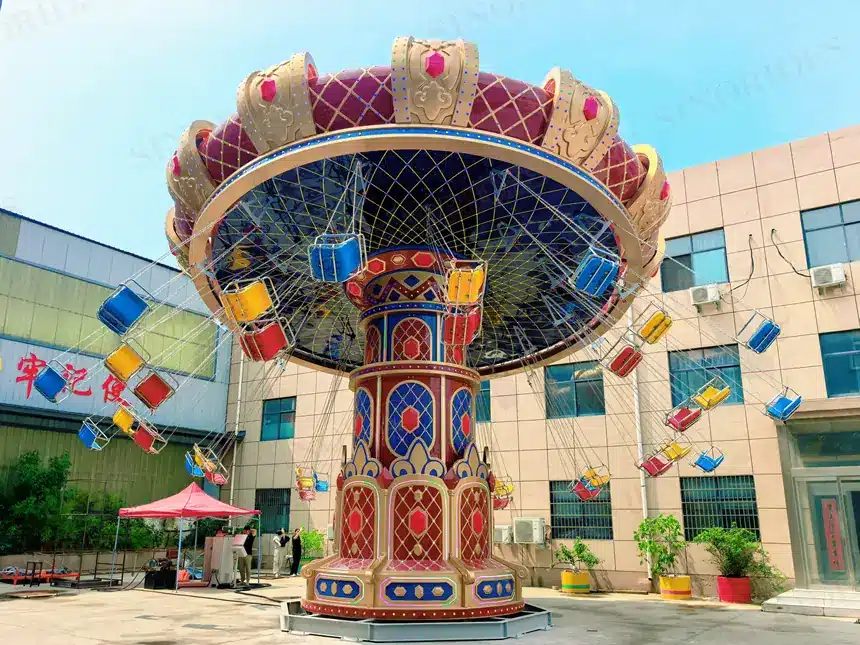
36-seat Crown Flying Chairs Ride
| TECHNICAL DATA | SPECIFICS |
|---|---|
| Structure: | foundation free |
| Footprint: | |
| Max Swing Speed: | |
| Max Height Reached: | |
| Passenger Height Requirement: | 1.2m to 1.9m |
| Restraint System: | Adjustable lap bar + safety belt |
| Theoretical Capacity: | riders/hour |
| Ride Duration: | seconds |
| Single Cabin Capacity: | 36 passengers per cabin |
| Drive Power: | |
| Total Power: |
Highlights About 36-seat Crown Flying Chairs Ride
- Dual-seat inner, single-seat outer improves family stability
- 304 stainless steel used in key structural components
- 35mm reinforced track improves load-bearing stability
- Secondary safety cable prevents key component drop risk
- External bearing lubrication ports for easy maintenance access
- Anti-loosening pin system reduces vibration failure risk
- PVC chain covers reduce pinch and improve safety
- Triple 7.5kW motors ensure stable rotational power output
- Siemens PLC ensures stable and controllable operation logic
- Modular LED and canopy system supports easy upgrades
The 36-seat Crown Flying Chairs Ride is a large-capacity rotating amusement ride designed for medium to large-scale theme parks and outdoor entertainment zones. It operates through a central rotating hub system where suspended chairs rotate outward under centrifugal force, creating both elevation and swinging motion during operation.
The seating system follows a hybrid configuration: inner double-seat units and outer single-seat units. This layout is engineered to support both family groups and individual riders while maintaining balanced load distribution. It also improves psychological comfort for children riding with parents, reducing hesitation during boarding.
Structurally, the ride is built around an upgraded steel framework with reinforced track sections and optimized welding access points. The mechanical system integrates multiple safety layers, including redundant steel cable protection and anti-loosening fastening structures in vibration-heavy joints. These designs reduce long-term operational risks in high-frequency commercial environments.
The drive system consists of multiple motors working in synchronized output, ensuring stable centrifugal speed and controlled ride dynamics. The control system is based on PLC architecture, enabling predictable operation logic and stable performance across long operating cycles.
From an environmental perspective, the ride uses a modular canopy system combined with large-scale RGB LED lighting arrays. This allows strong visual presence during night operation, which is critical for parks relying on evening traffic revenue.
The 36-seat Crown Flying Chairs Ride is commonly deployed in theme parks, amusement parks, resort entertainment zones, and commercial fairgrounds. Its design focuses on operational stability, maintenance accessibility, and long lifecycle usage under continuous public operation conditions.




Sinorides 36-seat Crown Flying Chairs Ride Quality Control
Sinorides applies a structured industrial quality system covering material control, welding inspection, assembly verification, and full ride testing.
Steel components are pre-processed and checked for thickness and load tolerance before assembly. Welding points are inspected to ensure structural integrity under dynamic stress.
Electrical systems follow standardized wiring rules. PLC cabinets and motors are tested for stability, overload protection, and response accuracy.
Each ride undergoes no-load and loaded operation tests to evaluate vibration behavior, mechanical stability, and safety response.
Material selection and design follow CE and ISO-aligned amusement ride safety standards depending on project requirements.
Final inspection includes emergency stop testing, safety redundancy checks, and full system operational verification.
Full Support on Your 36-seat Crown Flying Chairs Ride Installation
Sinorides provides complete installation support for the 36-seat Crown Flying Chairs Ride from delivery to final operation. The process starts with detailed foundation and layout guidance based on site conditions to ensure correct positioning and structural alignment.
Our technical team assists with on-site assembly of the main steel structure, mechanical system, electrical wiring, and PLC control setup. Key steps include motor alignment, chain tension adjustment, and safety system calibration to ensure stable operation.
After installation, full commissioning tests are conducted, including no-load and loaded operation checks, emergency stop response, and rotation stability verification.
Remote technical support and video guidance are available when needed. On-site engineers can also be dispatched for complex projects to ensure smooth startup and safe operation from day one.


Related Flying Chair Rides
Explore more Sinorides flying chair series and large-scale amusement rides with different capacities and designs. Each model is engineered for safety, stable operation, and strong visual attraction in theme parks and outdoor entertainment projects.


Send Your Inquiry Now
The amusement ride industry is closely tied to tourism infrastructure, commercial entertainment development, and urban leisure investment. Across global markets, demand continues to shift toward high-capacity, visually impactful rides that can generate continuous passenger throughput while maintaining operational efficiency.
Flying chair rides belong to a mature category within the amusement ride ecosystem. Their long-standing popularity comes from a combination of simple mechanical structure, predictable motion behavior, and high visual appeal during rotation. Compared with more complex roller coaster systems, flying chair rides require lower construction complexity while still delivering strong rider experience value.
In recent years, the industry has seen increasing demand for upgraded versions of traditional rides. Operators are no longer only focused on ride motion; they evaluate structural safety systems, maintenance efficiency, lighting performance, and lifecycle cost. This shift is driven by two factors: rising labor cost in park operations and increasing safety regulations across multiple regions.
As a result, manufacturers are redesigning classic ride categories with modern engineering improvements. Reinforced steel structures, modular maintenance systems, and intelligent control systems have become standard expectations rather than optional upgrades.
The flying chairs ride category has evolved through three main stages.
The first stage focused on basic mechanical rotation with minimal structural enhancement. These systems were simple but required frequent manual maintenance and had limited safety redundancy.
The second stage introduced improved steel structures and better motor systems. This phase focused on increasing ride capacity and operational stability, allowing rides to serve mid-size amusement parks.
The current stage emphasizes system integration. Structural engineering, electrical control, safety redundancy, and visual design are treated as a unified system rather than separate components.
The 36-seat Crown Flying Chairs Ride belongs to this third-generation category. It integrates reinforced mechanical structures with multi-layer safety systems and modern lighting design. The goal is not only to improve ride experience but also to reduce operational downtime and maintenance workload.
Another important development direction is modularity. Modern amusement rides are increasingly designed for easier transportation and installation. Foundation-free concepts are becoming more relevant in emerging markets where infrastructure investment is limited or project timelines are short.
Sinorides operates as an integrated amusement ride manufacturer with capabilities covering design, structural engineering, fabrication, assembly, and testing.
The production system is divided into specialized workshops including structural fabrication, surface treatment, fiberglass molding, painting, and final assembly. This separation allows controlled quality across different manufacturing stages.
Engineering teams focus on load analysis, dynamic simulation, and structural reinforcement design. Each ride is reviewed for stress distribution and fatigue behavior under long-term operational cycles.
The factory workflow includes pre-assembly verification before final installation. This reduces onsite adjustment time and improves installation predictability for international projects.
Material sourcing prioritizes industrial-grade steel and standardized electrical components. Key systems such as PLC controllers and hydraulic units are selected based on stability and long-term service availability.
Sinorides also emphasizes customization capability. Ride appearance, seating layout, lighting configuration, and structural dimensions can be adjusted based on park theme requirements and site conditions.
Flying chair rides are widely used in both permanent theme parks and seasonal outdoor amusement zones due to their flexible installation and strong visual attraction.
In theme parks, the ride often serves as a mid-level attraction that bridges children’s zones and high-thrill areas. Its moderate thrill level makes it suitable for family groups, increasing overall park participation rates.
In outdoor amusement parks, especially seasonal or traveling setups, foundation-free or simplified foundation designs reduce construction time. This allows operators to deploy rides quickly for festivals, temporary events, or tourism peaks.
Lighting systems play a critical role in commercial value. At night, LED-based illumination transforms the ride into a visual centerpiece, increasing secondary revenue through evening operations.
Operationally, flying chair rides are valued for predictable maintenance cycles. Compared with high-speed or high-impact rides, their mechanical structure is easier to inspect and service, reducing long-term downtime.
From an investment perspective, flying chair rides are often positioned as medium-risk, high-visibility assets. Their revenue performance depends on throughput capacity, operational hours, and park foot traffic.
A 36-seat configuration improves passenger turnover by allowing more riders per cycle compared to smaller versions. This directly impacts hourly revenue potential in commercial parks.
Maintenance cost is a key factor in long-term ROI. Designs that improve lubrication access, reduce fastener loosening, and simplify part replacement contribute to lower operational overhead.
Energy consumption is also a consideration. Multi-motor systems must balance power output with efficiency. Stable torque distribution reduces mechanical strain, extending component lifespan.
Lifecycle value is determined by structural durability and upgrade potential. Systems that allow lighting upgrades, control system expansion, and modular component replacement tend to retain value longer in park operations.
Globally, amusement ride demand is expanding in emerging tourism markets across Asia, the Middle East, and Eastern Europe. These regions prioritize visually strong rides that can be deployed in outdoor environments with varying infrastructure conditions.
There is increasing preference for rides that combine mechanical reliability with strong nighttime visual identity. LED integration and thematic design have become essential components in new park development.
Another trend is the adoption of standardized electrical control systems. PLC-based architectures are widely preferred due to their stability and compatibility with maintenance protocols across different countries.
Manufacturers are also adapting to logistical requirements. Transport-friendly structural segmentation and reduced onsite welding needs improve international deployment efficiency.
Theme park investors and procurement teams typically evaluate flying chair rides based on five core dimensions.
Safety architecture is the first priority. Buyers focus on redundancy systems, structural reinforcement, and emergency response behavior.
Operational stability is the second factor. Consistent rotation, minimal vibration, and predictable control systems reduce operational risk.
Maintenance efficiency is another key concern. Easy access to lubrication points, modular part replacement, and standardized components significantly affect long-term cost.
Visual impact influences visitor attraction rates. Crown-themed designs and large-scale lighting systems are often selected to enhance park branding.
Finally, lifecycle cost determines final decision-making. Buyers evaluate not only purchase cost but also energy consumption, maintenance frequency, and expected service life.
FAQ
Q1: What is the 36-seat Crown Flying Chairs Ride used for?
It is designed for theme parks, amusement parks, and outdoor entertainment projects. The ride provides a family-friendly rotating experience with strong visual impact, making it suitable for operators looking for high-capacity amusement rides to increase visitor flow and commercial attraction.
Q2: Is the Crown Flying Chairs Ride safe for children and families?
Yes, the ride is engineered for family use with dual-seat and single-seat layout options. It includes multiple safety systems such as secondary steel cables, anti-loosening connections, and protective chain covers, making it suitable for safe operation in amusement parks and outdoor rides environments.
Q3: What maintenance is required for this amusement ride?
Maintenance is simplified through external lubrication points on bearings, modular components, and accessible mechanical structures. Operators only need regular inspection, lubrication, and safety checks to ensure long-term stable performance of the amusement park ride.
Q4: What kind of control system does this flying chairs ride use?
The ride uses a Siemens PLC control system to ensure stable operation, precise motion control, and reliable safety response. It supports consistent performance in commercial amusement rides and can be upgraded with additional control interfaces if required.
Q5: Can this ride operate in outdoor amusement parks?
Yes, the structure is designed for outdoor amusement park environments. Corrosion-resistant materials and reinforced steel structure allow stable operation under different weather conditions, making it suitable for long-term outdoor theme park installations.
Q6: How many passengers can the ride handle per cycle?
The ride features a 36-seat configuration, allowing high passenger capacity per cycle. This improves throughput efficiency and makes it a strong investment option for amusement park operators focusing on visitor volume and ride ROI.
Q7: What makes this ride different from standard flying chairs ride?
This model features upgraded structural steel, multi-motor drive system, enhanced safety cable design, and advanced LED lighting. These improvements increase stability, safety, and visual attraction compared to traditional amusement flying chair rides.
Q8: What power system is used in the ride?
The system uses a triple 7.5kW motor configuration to ensure stable rotational power and smooth speed variation. This design supports consistent operation in commercial amusement ride environments with high usage frequency.
Q9: Is installation complicated for this amusement ride?
Installation is supported by Sinorides technical team with full guidance. The ride uses a modular structure design that simplifies assembly, electrical connection, and testing, making it easier to deploy in both fixed and outdoor amusement park projects.
Q10: Does the ride support customization?
Yes, customization is available for appearance, lighting system, canopy design, and structural configuration. This allows amusement park operators to match different themes and improve visual branding for their outdoor or indoor ride projects.