Building an amusement park in Kazakhstan costs roughly $500,000–2 million (235–940 million KZT) for a compact seasonal park on leased land, $2–6 million for a small family park, $8–30 million for a mid-size regional park, and $50–200 million+ for a destination project. Land takes 15–25% of capital, rides and attractions 30–40%, civil works and climate engineering 20–30%, design and permits 5–10%, and pre-opening operations 10–15%. Family rides cost $100,000–500,000 each, thrill rides $500,000–3 million, and landmark rides such as ferris wheels and roller coasters $1–20 million. Imported rides face Kazakhstan’s 12% VAT and EAEU safety certification. Because the outdoor season runs only 5–6 months in the north, season economics shape every budget: small parks typically break even in 2–4 years, destination parks in 8–12.
جدول المحتويات
Introduction: The Steppe’s Price Question
Ask five consultants what it costs to build an amusement park in Kazakhstan and you will get five different answers. The honest answer is a range, not a number. The country is Central Asia’s largest economy, and the government reported around 15 million foreign visitors in 2024. Almaty counts more than two million residents, Astana about 1.5 million. The appetite for family entertainment is real; the gap between a rented seasonal park and a destination project is more than a hundredfold in capital.
Two public projects frame that spread. In Astana, the Meruyert theme park was announced on a 180-hectare plot near the Korgalzhyn Highway, with construction estimated at $180–200 million, a 26,000 m² water park as the priority first phase, and themes such as Pirates, Old Europe and Dinosaurs. In the Aktobe region, a park at the Kargalinskoye Reservoir carries an investment of nearly 4 billion tenge — about $8.5 million — and is expected to create 200 jobs. Same country, twentyfold difference.
What drives the price? Four variables matter more than anything else: land strategy, ride mix and quality tier, scale, and how much you build at once. In Kazakhstan a fifth one sits on top: climate. Astana is the second-coldest national capital in the world, with winters of −30°C common and a river that stays frozen from November to April. That changes foundations, buildings, utilities and the length of your selling season.
This guide is written for investors, operators and procurement teams planning a project in Kazakhstan. Figures are indicative 2026 ranges in USD and tenge, converted at roughly 470 KZT per USD (the official rate in August 2026). Treat them as planning bands, not quotations. Where you see a link to ألعاب الملاهي, it points to equipment categories discussed in that section.
In project experience, equipment is rarely the reason a Kazakh park opens over budget. The usual culprits are land and permit timelines, foundation surprises in frozen or heaving soils, currency swings on imported rides, and underestimating the working capital needed to survive the first winter. Budget at least 10–15% contingency and settle your season plan before you order steel.
1. إجمالي الاستثمارات حسب حجم المنتزه
The fastest way to anchor a budget is to pick a format. The table below groups realistic 2026 capital costs — land preparation, rides, civil works, design, permits and pre-opening operating setup — by park size. The per-ride budget matters more than the headline number: two parks with the same total can look completely different if one buys ten cheap rides and the other five solid ones.
A useful rule of thumb used across regional parks: small and mid-size formats typically run $200,000–600,000 per hectare of developed area, excluding land purchase and themed buildings. Large projects with water parks, hotels and signature coasters blow past that quickly — the Meruyert estimate works out to roughly $1 million per hectare including the water park and resort elements.
Do not compare a regional park to a destination project. Compare to parks of the same size, catchment and ride count in similar cities. The Aktobe project at roughly $8.5 million sits squarely in the mid-size band; the Meruyert project is a different animal built to anchor regional tourism.
2. Land & Location: Astana, Almaty or the Regions
Land is typically 15–25% of capital for a purchased site, and close to zero upfront for a leased one — which is why most first parks in Kazakhstan start on municipal or private leases. Kazakh land law allows private ownership of agricultural land for citizens; foreign investors usually lease rather than buy, typically for up to 49 years. Municipal plots are allocated through auctions, and annual lease payments often run a small percentage of cadastral value.
Three land decisions shape cost more than the price per hectare. First, catchments: a park lives or dies on weekend traffic, so land within a 60–90 minute drive of a city of one million people outperforms cheaper remote land almost every time. Almaty and Astana are the two anchor markets; Shymkent, Aktobe, Karaganda and Turkistan are the second tier. Second, terrain: flat hard-standing for ride pads and existing trees for shade reduce earthwork and landscaping spend by 10–20%. Third, utilities: a plot without mains power, water and sewage will quietly eat a season’s profit in connection fees.
Budget site development on top of the land price: leveling, soil testing, drainage, fencing, approach roads and utility connections typically add tens of millions of KZT per hectare for a mid-size park. Run a geotechnical survey before signing — heavy clay soils that heave when frozen can add real foundation cost later.
3. الألعاب والمرافق الترفيهية: أين تذهب الأموال
Rides and attractions typically absorb 30–40% of total capital for a balanced park. The table gives indicative prices for new equipment supplied to Kazakhstan, before freight, customs and installation. Prices vary with size, theming, safety certification and manufacturer; Chinese factories generally price 30–50% below comparable European equipment at similar CE/ISO compliance levels, which is one reason supplier quotes diverge so widely.
A balanced small park typically allocates $700,000–1.5 million to equipment; a mid-size park $3–10 million; a destination park $15–80 million. Start with 6–8 core rides that give a full day of variety, then add one signature attraction every 12–18 months from cash flow. Remember that ride price is not the end of the story: foundations and installation add 5–15% on top (more for large rides), and shipping, customs clearance and certification add roughly 10–25% to the FOB price of imported equipment.
A 42–60 m ferris wheel is the most cost-effective hero attraction for a Kazakh city. It gives landmark visibility at a fraction of a coaster’s price, its capacity drives strong per-hour revenue, and it photographs beautifully against the skyline — marketing you do not have to pay for separately.
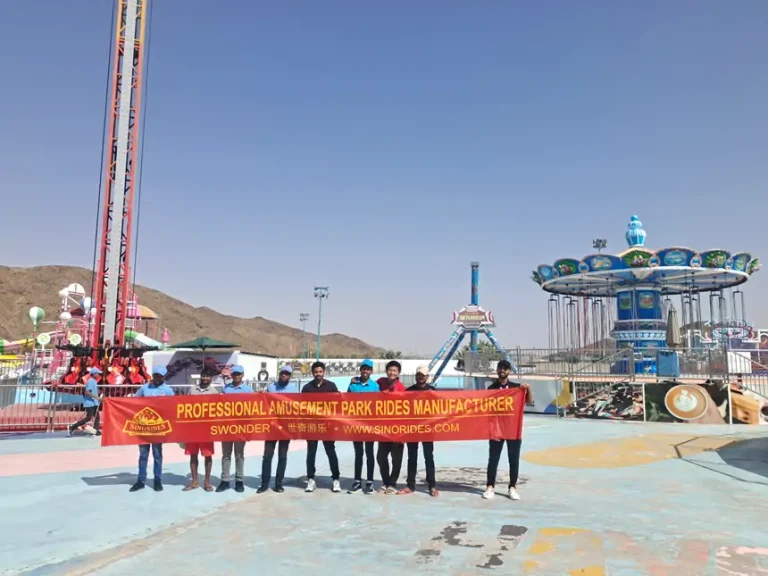
Cold-climate regions already run this equipment mix successfully. سينوريديس delivered a double-decker carousel, a pirate ship, a 30 m drop tower and an energy storm to Maxim Gorky Central Amusement Park in Russia in 2023; a wacky worm coaster to a shopping mall in Mongolia in 2018; and a carousel, disco tagada, mini shuttle and bumper cars to Firdavsi Park in Tajikistan in 2019. These are the kinds of parks that keep Central Asian families coming back on weekends.
4. Civil Works & Climate Engineering
Civil infrastructure typically takes 20–30% of capital, and in Kazakhstan a meaningful slice of that is climate engineering. Foundations must go below the seasonal frost line; outdoor steel rides need weatherproofing for −30°C; hydraulics and bearings need winter-grade oils; and any building with guests inside needs real heating, not a space heater. An outdoor park in the north is simply closed for five months, so every tenge spent on civil works has to earn its keep in six.
The single most important civil decision in Kazakhstan is indoor-outdoor balance. An indoor family entertainment hall keeps revenue flowing from November to March and doubles as a weather-proof anchor for school groups and birthdays. Parks that skip it effectively write off half the calendar year. See how ride foundations are designed for soil and concrete conditions for the engineering detail.
Design for winter from day one. Heated queuing corridors, frost-protected water lines, snow-melt paths at entrances and a warm staff base add 2–4% to civil costs but protect attendance on cold weekends — and they keep the park from looking abandoned in December.
5. Design, Theming & Engineering
Master planning, architecture, ride layout and theming usually run 5–10% of capital. This is where a park stops being a collection of rides and becomes a place families choose. The Meruyert project planned themed areas around Pirates, Old Europe and Dinosaurs plus a miniature park, an ice maze and VR attractions; Caravan Saray in Turkistan anchors its entertainment center around a panoramic attraction and an 8D flying theater. Theming sells tickets, but it also carries a cost: custom theming can add 20–50% to a ride’s delivered price.
For a first park, the pragmatic path is standardized ride platforms with light theming — paint, signage, landscaping — rather than fully custom packages. Fewer custom parts mean shared spares, simpler staff training and cheaper maintenance contracts. Add deeper theming in phase two, when cash flow and visitor feedback tell you which zones earn it.
6. Import, VAT, EAC Certification & Logistics
Kazakhstan is part of the Eurasian Economic Union (EAEU), and that shapes import costs in three ways. First, rides imported from outside the union pay the common customs tariff plus 12% VAT. Second, the union’s technical regulation on the safety of amusement rides (TR EAEU 038/2016) requires EAC conformity assessment before equipment can be operated — plan for it in your timeline, not after delivery. Third, rides from EAEU member states avoid customs duty, though VAT still applies.
For documentation, manufacturers that design to EN 13814, ISO 17842 and ASTM F24 and carry CE certification have a shorter path to EAC approval, because the conformity evidence already exists. Ask suppliers for their EAC readiness before you compare prices; a cheap ride that fails certification is the most expensive ride in the park.
Logistics are straightforward but worth planning. Most Chinese equipment enters through the Khorgos–Altynkol border crossing and moves by rail or road to Almaty and Astana; sea freight can route through the Caspian ports of Aktau or Atyrau. Budget 10–25% of FOB price for freight, duty and VAT cash-flow, certification and commissioning — and lock currency terms in the contract, because tenge swings against the dollar change delivered costs. This is also where تختلف أسعار الألعاب الترفيهية باختلاف الموردين most.
In practice, the biggest import surprises are not the tariff rates — they are VAT cash-flow during construction, winter port delays, and certification paperwork that nobody started early enough. Open the EAC process when you sign the equipment contract, not when the container arrives.
7. Seasonal Economics & Operating Costs
Season is the first number an investor should model, not the last. Outdoor parks in northern Kazakhstan effectively sell tickets from May to September or early October — about five to six months. Southern cities such as Almaty, Shymkent and Turkistan stretch that to seven or eight months. An indoor hall can trade year-round. Choose the operating model to match the climate before you choose the rides.
Inside those numbers, staff typically takes 35–45% of opex, power and heating 15–25% (winter heating of an indoor hall is a real line item), insurance and permits 5–10%, and marketing the rest. Maintenance should be planned at 3–5% of equipment value per year — and in a cold climate it is a season, not a line item. Winter is when bearings get serviced, paint touched up, hydraulic systems flushed and inspection records updated. Parks that treat the off-season as a maintenance season open stronger every spring. A practical قائمة مراجعة صيانة معدات الترفيه covers the cycles.
Model revenue on the true season, not twelve months. A northern park that earns hard in summer must carry fixed costs across a frozen winter — that is why lease terms, staff contracts and energy deals should all be built to flex. Seasonal staffing and winter events (New Year fairs, ice rinks) smooth the trough.
8. ROI, Ticket Prices & Revenue Models
Kazakh park tickets typically run 1,500–5,000 KZT ($3–11), depending on city, ride mix and whether admission bundles rides. Annual passes, school programs, corporate days and birthday packages fill the weekdays that weekend traffic cannot. F&B adds 25–30% margin on top, and in a country where families already treat shopping centers as weekend destinations, a well-run park competes for the same hours.
Observed break-even patterns: compact and small parks on leased land typically reach break-even in 2–4 years if location and marketing hold up; mid-size regional parks in 4–7 years; destination projects in 8–12 years, with returns driven by hotels, retail and events as much as ride tickets. The highest-leverage levers are dwell time and repeat visits. Every extra hour a family stays adds F&B spend; every repeat visit lowers marketing cost. Ride mix, shade, indoor space and queue design are investment decisions, not decoration — see the جولات عائلية range that anchors most weekday traffic.
Build the financial model around weekend peaks, school holidays and Nauryz in March. A park that can host 3,000 visitors on a Saturday but only 300 on a Tuesday needs pricing, passes and programs that shift demand — not more rides.
9. Government Support & Financing
Kazakhstan treats tourism as a priority sector. National strategies target tourism clusters around Astana, Almaty and the regions, visa-free entry has been expanded for dozens of countries, and state bodies have backed large leisure infrastructure — the Meruyert project was initiated with Kazakh Tourism and the Ministry of Culture and Sports behind it. The Caravan Saray complex in Turkistan, with a family entertainment center sized for 300,000 visitors a year, a panoramic attraction and an 8D flying theater, shows how entertainment anchors regional tourism development.
At the regional level, akimats support projects that create jobs and tourist zones — the Aktobe park is part of a reservoir tourism zone and expected to employ 200 people. Financing in practice comes from bank loans in tenge, equipment finance from manufacturers, and milestone-based payment schedules (commonly 30% at order, 40% at production, 20% before shipment, 10% after installation) that reduce upfront strain. Development institutions and special economic zones add options for larger projects.
Hidden costs to budget from day one: land registration and notary fees, VAT cash-flow during construction, utility connection charges, pre-opening payroll and marketing for the first season, and a 10–15% contingency treated as a line item, not a rounding error.
10. ثماني طرق لخفض التكاليف دون المساس بالجودة
The spread between a $2 million park and a $6 million park with similar rides is mostly decisions, not luck. These eight levers are the ones operators actually use:
Municipal leases cut upfront capital dramatically and keep cash for rides. Verify zoning for amusement use before bidding.
Open with 6–8 core rides, then add one signature attraction every 12–18 months from cash flow.
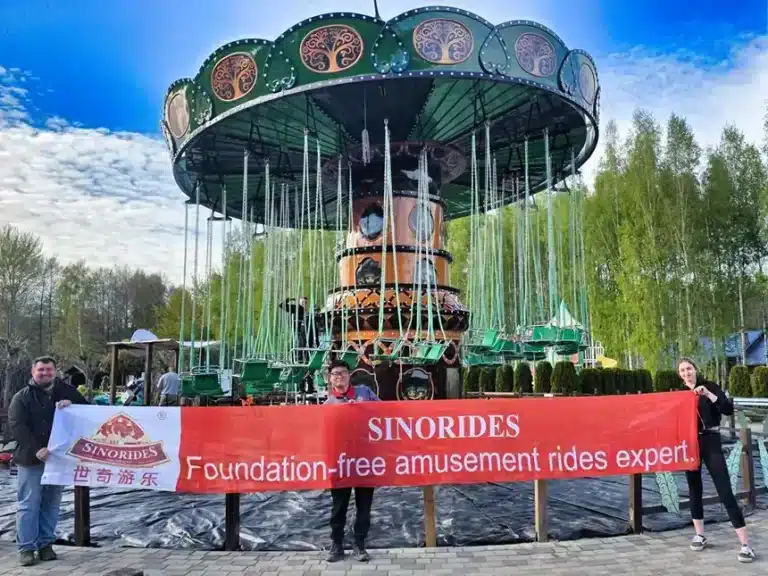
No concrete curing in frozen ground, 40–60% faster installation, and equipment can relocate if a lease ends. See جولات خالية من الأساس.
Direct exporters undercut intermediaries by 15–30% at similar CE/ISO compliance. Ask for certifications and references.
Fewer ride models mean shared spares, simpler training and cheaper maintenance contracts.
An indoor hall carries winter revenue and extends the season without a full indoor-park budget.
LED lighting, heat recovery, inverter drives and insulated buildings cut the power bills that eat 15–25% of opex.
Installation supervision, EAC documentation support, training and spares vary widely between suppliers — get them in writing.
11. What Kazakh Projects Tell Us
The announced projects point to three distinct market tiers. The Meruyert park shows the destination tier: multi-stage development, a water park as the first revenue anchor, and resort elements to extend stay. The Aktobe park shows the regional tier: a focused investment of roughly $8.5 million that anchors a reservoir tourist zone and creates local jobs. And existing anchors — Khan Shatyr in Astana, Kok Tobe above Almaty, the entertainment halls in shopping malls — show the urban tier where compact, high-footfall formats work year-round.
For an investor entering Kazakhstan, the pattern is encouraging: the country has demand, policy support and examples at every scale, but still a thin supply of modern family parks. The parks that win will be the ones that match scale to catchment, take the climate seriously, and buy equipment that can be certified, installed and maintained locally — not the ones that spend the most.
12. الأسئلة الشائعة
Get a site-specific cost estimate
Sinorides helps park developers across Kazakhstan and Central Asia plan ride mixes, budgets and phased rollouts — from a single ferris wheel to a complete معدات الملاهي package. Send your land size, city and target budget for a free equipment plan.
عن سينوريديس
Sinorides (Henan Swonder Amusement Rides Co., Ltd.) has manufactured amusement rides since 1992 and delivered projects for more than 1,200 parks worldwide, including operators across Central Asia and cold-climate markets. The range covers family rides, thrill rides, ferris wheels, roller coasters, trackless trains, bumper cars and kids’ rides, with CE certification, ISO systems, custom theming, installation guidance and after-sales support. Foundation-free solutions cut installation time by 40–60% — an important option for leased and seasonal sites. This article is educational content; ride prices and project budgets vary by specification, site and market conditions, and final costs should always be confirmed with suppliers and local authorities. See كيف تقوم شركة Sinorides بتصنيع وتركيب الألعاب الترفيهية for the process and project references.
Verifiability note: Kazakhstan project figures (Meruyert, Aktobe, Caravan Saray, tourism arrivals, climate, exchange rate) come from published sources cited in the knowledge-base archive. Park cost bands, ride prices, opex shares and payback periods are industry planning ranges; confirm with suppliers and local authorities before budgeting.