Quick Answer: ASTM vs EN13814 Safety Standards
The two most important international safety standards for amusement rides are
ASTM F24 (widely used in North America and international markets)
and EN13814 (the official European Union safety regulation).
- ASTM focuses on ride operation, inspection, and maintenance procedures.
- EN13814 emphasizes engineering design verification and structural safety.
- Professional amusement rides manufacturers often design rides that comply with both standards.
- Compliance ensures government approval, insurance acceptance, and safe park operation.
Short answer: A compliant amusement ride must follow internationally recognized standards such as ASTM (USA) or EN13814 (Europe), covering design, manufacturing, testing, and operation safety.
“Is this ride really safe?”
That question appears in almost every serious conversation between investors and an amusement rides manufacturer. Whether you are purchasing a Ferris Wheel, installing a Pirate Ship Ride, planning a family-friendly Trackless Train, or developing a high-adrenaline Drop Tower Rides attraction, safety certification determines far more than paperwork. It determines insurance approval, government permits, and long-term operational reliability.
Modern amusement parks ride systems are complex mechanical structures involving steel fabrication, dynamic loads, electrical control systems, passenger restraints, and structural fatigue calculations. This complexity is exactly why global markets rely on strict technical frameworks like ASTM F24 standards and EN13814 safety regulations.
The question is not simply whether a ride operates. The real question is: was it engineered, tested, and documented according to internationally accepted safety rules?
Table of Contents
- The Origins of Modern Amusement Ride Safety Standards
- What the ASTM Standard Covers
- Understanding the EN13814 European Standard
- ASTM vs EN13814: Key Differences Investors Should Know
- How Manufacturing Quality Determines Certification
- Safety Across the Entire Ride Lifecycle
- Global Park Case Experience
- Investor Checklist Before Purchasing Amusement Rides
The Origins of Modern Amusement Ride Safety Standards
The earliest mechanical amusement rides appeared in Europe in the late 19th century. Early carousel rides and primitive roller coaster tracks were largely handcrafted machines with minimal engineering documentation.
By the mid-20th century, the global amusement industry had expanded rapidly. Larger structures like Ferris Wheel systems, rotating Flying Chair Ride attractions, and steel Park Rides demanded standardized safety calculations.
This led to two major regulatory frameworks:
- ASTM F24 Committee – widely used in the United States and many export markets
- EN13814 – the primary safety regulation across the European Union
Today, serious theme parks and government regulators rely on these standards to verify ride safety.
What the ASTM Standard Covers
The ASTM F24 Committee publishes a comprehensive set of standards governing the design, construction, inspection, and operation of amusement rides.
It is particularly influential in markets such as North America, Southeast Asia, and the Middle East.
Core areas covered by ASTM:
- Structural engineering calculations
- Passenger restraint system safety
- Electrical and control system requirements
- Daily operational inspections
- Maintenance procedures
- Ride evacuation protocols
For example, a large Drop Tower Rides structure must demonstrate structural load calculations, emergency braking redundancy, and fall-protection verification.
Even smaller attractions—like Kids Rides, bumper cars, or a kids backyard roller coaster—must follow design and operational safety guidelines.
Important insight: ASTM standards are not only about design. They also regulate how operators inspect rides every day.
Understanding the EN13814 European Standard
EN13814 is the primary safety regulation governing amusement rides throughout the European Union.
Unlike ASTM, which focuses heavily on operational procedures, EN13814 places strong emphasis on engineering design verification.
Main components of EN13814
- Structural analysis and fatigue testing
- Material quality verification
- Manufacturing documentation
- Installation inspection procedures
- Risk assessment and hazard analysis
For example, when installing a large Ferris Wheel or a steel roller coaster, EN13814 requires detailed stress analysis under multiple loading conditions—including wind load and passenger imbalance.
This engineering rigor is why European safety standards are widely respected globally.
ASTM vs EN13814: Key Differences Investors Should Know
| Category | ASTM Standard | EN13814 Standard |
|---|---|---|
| Main Region | United States / global export | European Union |
| Focus | Operational safety procedures | Engineering design verification |
| Inspection Emphasis | Daily operational checks | Design and installation review |
| Common Use | Theme parks, traveling fairs | Permanent theme parks |
In practice, many reputable amusement rides supplier companies design rides that comply with both standards simultaneously.
This dual compliance simplifies international project approvals.
How Manufacturing Quality Determines Certification
Certification begins long before a ride arrives at the park.
Manufacturing quality is the foundation of safety compliance.
For example, a professional amusement rides manufacturer must maintain strict control over:
- Steel welding procedures
- Load-bearing structure machining
- Anti-corrosion surface treatment
- Electrical control systems
- Factory testing cycles
During production, each amusement ride undergoes repeated operational testing. In many cases, a ride must complete dozens of full cycles before shipment.
This process is critical whether the product is a family-friendly Train Rides attraction or a large kinetic Theme Park Rides installation.
Safety Across the Entire Ride Lifecycle
One common misunderstanding is that certification guarantees permanent safety.
It does not.
Ride safety depends on correct installation, daily inspection, and long-term maintenance.
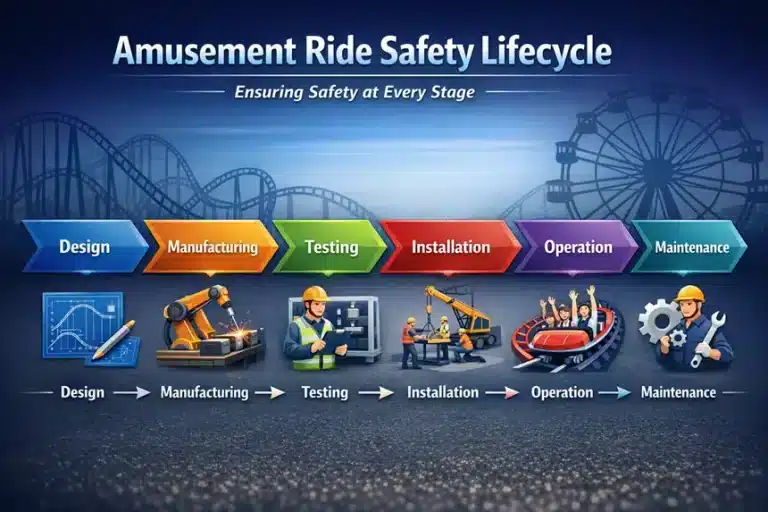
Key lifecycle stages
- Engineering design
- Manufacturing inspection
- On-site installation
- Operational training
- Periodic safety inspection
Operators of family rides, Trackless Train attractions, or high-capacity Park Rides must establish strict maintenance schedules.
Some parks perform daily inspections before opening. Others conduct monthly structural checks.
Popular Amusement Ride Categories in Modern Parks
When evaluating safety certifications like ASTM and EN13814, investors should also understand the different ride categories used in modern parks. Each ride type involves unique engineering and safety considerations.
- Theme Park Rides – large-scale attractions designed for high visitor throughput.
- Kids Rides – family-friendly attractions built with lower speed and enhanced passenger restraint systems.
- Flying Chair Ride – rotating swing rides requiring dynamic load analysis and structural balance calculations.
- Drop Tower Rides – vertical freefall attractions that rely on advanced braking and redundancy systems.
- Train Rides and Trackless Train – commonly used in parks, resorts, and tourist attractions.
- Ferris Wheel – iconic observation rides requiring wind-load structural verification.
- Roller Coaster – high-energy attractions involving complex track engineering.
- Bumper Cars – interactive rides with specialized electrical floor systems.
- Pirate Ship Ride – pendulum rides requiring dynamic motion and structural fatigue calculations.
Global Park Case Experience
Across international projects, regulatory requirements often vary.
For instance, parks in the Middle East frequently request ASTM documentation, while European operators require full EN13814 compliance.
In projects supplied to parks such as Safari World (Oman), Snober Land (Algeria), Happy Land World (Saudi Arabia), and FABRIKUS WORLD (France), certification documentation became a central part of procurement discussions.
Operators were not just buying amusement rides for sale. They were evaluating the long-term safety credibility of the supplier.
Reliable manufacturers—such as Sinorides—typically combine multiple international certifications including CE, ISO, SGS testing, and ASTM-aligned design procedures.
This multi-standard approach helps operators navigate complex import regulations and insurance approvals.
Investor Checklist Before Purchasing Amusement Rides
If you are evaluating amusement rides supplier proposals, the following questions should always be asked:
- Does the ride design comply with ASTM or EN13814 standards?
- Is there complete engineering documentation?
- Are welding and structural tests recorded?
- Has the ride passed factory cycle testing?
- Will the supplier provide installation supervision?
These checks help protect not only passengers—but also the long-term profitability of your park.
A ride that fails inspection can delay park openings, increase insurance costs, and damage reputation.
Professional recommendation:
When selecting an amusement rides manufacturer, prioritize suppliers capable of meeting international safety standards and providing complete documentation support.
Sinorides supplies a wide range of Theme Park Rides, Kids Rides, Train Rides, Ferris Wheel, Flying Chair Ride, Pirate Ship Ride, Trackless Train, bumper cars and other attractions designed to meet global safety expectations.
Operators planning new parks or ride upgrades can contact Sinorides for engineering consultation and equipment selection guidance.
Industry Insight from Sinorides Team
With more than 30 years of experience in amusement ride manufacturing, Sinorides has supplied equipment to over 1200 amusement parks worldwide. The engineering team designs rides according to internationally recognized safety frameworks including ASTM, EN13814, CE certification standards, and ISO quality management systems.
Projects have been installed in parks such as Safari World (Oman),
Snober Land (Algeria),
FABRIKUS WORLD (France),
Happy Land World (Saudi Arabia),
Joy Land (Pakistan), and
U-World Luge Theme Park (South Korea).
For investors planning new amusement parks or upgrading existing attractions, consulting an experienced amusement rides manufacturer helps ensure that ride selection, engineering documentation, and installation procedures comply with international safety standards.