Why speed is the easiest thing to get wrong
Take two operators running the same six cars, one in a shopping mall bay and one in a 300 sq m hall. Both cars are set to the factory speed. One operation feels brisk and slightly out of control. The other feels tame, and guests leave unimpressed. Nothing about the cars changed. The arena did.
This is why quoting a safe speed as a single figure tends to mislead. What riders experience is not the top speed on the data sheet. It is how quickly a car reaches that speed in the space available, how long it takes to stop, and how much of the arena a car covers before the session ends. In a small arena, a car spends most of its run at or near a hard turn. In a large one, the same car is still accelerating when it reaches the wall.
There is a second reason operators underestimate speed, and it is the one that causes most of the arguments after an incident. Bumper cars are designed for contact, so the collision itself is expected. What is not expected is the closing speed. Two cars travelling towards each other at 5.9 mph are closing at 11.8 mph. That is roughly the energy of a 250 kg car hitting a stationary object at 8 mph, and it happens because of a dispatch decision, not a motor setting.
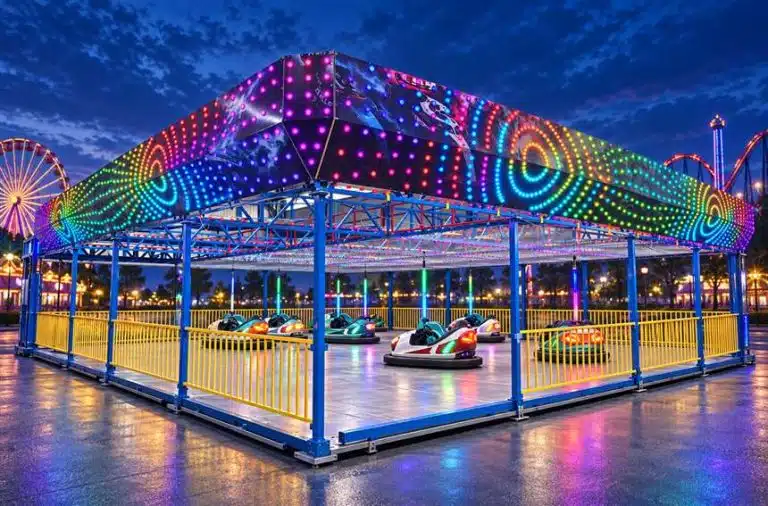
What the published speeds actually say
Speed figures are usually published in whatever unit the factory used, which makes them hard to compare. Sinorides publishes two seat bumper cars with a 9.5 km/h ceiling on the grid-powered model and a 2.2 m/s ceiling on the battery model. Converting both to miles per hour puts them at 5.9 mph and 4.9 mph.
That matters because the widely repeated industry range is 5 to 10 mph. Sinorides sits at the bottom half of that band on both power systems. It is worth knowing whether the machine you are buying is a 5 mph machine or a 10 mph machine before you agree a floor layout, because they are not the same attraction and they do not carry the same duty of care.
| Sinorides model | Published max speed | Same figure in mph | Seats | Power train | Rated throughput |
|---|---|---|---|---|---|
| 2P Electric Bumper Car | 9.5 km/h | about 5.9 | 2 | 380 V, 230 W, floor grid | 24 pph |
| 2P Battery Bumper Car | 2.2 m/s | about 4.9 | 2 | 24 V, 580 W, 2 × 58.5 Ah battery | 6 h working, 8 h charging |
| 20P Portable Bumper Car arena | 9.5 km/h | about 5.9 | 20 (10 cars) | AC 380 V / DC 48 V, 5.5 kW motor | 240 pph |
The energy behind those numbers is small but not trivial. The Sinorides two-seat electric car is published at 250 kg. At its 9.5 km/h ceiling it carries roughly 870 joules before a rider is added, and about 1,130 J with a 75 kg adult in the seat. For comparison, the US federal bumper rule for passenger cars is tested at 2.5 mph, which for a 1,500 kg car is a similar order of magnitude of energy, concentrated into a four wheeled steel body rather than a fibreglass shell with two people sitting above it.
That comparison is not an argument that bumper cars are dangerous. It explains why the ring, the belt and the seating position carry so much of the safety load on a ride with a slow published speed. Car design detail sits on the electric bumper car page, and the operating limits of each power system differ enough that they are worth reading separately for the ground grid and battery versions before comparing quotes. Portable kits are published with the same 9.5 km/h ceiling on a folded arena that can be moved between sites, which is covered on the portable bumper cars page.
A last piece of vocabulary, because it shows up in local rules. The ride is sold as a bumper car in most markets and as a dodgem in the United Kingdom and Ireland, and both names describe the same hardware. If a local inspector asks for your dodgem operating procedure, the document you keep for your bumper car arena is the answer. Sinorides builds both under the dodgem bumper cars label, and the engineering distinction between a ground grid arena and an overhead one is a building question rather than a naming one.
Restraints: what the belt is for, and what it is not
A bumper car belt is a positioning device. Its job is to keep the rider’s hips back in the seat and the torso inside the seat envelope during a bump from the side or the rear, so the rider does not slide out of position or catch an elbow on the rim. It is not a crash restraint in the automotive sense. There is no pretensioner, no load limiter, no crumple zone behind it, and the anchor is a seat bolted to a car that is itself designed to be hit.
Once that is clear, the inspection logic follows. A belt is either doing its positioning job or it is not, and there is very little middle ground. Webbing that has stiffened, a buckle that releases with light pressure, a frayed edge, or an anchor plate that has started to move in its mounting are all reasons to take the car off the floor today rather than at the next service.
Three restraint questions are worth putting to any supplier before an order, because the answers affect what your staff can enforce.
First, what is the belt anchored to? A belt bolted through a fibreglass shell with no reinforcement behind it will loosen over a season. A belt anchored to a steel seat frame or a reinforced floor section will not. Second, can a rider release it unintentionally? Buckles that sit under a thigh, or that a child can reach and press while steering, get opened mid-session, which is worse than a belt that was never fitted. Third, is there a defined combined weight for the two-seat configuration? A two-seat car is a rated configuration, not an invitation to add a passenger whenever the queue is long.
Sinorides ships its commercial bumper cars with safety belts and full-perimeter protective bumpers as standard equipment rather than as options. On the two-seat models that matters for family operation, because a parent and a child share one restraint footprint: the adult belt takes the load, and the child needs to be inside the adult’s seating position rather than beside it. Kids-specific cars have a different seat geometry, and the kids bumper cars range is where a mixed-age floor should be sourcing from.
Standing up mid-ride remains the single behaviour that turns a routine bump into an injury. It is worth telling riders why, not just that they cannot. A rider who understands that the belt is holding them in place against a car that is about to be hit from behind sits down without arguing.

Speed control: four things that set the ceiling
Operators tend to talk about speed control as if it were a dial. On a bumper car it is a chain with four links, and the operator only owns the last two.
Motor and gearing come first, and they are fixed at the factory. A 230 W grid car and a 580 W battery car do not accelerate the same way, and no amount of operating discipline will change that. This is the part of the chain you choose when you choose a model, which is why the model choice belongs in the same meeting as the arena layout.
The controller comes second. A controller that ramps current over a second or so produces a car that pushes the rider into the seat back. A controller that steps current instantly produces the same top speed and a completely different neck load. If you are retrofitting an older fleet, a controller change is usually cheaper than replacing the cars and does more for rider comfort than repainting them.
Tyres and floor come third, and they are the most neglected link in the chain. Worn tyres reduce braking and turning response long before they reduce top speed, so a car that feels fine in a straight line can still be unable to stop before the wall. A dusty, damp or polished floor does the same thing from the other side. On a ground grid system the floor is also the conductor, so a wet arena is an electrical question as well as a grip question, which is why insulated bases and drainage are specified into the build rather than added later. Overhead systems carry their own version of the same problem, and the ceiling bumper cars page sets out the collector and rail configuration if that is the format you are running.
Dispatch and session design come last, and they are entirely yours. How many cars go out at once, how long a session runs, whether the same group gets a second consecutive turn, and whether the operator calls a stop when two cars start lining each other up head on. Most of the closing-speed events on a bumper car floor are created in the thirty seconds before dispatch.
| Lever | Who controls it | What it changes | What to check |
|---|---|---|---|
| Motor and gearing | Factory | Top speed and acceleration | Published speed in a unit you can convert, per model |
| Controller ramp | Factory, or a retrofit | How hard the car pushes the rider back | Acceleration feel car by car, not just at the wall |
| Tyres and floor | Operations | Braking, turning, and the whole safety margin | Tread condition, floor dryness, cleaning schedule |
| Dispatch and session design | Operations | Closing speed between two cars | Cars on the floor, session length, head-on calls |
If you want the practical version of this, the published answers most operators are looking for are the ones on the how fast do bumper cars go page, which sets the market band against the model figures. The short version: do not raise the speed to make a small arena exciting. Lengthen the session, or change the dispatch pattern, and leave the ceiling where it is.
The 2.5 mph number, and why it does not apply to a bumper car
Search for bumper standards and you will find 2.5 mph attached to the word safety. It comes up in ride-industry content often enough that some operators quote it as if it were a speed limit for bumper cars. It is not, and the mix-up is worth clearing up because it can send an operator looking for a compliance document that does not exist.
The 2.5 mph figure belongs to 49 CFR Part 581, the United States bumper standard. Read the scope and purpose statements and the target is clear: the standard exists to reduce physical damage to the front and rear ends of a passenger motor vehicle in low speed collisions. It sets an impact speed of 1.5 mph on a corner impact test and 2.5 mph for longitudinal front and rear impacts, and it then asks whether lamps, hood, trunk, doors, fuel and cooling systems, exhaust, propulsion, suspension, steering and braking still work normally afterwards.
Two things follow. The first is that the standard is about damage and repair cost, not occupant injury. Its acceptance criteria are things like cracked lamp lenses and fluid leaks. The second is that it applies to passenger motor vehicles, and the application clause excludes multipurpose passenger vehicles and low-speed vehicles, which is the category a bumper car would sit in if it were a road vehicle at all. It is not. A bumper car is an amusement ride.
There is a useful coincidence hiding in the numbers, though, and it is worth noting rather than dismissing. Both a passenger car tested to 2.5 mph and a bumper car running at its published 5.9 mph are in the low-hundreds-to-low-thousands of joules, measured as kinetic energy. The difference is where that energy goes. The car has a crush structure, a seat belt with a pretensioner and a body designed around the occupant. The bumper car has a rubber ring, a lap belt and a rider sitting high with nothing behind their head. That gap is precisely what the ride-safety standards are written to manage.
Which standards apply, and who enforces them
There is no single global bumper car standard, and operators who expect one tend to buy the wrong certification. What exists is a design standard, an operating standard, a regional standard, and then local law. Each answers a different question.
| Document | What it covers | Who relies on it |
|---|---|---|
| ASTM F2291 | Design of amusement rides and devices: loads, factors of safety, restraint design intent | Manufacturers, structural engineers, jurisdictions that adopt it |
| ASTM F770 | Ownership, operation, maintenance and inspection practice for amusement rides | Operators and their maintenance teams |
| EN 13814 series | Amusement park and amusement ride safety: design, manufacture, installation, operation and use | European market projects and many export specifications |
| HSE HSG175 | Guidance on safe practice for fairgrounds and amusement parks | United Kingdom operators and their inspectors |
| National and local ride law | Licensing, inspection intervals, incident reporting, operator training records | Everyone, because this is the document that can close the attraction |
The ASTM F2291 design practice and the ASTM F770 operating practice are the two documents a manufacturer and an operator respectively tend to be asked for in the United States. Both are voluntary consensus standards, which means a jurisdiction has to adopt them before they carry legal weight. Most US states that license amusement devices have adopted something in that family, and a licensed inspector will know which edition their jurisdiction follows. The European series is published through CEN-CENELEC, and the UK guidance is published by the Health and Safety Executive as HSG175.
A separate standards question applies to the factory rather than the ride. Sinorides states CE and ISO compliance for its production, and buyers importing from China should ask for the declaration of conformity, the factory test records and the model-specific technical file rather than treating a logo as the evidence. The difference between a genuine technical file and a brochure with a CE mark on it is the difference between a jurisdiction accepting your ride and your customs broker holding it. These documents, and how to read them, are collected on the ASTM and EN 13814 amusement ride safety standards guide.
The crash structure: ring, chassis and body
Three components do three different jobs on a bumper car, and buyers routinely assign them to the wrong order of importance.
The rubber ring is the part that absorbs the impact. It is the reason a bump feels like a shove rather than a jolt, and its condition is the single best proxy for how a fleet will behave on the floor. Rubber hardens as it ages and as it is exposed to ozone, sunlight and cleaning chemicals. A hardened ring is still intact, still black and still round, so it passes a visual inspection while absorbing noticeably less energy than it did when the car was new. Operators should be checking for stiffness and surface crazing, not only for cracks and missing sections.
The chassis carries the load. It takes the rider’s weight, the motor and battery mass, and the repeated stress of a fleet that does nothing but bump into things. A chassis that has loosened in its mountings shows up as rattles, uneven wheel loading and steering that has developed play. Steering play is the one to catch early, because a rider who cannot steer accurately will hit walls at an angle instead of square.
The body shell protects the electrical system, not the rider. This is the misunderstanding that leads buyers to over-weight body thickness in a specification. Fiberglass gives a bumper car its shape, its colour and its weather resistance, and a thick shell is a good sign for durability. It is not what keeps a rider in the seat, and a dealer who sells the shell as a safety feature rather than a durability feature is answering a question nobody asked.
On a ground grid arena there is a fourth element worth naming, because it is part of the safety system rather than the building: the floor itself. It conducts, it must drain, and it must be insulated from the structure beneath. A grid arena built without those three properties will pass a visual inspection on a dry day and fail in a way nobody wants to describe in a report.
Who is allowed in the seat
Age is the easiest admission rule to write and the worst one to rely on. Two children of the same age can differ by 20 cm of height and by a wide margin in balance, judgement and willingness to follow an instruction. Operators who screen on a single number spend their season making judgment calls at the boarding point with a queue watching.
A fit test takes ten seconds and settles more of these arguments than any sign. Can the rider sit fully back in the seat with the belt low across the hips? Are both feet flat on the floor pan? Can they reach the steering wheel and hold it with elbows bent rather than straight? Is the top of their head clear of the ring line at the highest point of the seat? And can they repeat back what they must not do, in the language the briefing was given in?
| Screening criterion | What it actually tests | Why age alone fails |
|---|---|---|
| Seat and belt fit | Whether the restraint can hold the rider in a side or rear bump | A tall eight-year-old may fit safely where a small ten-year-old does not |
| Reach to the wheel | Whether the rider can steer accurately or will hit walls at an angle | Reach depends on arm length and seat position, not birth date |
| Head clearance | Whether the head stays inside the protection the ring provides | Height, not age, decides which car a rider belongs in |
| Understanding the briefing | Whether the rider will stay seated and keep hands inside | Comprehension and impulse control vary far more than age |
| Combined weight, two-seat use | Whether the rated configuration is being exceeded | Riders are admitted to a car, not to an age bracket |
Three exclusions belong on the sign, in plain language. Riders who are pregnant, riders who have a current neck, back or heart condition that sudden movement would aggravate, and riders who are intoxicated or otherwise unable to stay seated should not ride. Loose scarves, dangling bags and phones in a hand are the same class of problem as standing up, because they give a rider a reason to reach outside the car. Long hair should be tied back.
Put the signage in two places, not one: at the head of the queue, where a group can read it and self-select, and again at the boarding point, where the attendant can point at it. A sign that only exists at the boarding point turns a rule into an argument.
Accessibility is the case that gets improvised and should not be. If a venue wants to carry a rider with mobility or sensory needs, work out the specific model and the specific assistance in advance, with the manufacturer’s guidance in hand and, where local rules require it, with the local authority. Cushions, temporary restraints and unauthorised seat modifications are not an accessibility solution. They are a liability with a friendly name.
The daily check that prevents the incident
Almost every incident story that ends with an operator saying they should have caught it earlier ends at the same place: a pre-opening inspection that was signed without being done. The inspection is the handover between whoever maintains the ride and whoever runs it, and the signature is the point at which responsibility changes hands.
A useful checklist is short enough to be completed honestly. Twelve items, walked in the same order every morning, will catch more than forty items completed in a hurry.
| Check | What you are looking at | Why it is on the list |
|---|---|---|
| Belt webbing and buckle | Frays, stiffness, buckle release pressure | A belt that releases too easily is not a restraint |
| Belt anchor points | Movement, cracking, loose fasteners | Anchors loosen gradually and fail suddenly |
| Bumper ring | Hardening, crazing, cracks, uneven wear, mountings | It is the energy-absorbing part of the whole ride |
| Tyres and wheels | Tread condition, grip, bearing noise | Grip loss shows up as a braking problem, not a speed problem |
| Steering response | Play in the wheel, return to centre | Riders who cannot aim hit walls at an angle |
| Throttle and stop behaviour | Smooth start, no runaway, consistent stop | Cars must behave the same as each other |
| Battery, connectors, charger | Cable damage, charge status, ventilation | Charging areas cause fires and stalls, not bumps |
| Emergency stop | Tested before the first session, not merely present | An untested stop is a decoration |
| Floor condition | Dryness, debris, panel damage on grid arenas | Wet or dirty floors change control and, on grid systems, insulation |
| Barriers and gates | Height, fixings, gate latches, escape routes clear | Containment is the ride’s outer restraint |
| Signage and briefing | Legible, current, matches the rules staff enforce | Rules that staff do not enforce are worse than no rules |
| Attendant sightlines | Full arena visible from the control position | You cannot stop what you cannot see |
Record the result and keep the record. Digital or paper does not matter, but a defensible document does: date, cars checked by number, defects found, action taken, and the name of the manager who released the attraction. Anything unresolved on a safety-critical item keeps the attraction closed, and the staff need to know that they will not be pressured to open it.
Defects follow a rule worth stating out loud to the team: tag it, isolate it, and release it only after an authorised person has fixed it and documented the fix. A car that behaves differently from the rest of the fleet should be off the floor the same morning, because “it drives a bit odd” is how most mechanical faults are first described.
Beyond the daily walk, build the maintenance schedule on operating hours rather than the calendar. A bumper car on a ten-hour Saturday is doing several weeks of a Tuesday’s work. The setup and operating sequence for a new arena, including the commissioning checks, is set out on the how to install and operate a bumper car page if you are still in the build phase.
Watch a bumper car arena in motion
A specification sheet cannot show what a bumper car session actually looks like, and that gap matters when you are trying to judge whether your arena will produce gentle contact or repeated hard hits. The clip below is Sinorides footage of bumper cars running continuously, with the ring contact, the car-to-car spacing and the general pace of a commercial floor all visible.
Watch the pace rather than the paintwork. In a well-run arena the cars spend most of the session at part throttle, contact happens at an angle as often as it happens head on, and the operator’s stop calls interrupt the flow before the floor becomes a traffic jam. If the arena you are planning would give the same cars twice the run-up distance, that is a speed management question, not a footage question.
What to settle before you order
Safety decisions on a bumper car project are made in the quotation stage, whether or not anyone calls them safety decisions. The model you choose sets the speed ceiling. The seat and restraint design sets who can ride. The arena you agree to build sets the closing speeds. By the time the cars arrive, all three are contracted.
Nine questions are worth putting in writing, and worth reading the answers to rather than filing them. Which rider group is this model designed for? Is it rated for indoor or outdoor use? What is the body material and the chassis construction? What type of bumper ring is fitted, and what does a replacement cost? Does the car include seat belts, and what are they anchored to? Is there an emergency stop, and where is it operated from? What is the recommended speed setting for an arena of my size? What is the rated combined weight in the two-seat configuration? Are spare parts, part numbers and a maintenance schedule included?
Two documents are worth asking for at the same time as the price. The first is the model’s technical specification with the speed figure in a unit you can convert, because a quotation that lists the motor in watts and never states the speed has told you the least important half of the story. The second is a cost view that separates the cars, the arena and the floor works, all of which sit in the same capital budget and none of which the supplier of any single item should be guessing at. Published planning ranges for the equipment sit on the how much is a bumper car page, and the wider configuration comparison, including the systems that need a conductive floor or an overhead grid, is on the amusement bumper cars hub.
One last point, and it is the one that separates a fleet that ages well from one that does not. Bumper car safety is a maintenance outcome as much as a design outcome. A well-designed car with a hardened ring, a stretched belt and a wet floor is a poorly protected ride. A mid-range car with a disciplined daily inspection is a safe one. Buyers spend most of their attention on the first half of that sentence and should probably spend more on the second.
Frequently asked questions
These are the questions that come up in almost every bumper car safety enquiry. Each answer is deliberately short.
How fast do commercial bumper cars go?
Published figures put most commercial bumper cars in a 5 to 10 mph band, which is roughly 8 to 16 km/h. Sinorides lists 9.5 km/h, about 5.9 mph, as the maximum operating speed of its two-seat electric bumper car and of its twenty-seat portable arena, and 2.2 m/s, about 4.9 mph, for its two-seat battery car. Both sit in the lower half of the market band rather than at the top of it.
What is the 2.5 mph bumper standard?
It is 49 CFR Part 581, a United States federal standard for passenger motor vehicles. It requires a car to withstand impacts of 1.5 mph on a corner and 2.5 mph longitudinally without damage to lamps, doors, hood, trunk, fluids and running systems. Its stated purpose is reducing physical damage to the front and rear of a passenger car, and it applies to road vehicles rather than amusement rides. It is not a bumper car speed limit.
Do bumper cars legally need seat belts?
Requirements vary by jurisdiction, so the controlling answer belongs to local amusement-device law and the manufacturer’s operating instructions. In practice, commercial bumper cars intended for mixed-age and family use should have a lap belt, and Sinorides supplies safety belts and protective bumpers as standard on its commercial models. A belt’s purpose is to keep the rider positioned during a side or rear impact, which is exactly the situation a young rider cannot manage alone.
Are bumper cars safe for children?
They are safe when the car matches the child, the belt can hold them, and someone is watching. Screen on fit rather than age: can the child sit fully back, reach the wheel, keep their head inside the ring line, and repeat the safety instruction? Use smaller kids models with lower speed settings for younger riders, and use a two-seat car with an adult when the child cannot yet manage the controls alone.
Which standards apply to bumper cars?
ASTM F2291 covers the design of amusement rides and devices, and ASTM F770 covers ownership, operation, maintenance and inspection. The EN 13814 series covers amusement park and amusement ride safety in Europe, and HSE HSG175 is the UK guidance on safe practice for fairgrounds and amusement parks. Local ride-safety law is what actually licenses the attraction, and it decides which of the others an inspector will ask you to demonstrate.
How do I control the speed of a bumper car fleet?
Four levers decide it. Motor and gearing are fixed at the factory, controller ramping can sometimes be adjusted or retrofitted, tyres and floor surface are maintained by the operator, and dispatch pattern is decided per session. The first two set the ceiling; the last two decide how much of that ceiling riders ever reach. Most closing-speed problems are solved in the third and fourth levers rather than the first.
Does a bigger arena mean I can raise the speed setting?
A larger arena does not make a higher speed safer. It gives a car more run-up distance and therefore a higher speed at the moment of contact, and it lets riders build speed in a straight line before they meet. If a small arena feels slow, lengthen the session or add a second activity rather than raising the ceiling. Keep the speed at the manufacturer’s recommended setting for the model.
How often should restraint systems be checked?
Check belt webbing, buckle release pressure and anchor points every day before the first session, and test them on each car rather than on a sample. Move anchor points, mountings, steering play and chassis fasteners onto a weekly or monthly schedule depending on volume. Replace damaged belts rather than repairing them, and take the car off the floor until the replacement is fitted and the work is documented.
Do bumper cars cause injuries?
Reported injuries cluster in the neck, back, wrist and knee, which is what a low-speed impact produces when a rider is out of position or is caught by surprise. Most resolve quickly. The serious cases are associated with standing up mid-session, riding outside the restraint envelope, or repeated deliberate head-on contact rather than with the ride’s normal speed. We did not find a published injury-rate dataset specific to bumper cars, so no rate is quoted here.
What speed is safe for an indoor bumper car arena?
There is no single number, because the same speed produces different closing velocities and different stopping distances in different arenas. Keep the car at the manufacturer’s setting, keep the floor dry and the tyres in condition, and manage the session instead. A 5.9 mph ceiling with disciplined dispatch is safer and better received than a higher setting in an arena where cars meet head on thirty times a session.
Can I take a second rider to improve throughput?
Only where the car is rated and configured for two riders and the stated combined weight, seat arrangement and restraint requirements are all met. A two-seat car is a rated configuration, not spare capacity. Adding a second rider to a single-seat configuration to shorten a queue changes the load case the car was designed around, and no throughput gain justifies that.
What documents should I ask a supplier for?
Ask for the model-specific technical file, a general arrangement drawing, the foundation or load plan, the electrical load and supply schedule, an operating manual that states restraint specification and rider limits, the factory test record, a spare-parts list with part numbers, and a maintenance schedule with intervals. Confirm which documents your local authority accepts before the order is placed, rather than discovering the gap at import.
About Sinorides
Sinorides is the export brand of a Chinese amusement ride manufacturer whose production experience dates back to 1992. The company builds bumper cars alongside carousels, ferris wheels, pirate ships, drop towers, flying chairs and family coasters, and has supplied rides into projects across more than 20 countries in Asia, the Middle East, Africa, Europe and Latin America. Sinorides states CE and ISO compliance for its production.
In the bumper car range the company manufactures battery, ground grid, ceiling grid, portable and kids models. Published figures for the models referenced in this article are 9.5 km/h, 2 seats, 380 V and 230 W for the two-seat electric car; 2.2 m/s, 24 V and 580 W with six hours of working time and eight hours of charging for the two-seat battery car; and 9.5 km/h with ten cars, twenty seats and a 5.5 kW motor for the twenty-seat portable arena. Every commercial model ships with safety belts and protective bumpers.
Model figures in this article are quoted from Sinorides’ own published data with the model they belong to. Energy comparisons, arena planning allowances and injury descriptions are engineering arithmetic or general industry observation, not measurements from a specific site. Standards are referenced from the ASTM F2291 design practice, the United States federal bumper standard at 49 CFR Part 581, the ASTM F770 operating practice, the EN 13814 series and the UK fairground guidance HSG175, each of which is linked once in the sections above and not repeated here. Where a figure that mattered to a safety decision could not be traced to a primary source, this article says so rather than filling the gap.
Follow Sinorides
Arena walkthroughs, model footage and installation notes go out first on Sinorides’ own channels. Follow along for practical material on ride selection, restraint configuration and project delivery.
LinkedIn: Sinorides Amusement Rides
YouTube: Sinorides channel
Facebook: Sinorides on Facebook
Instagram: sinoridesamusement
If you are specifying an arena now, send the floor plan and the rider mix rather than a wish list. Those two documents decide the restraint specification and the speed setting more reliably than any catalogue page.