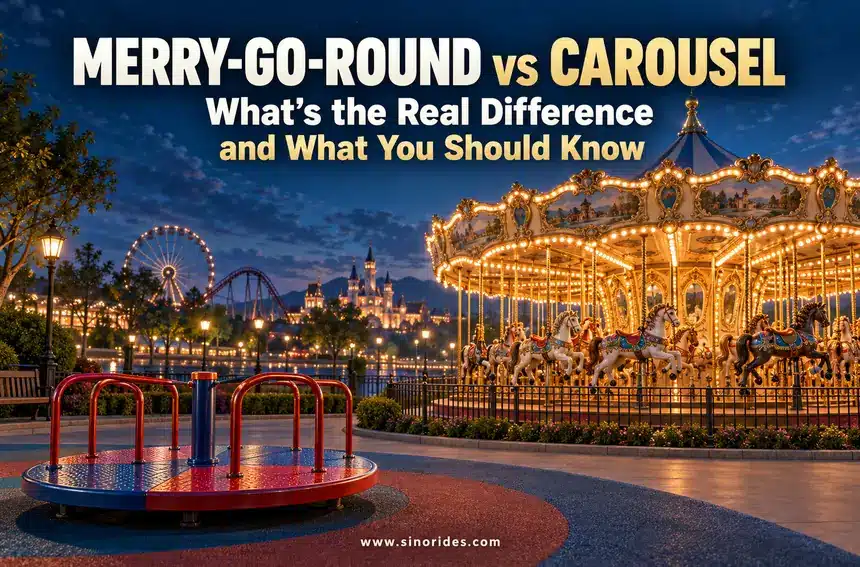
What do carousel and merry-go-round actually mean?
Imagine two people discussing the same park photograph. One calls the ride a carousel; the other remembers riding the merry-go-round as a child. Both may be describing exactly the same machine. The practical confusion starts when a third person pictures a low playground platform that children push themselves.
This is a language problem before it becomes a purchasing problem. Dictionaries recognize the amusement-ride meaning of merry-go-round, including a rotating platform with seats or animal figures. Cambridge also identifies carousel as a US synonym. Neither source makes elaborate decoration a necessary boundary between the two names. The source list below gives the dictionary references.
Meaning 1: a powered amusement ride
In a park or attraction catalogue, either name can refer to a ride with a driven rotating platform and defined passenger positions. Horses are familiar, but other animals, themed vehicles and chariots are possible. Some passenger positions move vertically relative to the platform; others remain fixed on it. “Fixed” here does not mean stationary relative to the ground.
A product family such as commercial carousel rides therefore needs individual specifications. A name, photograph and seat count still leave questions about the drive arrangement, passenger limits, access and installation requirements. Those questions should be answered before a buyer compares manufacturers.
Meaning 2: a playground roundabout
In a playground context, merry-go-round often describes a rotating play platform, commonly moved by its users. Its intended activity is active play rather than an attendant dispatching a timed amusement ride. Modern playground designs vary, including different seating and access arrangements. Do not assume that every product is a traditional flat disk with bars.
The useful naming habit is simple: write “powered amusement carousel” or “playground roundabout” in the brief. Add the manufacturer and model whenever technical details matter. This takes far less effort than correcting a quotation based on the wrong interpretation.
Compare equipment categories, using the same criteria
The table below compares common configurations, not two legally defined words. Actual designs can depart from these patterns. The supplier’s documentation and local classification determine what the project needs.
| Question | Powered amusement carousel | Playground roundabout |
|---|---|---|
| How does it move? | A drive system operates the platform; the ride follows defined controls and operating procedures. | Often moved by users; verify the actual mechanism and permitted use. |
| Where do passengers go? | Specified horses, figures, benches or other approved passenger positions. | Model-specific standing or seated play positions, handholds or accessible arrangements. |
| What is the operating model? | Boarding, checks, dispatch, stopping and unloading as a managed cycle. | Use within a managed playground environment, with suitable supervision and inspection arrangements. |
| What space is required? | Approved installation envelope plus boarding, queue, exits and service access. | Equipment area plus its specified use zone, surfacing and approach space. |
| What should be compared financially? | Installed project cost and operating cost; revenue only where supported by demand assumptions. | Installed play provision and lifecycle cost; ticket throughput may be irrelevant. |
| Which standard family may matter? | Amusement-ride standards, including ASTM F2291 or EN 13814 where applicable. | Playground standards, including ASTM F1487 or EN 1176 where applicable. |
Choose the amusement carousel when the project calls for an operated attraction with defined boarding cycles. Choose the playground roundabout when the project calls for active play and the proposed design fits the playground’s users and site. Neither becomes the better purchase simply because one name sounds more traditional or more expensive.

Spelling, history and the myths behind the names
How do you spell carousel?
The standard spelling is carousel: c-a-r-o-u-s-e-l. Its plural is carousels. “Carrousel,” with a second r, also appears in established names and historical usage. For ordinary product copy, carousel is a clear choice; preserve the official spelling when naming a particular attraction.
Merry-go-round is the conventional hyphenated spelling. The unhyphenated search phrase “merry go round” usually points to the same word. A repeated phrase such as “merry go round round” does not identify an additional equipment type. Correct the wording in a specification instead of treating the repetition as a technical distinction.
When was the carousel invented?
There is no single useful invention date for every device now called a carousel. Historical rotating amusements, riding traditions and later mechanical rides belong to a long development rather than one universal launch. The National Carousel Association’s historical material discusses that development. A precise date should be attached to a defined milestone or a documented surviving machine.
That matters when a description says “the first carousel.” First in which country, with which mechanism, and according to which record? A historical claim about a steam-driven fairground machine does not establish the invention date of every hand-powered rotating amusement. This guide therefore does not repeat an unsupported single-year answer.
Real examples make the terminology clearer
Disney’s Prince Charming Regal Carrousel at Magic Kingdom is an identifiable amusement-ride example. Disney describes 90 wood-carved horses and a chariot. That description illustrates the form; it should not be converted into an approved total passenger capacity without the operator’s own capacity information.
For a different modern form, consider a double-decker carousel. Two levels change access, supervision and installation questions, but the ride can still be called a merry-go-round in everyday conversation. The physical configuration provides the useful distinction.
How the ride moves—and why direction is not a definition
A powered carousel turns a passenger platform around an axis. Depending on the design, a separate mechanical arrangement also moves selected passenger figures up and down. Buyers should ask which positions move, how moving parts are guarded and how the drive and control systems are accessed for inspection. An attractive canopy says little about those details.
Clockwise versus counterclockwise rotation is not a dependable test of the two names. Nor does the presence of jumping horses make every otherwise similar ride a separate class. Regional traditions and individual designs can differ. Use a drawing, video and technical specification to describe the movement instead of relying on a naming rule.
Rotation speed is not the same as travel speed
Revolutions per minute describe how often the platform turns. Linear speed also depends on the distance from the axis: a passenger farther outward travels a longer path in the same revolution. In simple circular motion, speed equals 2π multiplied by radius and revolutions per minute, divided by 60, when radius is in metres and speed is in metres per second.
This is why a general claim that all carousels run at one speed in miles per hour is unhelpful without a radius. More importantly, an operator should not use an internet calculation to change approved settings. The relevant operating limits are those of the actual machine and its accepted operating documentation.
The official Sinorides video below shows a merry-go-round product in motion. It helps explain the appearance of a powered attraction; it is not evidence that every seat layout, capacity or drive option in the catalogue belongs to the filmed unit.
How many people can ride a carousel at the same time?
There is no universal carousel capacity. The answer belongs to the model and passenger arrangement. Sinorides’ product knowledge records provide the examples below, each tied to a specific configuration. These are catalogue values, not permission to load a particular installed ride without checking its operating documentation.
| Identified model | Instant capacity | Catalogue footprint | Total height | Total power | Theoretical capacity |
|---|---|---|---|---|---|
| 16P CAROUSEL, option 1 | 16 people | 7 m diameter | 6 m | 4 kW | 192 people/hour |
| 24P CAROUSEL | 24 people | 10 m diameter | 7 m | 8 kW | 288 people/hour |
| 60P DOUBLE-DECK CAROUSEL | 60 people | 15 m diameter | 10 m | 15 kW | 720 people/hour |
Source: Sinorides model knowledge records dated 10 September 2026. The 16P family has several options; this table uses option 1 only. A 24-seat carousel enquiry should still identify the required configuration and obtain the project drawing. The linked product pages may describe other configurations; the dated knowledge records are the source for this table. Confirm differences in the current project drawing. Total installed power is not a measured average electricity consumption figure.
Seats per cycle and riders per hour answer different questions
A theoretical hourly figure assumes a cycle and operating conditions. It cannot show how many tickets a venue will sell. For planning, calculate capacity as approved passengers per dispatch multiplied by 60, divided by the complete cycle in minutes. Include unloading, boarding, required checks and the ride, not just the moving portion.
For an explicitly hypothetical example, 24 available passenger positions and a five-minute complete cycle give 288 passenger places per hour. At an assumed 60% occupancy, that becomes about 173 riders per hour before further downtime. The arithmetic explains throughput; neither the cycle time nor the occupancy is a Sinorides performance promise.
Now picture a busy boarding period: a family needs help selecting a seat, a bag needs to be stored, and the attendant must finish the checks before dispatch. Cutting those steps to match a spreadsheet is not a capacity improvement. Build the business case around an achievable operating cycle and leave room for variation.
Count accompanying adults correctly
A parent beside a child is not automatically an uncounted extra passenger. Check the approved arrangement, passenger count, weight limits and attendant rules. Do not infer an adult allowance from a photograph or from the number of horses. An unsuitable loading assumption can also distort the queue and revenue calculations.
Which type fits your venue and available space?
A municipal playground, a shopping mall and a theme park may all want a rotating attraction, but their operating briefs differ. Start with who uses the equipment, who supervises it and whether the experience is free play or a managed ride. Only then compare appearance and the equipment purchase price.
For a park building a mixed-age area, a carousel can form part of a broader family rides plan. Review the shared queue and circulation routes rather than placing each attraction independently. A compact ride becomes awkward if its queue blocks the next attraction’s exit.
For younger visitors, examine the approved passenger restrictions and operating arrangements of individual kids rides. A bright theme does not establish suitability for every child. The same caution applies to a playground roundabout: its age and use limitations come from the actual product and applicable requirements.
Footprint is not the complete site allocation
A catalogue diameter should never be treated as a complete installation plan. The project may need additional space for the operating envelope, separation from other activities, boarding, exits, queueing and maintenance. Clarify exactly what the manufacturer includes in the word footprint. The term is not used consistently across catalogues.
Playground product specifications can make the distinction especially visible by listing equipment diameter separately from the use zone. Use the selected model’s instructions and appropriate surfacing requirements. Do not transfer a clearance measurement from a playground roundabout to a powered amusement carousel, or from one playground design to another.
Indoor sites need a three-dimensional check
A ride that fits on a floor plan may still fail a ceiling-height check or a structural assessment. Confirm the full installed height, building services, maintenance clearances, loads and fixing arrangement. Also confirm the delivery route: doors, loading bays, lifts and installation access can determine whether the equipment can reach the proposed location.

Safety requirements follow the equipment, not its nickname
There is no single worldwide approval called “merry-go-round safety.” The destination, equipment category and local authority determine the applicable requirements. Obtain project-specific confirmation of classification, adopted standards, inspections and permits. The following references explain the distinction; they do not replace the complete standards or local approval process.
Amusement rides and playground equipment use different frameworks
ASTM F2291 concerns amusement-ride design, while ASTM F1487 addresses public playground equipment. The scope of F2291 explicitly distinguishes certain playground equipment. In Europe, the EN 13814 family concerns amusement rides and devices; the EN 1176 family concerns playground equipment, with Part 5 addressing carousels in that playground context. Check the applicable edition for the project.
The US Consumer Product Safety Commission’s Public Playground Safety Handbook provides public playground guidance, including rotating equipment. It is a useful planning reference, but should not be presented as a universal operating manual for powered amusement rides or as an automatically binding rule everywhere.
Ask what a certificate actually covers
A statement that a business has an ISO management-system certificate does not itself approve a specific ride design. Likewise, a CE mark or a component certificate needs an identified legal basis and scope. It does not by itself establish approval to install and operate the complete attraction in the destination country.
For example, the EU Machinery Directive 2006/42/EC excludes specific equipment for use in fairgrounds and amusement parks from its scope. Other requirements may still apply. A responsible review examines the actual equipment and documents rather than treating “CE approved carousel” as a universal legal conclusion.
Accessibility needs a complete boarding plan
A chariot or bench is not automatically a wheelchair riding position. Confirm whether a passenger transfers, whether remaining in a wheelchair is permitted by the design, and what assistance or securing arrangements are required. Check the approach, boarding interface and exit as well as the passenger position itself.
For any selected arrangement, the operator needs documented boarding and evacuation procedures that staff can actually follow. Marketing photographs cannot demonstrate those procedures. Ask the supplier to identify the approved configuration and the information needed by the local accessibility and safety review.
Compare installed cost and daily work
A playground roundabout price and a commercial carousel quotation do not buy the same project. The meaningful comparison uses equivalent scope: equipment, transport, import costs where relevant, unloading, ground or structural works, installation, electrical supply, surfacing, inspection and training. Request exclusions as clearly as included items.
A playground installation may avoid powered ride controls and ticket operations but still need specialist surfacing, foundations and regular inspection. A powered carousel may introduce additional electrical and operational responsibilities. Neither is maintenance-free, and the cheapest equipment line does not establish the lowest cost of ownership.
Make the financial assumptions visible
For more detailed budget planning, the carousel cost guide provides a related starting point. Obtain a current quotation for the actual scope. This article deliberately gives no universal price range because mixing toy, playground and commercial ride listings produces a misleading number.
Where tickets are sold, estimate demand separately from mechanical capacity. Multiply expected paid rides by the realized ticket price, then account for staffing, rent or revenue share, energy, insurance, inspections, maintenance and downtime. A free public playground needs a different value measure, such as usable play provision within its lifecycle budget.
Inspection responsibilities should be assigned before opening
For a powered attraction, establish the manufacturer’s required checks, maintenance intervals, qualified personnel and recordkeeping. The operating documentation should determine inspection and testing procedures. The carousel maintenance guide is supporting reading, not a substitute for the supplied manual.
Give faults a clear reporting route and define who can authorize return to service. A loose component, unusual sound or control issue should not become a judgment call made simply to keep the queue moving. The same management discipline applies to playground equipment, using the appropriate inspection regime and product instructions.
Ask about replacement parts while evaluating the quotation. Identify the components, documentation, lead times and support responsibility rather than accepting “spares available” without detail. Decorative repairs and critical mechanical replacements have different consequences; the maintenance plan should make that distinction visible.
What should go into a carousel enquiry?
A clear enquiry is short enough to read and specific enough to price. Start with the destination and venue type. State whether the equipment is a powered amusement ride or a playground roundabout. Attach a dimensioned site plan and identify the intended users, access arrangements and operating pattern.
- Define the configuration. Specify the intended capacity, seat types, required accessibility arrangements and whether a single or double deck is under consideration.
- Define the installation constraints. Include available area, ceiling limits if indoors, ground or structural information, access route and electrical supply details.
- Define the evidence required. Ask for drawings, load and foundation information, applicable standards, operating and maintenance manuals, inspection requirements and the scope of any certificates.
- Define the commercial scope. Separate equipment, shipping, installation support, commissioning, training, spare parts and exclusions. Establish who is responsible for each interface.
Then compare the returned offers against the same brief. If one supplier assumes a different capacity or omits site works, resolve that difference before treating the totals as comparable. The best question is not “Which name is better?” It is whether the proposed machine, documentation and operating plan fit the project.
Not every carousel search is about a ride
“Merry-Go-Round of Life” is a music title associated with Joe Hisaishi. “A merry-go-round rotates from rest” usually introduces a physics problem requiring values such as acceleration and elapsed time. Neither phrase defines a separate commercial ride category.
“Where is the carousel?” needs a named venue or city; carousel is a general noun, not one destination. “A carousel you shouldn’t ride” may be a riddle or refer to a different meaning, such as an airport baggage carousel. Without the original context, a specific answer would be a guess.
Product searches also mix in tabletop musical toys. Check whether a listing is for a ride-on installation before comparing its price or dimensions. A search result sharing the same name does not establish the same function, passenger capacity or safety classification.
Frequently asked questions
What is a carousel?
A carousel is a rotating amusement ride with designated passenger positions, often horses, other figures or seats. The term also has other meanings outside amusement rides, so a product enquiry should identify the equipment category and model.
What is a merry-go-round?
A merry-go-round can mean the same amusement ride as a carousel. In playground contexts, it often means a user-powered rotating play platform or roundabout. The context matters more than the name alone.
What is the difference between a merry-go-round and a carousel?
For amusement rides, the names can be synonyms. The practical distinction arises when merry-go-round means playground equipment; compare that roundabout with a powered amusement carousel by its actual design, operation and applicable requirements.
How do you spell carousel and merry-go-round?
Write carousel, with one r, and carousels for the plural. Merry-go-round is conventionally hyphenated. Carrousel also appears in established attraction names, where the official spelling should be preserved.
When was the carousel invented?
No single date describes the development of all carousels. Earlier rotating amusements and later mechanical rides represent different stages. A precise historical date should identify the particular invention, machine or milestone being discussed.
Can you give examples of carousel rides?
Examples include Disney’s Prince Charming Regal Carrousel at Magic Kingdom and modern single-deck or double-deck amusement carousels. Sinorides’ catalogue includes 16P, 24P and 60P double-deck models; specifications must remain attached to the exact model and option.
How many people can ride a carousel at once?
Capacity depends on the approved model and configuration. Sinorides catalogue examples include 16, 24 and 60 people. Check passenger and loading rules, including accompanying adults, rather than assuming that every visible space can carry an additional person.
Are there safety regulations for carousel rides?
Requirements depend on location and equipment classification. Relevant frameworks may include ASTM F2291 or EN 13814 for amusement rides and ASTM F1487 or EN 1176 for playground equipment. Confirm local requirements, adopted editions and inspections for the proposed installation.
Do carousels and merry-go-rounds turn in different directions?
Direction is not a reliable naming rule. Identify the actual model and its approved motion and control settings. Clockwise or counterclockwise rotation alone does not tell a buyer whether the equipment is a carousel or a merry-go-round.
Is a playground merry-go-round suitable for an amusement park?
It may suit a dedicated play area if its intended users, site layout and applicable requirements match the project. It does not automatically replace a powered, operated carousel. Decide whether the brief is active play or a managed ride experience.
Where is the carousel located?
There is no single location for “the carousel.” The word describes a type of attraction found at many venues. Use the attraction’s full name and city or park, then check that operator’s current map and visitor information.
Is Merry-Go-Round of Life a type of ride?
No. It is a music title associated with Joe Hisaishi, rather than a technical carousel category. When looking for equipment, add terms such as amusement ride, playground roundabout, passenger capacity or manufacturer to make the intended search clearer.
Sources and evidence notes
About this guide. Sinorides supplies amusement equipment. Model figures above come from its product knowledge records, and the Nepal installation example comes from its company case list. These records support the stated specifications and recorded project only; they do not demonstrate earnings, universal suitability or destination approval. Confirm the final configuration in current project documentation.
Dictionary meanings and standards scope are independently checkable through the references below. Selection and procurement advice is editorial guidance. The throughput example is hypothetical arithmetic, not measured operating performance. No market price, return on investment or medical suitability claim is made.
- Merriam-Webster. “Merry-go-round.” Dictionary entry. Accessed 29 Sept. 2026.
- Cambridge University Press. “Merry-go-round.” Cambridge Dictionary. Accessed 29 Sept. 2026.
- National Carousel Association. The Origin of the Carousel. Historical resource guide. Accessed 29 Sept. 2026.
- Walt Disney World Resort. Prince Charming Regal Carrousel. Attraction description. Accessed 29 Sept. 2026.
- US Consumer Product Safety Commission. Public Playground Safety Handbook. July 2025. Accessed 29 Sept. 2026.
- ASTM International. F2291: Standard Practice for Design of Amusement Rides and Devices. Scope reference; confirm the project’s adopted edition.
- ASTM International. F1487: Playground Equipment for Public Use. Scope reference; confirm the project’s adopted edition. Accessed 29 Sept. 2026.
- British Standards Institution. BS EN 1176 series and amusement-device standards committee catalogue. Accessed 29 Sept. 2026.
- European Parliament and Council. Directive 2006/42/EC, article 1, scope exclusions. Accessed 29 Sept. 2026.
- Joe Hisaishi Official US Store. Symphonic Pieces. Music-title reference. Accessed 29 Sept. 2026.
Follow Sinorides product and project updates
For equipment demonstrations and company project updates, use the official Sinorides accounts: LinkedIn, YouTube, Facebook and Instagram