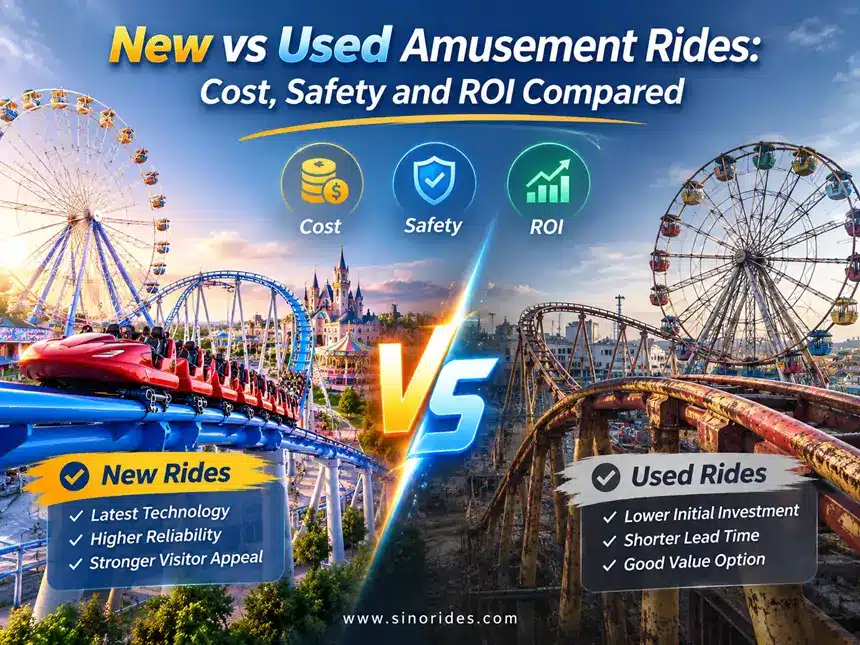
A used amusement ride typically costs 30–60% less upfront than a new one, and some distressed deals go deeper. The catch is everything after the sticker price: dismantling, freight, refurbishment, new foundations, re-certification and lost opening days. For a long-term park, a new ride usually delivers lower total cost of ownership and a more predictable payback, because it ships with current safety compliance, a factory warranty and manufacturer support. A used ride can make sense for seasonal operators, veteran maintenance teams, or quick market entry — but only when the documentation is complete, the structure passes third-party inspection, and local re-approval is confirmed before payment. Buy the outcome, not the discount.
2. Upfront cost: what buyers actually pay
3. Where used rides come from
4. Hidden costs that change the math
5. Safety and compliance
6. Maintenance, parts and downtime
7. Lifespan, depreciation and resale
8. ROI and payback: a worked example
9. When used rides make sense
10. The pre-purchase inspection checklist
11. Financing, contracts and seller questions
12. The decision scorecard
FAQ
1. Why This Decision Deserves More Than a Price Tag
Every few weeks, a park operator sends the same question: “I found a used ride for a third of the new price — should I take it?” The honest answer is: it depends on everything the quotation does not show.
An amusement ride is not a forklift or a shipping container. It is a passenger-carrying machine that runs in public, under load, day after day. It has to be approved by local authorities, insured, maintained on a schedule, and re-certified when it moves. The purchase price starts the conversation; it does not end it.
A buyer in Yemen once toured a factory, liked what he saw, and still bought a second-hand wheel from another supplier because the deposit was smaller. The reported result after opening was not what the brochure promised. Nobody can say every used deal ends that way — plenty work out fine. But the pattern is real: the cheaper machine carries the risk, and the risk shows up after the money moves.
This guide treats the decision the way an experienced procurement team would. Compare total cost of ownership, not sticker price. Check safety compliance against the standards your market actually enforces. Model payback with downtime built in. Then apply a scorecard that fits your park’s stage, budget and maintenance capability. By the end, the “new or used” question should answer itself.
2. Upfront Cost: What Buyers Actually Pay
New ride pricing spans a wide band because size, capacity, theming and certification all move the number. Published industry guides put a basic kiddie ride at roughly US$5,000–50,000, family attractions in the tens of thousands, and custom steel roller coasters anywhere from about half a million to over US$20 million. A mid-size regional park typically budgets equipment procurement in the US$200,000–1.5 million range.
Used ride pricing is harder to generalize, and that is the first red flag worth understanding. Industry sources quote savings of 30–60% versus new, with some transactions at 60–70% off for old, distressed or heavily used stock. The spread is wide because age, brand, duty cycle, maintenance history and seller urgency all matter. A two-year-old carousel from a reputable manufacturer with full records is a different asset from a fifteen-year-old drop tower that ran daily on a saltwater coast.
The table is a planning reference, not a quote. Exact figures depend on the supplier, the specification and the market. For current new-equipment pricing by category, a direct factory inquiry is the only reliable number — and that is where the comparison should start, before a used listing ever enters the picture.
Two quotes for the “same” ride can differ by 30% or more because of steel grade, drive redundancy, certification scope, packing for export, installation supervision and warranty terms. The same logic applies to used deals — a low price often means fewer included items, not a better asset. See how amusement ride prices vary between suppliers before comparing offers.
3. Where Used Rides Actually Come From
Understanding the seller tells you more than the listing photos. Used amusement rides usually leave the market through one of five channels:
- Closed parks and insolvencies. A park closes and the equipment is sold fast. Prices can be aggressive, and documentation is often the first thing lost.
- Seasonal carnivals and travelling operators. Mobile rides rotate out of fleets when owners upgrade or retire. These machines live hard but are serviced on a known cycle.
- Relocations and lease expiries. A park moves sites and the ride is too expensive to move, or a lease ends and the owner liquidates. Some of the best used deals come from here.
- Brokers and dedicated used-equipment dealers. They buy, refurbish and resell. Prices are higher than direct deals, but inspection and paperwork are usually better.
- Manufacturer trade-ins and demo units. Rare, but the safest category when available — the original builder knows the machine and can document it.
Each channel carries a different risk profile. A manufacturer demo unit with full records is close to new. A bankruptcy sale without maintenance logs is a project, not a bargain. The source also affects who you can hold accountable after the sale — an important point when the ride needs re-certification in your country.
A note on geography: importing a used ride crosses customs, duty and approval borders. Some markets treat used amusement equipment as second-hand machinery with extra inspection requirements; others restrict it outright. Before you fall in love with a listing in another country, confirm that the ride type can be imported and re-approved in yours. That single step filters out most bad deals.
5. Safety and Compliance: The Non-Negotiable
Safety is where the new-versus-used debate stops being about money. Amusement rides are regulated against written standards, and the standard that applies to you is the one your market enforces:
- EN 13814 — the European safety framework for fairground and amusement park machinery, covering design, manufacture, operation and maintenance.
- ASTM F24 — the American committee standards for amusement rides and devices, referenced across the United States and many export markets.
- ISO 17842 — the international safety requirements for amusement rides, used as a cross-border reference.
- CE marking — mandatory to place a ride on the EU market; certificates must match the actual machine.
A new ride is designed, built and factory-tested against the current version of these standards. The manufacturer holds the design file, test reports and declaration, so local approval is a paperwork exercise rather than an investigation. This is worth real money in markets where certification is strict — think European parks, Gulf states and export destinations that require CE or equivalent proof.
A used ride inverts the burden. Instead of trusting factory documentation, the buyer must prove the machine still meets the standard. The typical problem list: missing design drawings, expired or non-transferable certificates, steel fatigue in structural welds that nobody can trace, aged cables and control relays, and safety devices that were certified to an older standard edition. Re-certification after relocation is not automatic anywhere; it is an engineering review with a fee and a schedule.
Liability insurers ask what standard the ride meets and how it was verified. A new ride with a factory declaration is straightforward to insure. A used ride may require a third-party inspection and documented upgrades before a policy is issued — and the premium often reflects the risk. Factor insurance into the TCO, not into a line item you hope to skip.
The practical rule: if the seller cannot produce the original certificate, the design file and a maintenance log, assume the ride will need an engineering review before it operates. Budget for it. For rides that simply cannot be re-approved — no drawings, no traceability — walk away regardless of the price. A ride that cannot legally open has a negative value, not a bargain value.
6. Maintenance, Spare Parts and Downtime
New rides typically ship with a factory warranty of 12–24 months, covering parts and defects while the park learns the machine. Year-one maintenance is light: inspections, lubrication, adjustments. Spare parts come from the manufacturer, who also knows exactly which components wear first. Downtime in the first seasons is rare and usually covered.
Used rides inherit the opposite profile. The previous owner’s maintenance discipline is unknown, the wear pattern is invisible from photos, and parts for an older model may be discontinued. A common industry planning figure is that annual maintenance runs around 2–5% of the purchase price for reasonably new equipment, and rises sharply for older machines with sourcing problems. That figure is an estimate, not a standard — it depends on ride type, climate and duty cycle. What is not an estimate is the pattern: older rides cost more per operating hour, and the gap widens every year.
Downtime is the cost buyers underrate most. A ride closed for a week during high season does not just lose tickets — it breaks the park’s rhythm, pushes queues onto other rides and invites refund requests. For a park that depends on a handful of attractions, one unreliable machine drags down the whole day. Maintenance records are the cheapest insurance a used-ride buyer can demand: a seller who kept logs probably kept the ride; a seller with no logs is selling you their problem.
7. Lifespan, Depreciation and Resale Value
Amusement rides are long-life assets. With documented maintenance, a well-built ride commonly operates 15–25 years, and some classics run longer. That is good news for both sides of this comparison — the real question is remaining useful life, and that is where new and used diverge.
A new ride gives you the full envelope: design life ahead, no hidden fatigue, and a known maintenance baseline. It also depreciates fastest in its first years, which matters for accounting and resale planning. A used ride has already absorbed the steepest depreciation — the buyer steps in at a lower asset value. But the remaining life is an estimate built on age, duty cycle, climate and maintenance history. A ten-year-old seasonal ride with full records can have plenty of life left; a five-year-old ride that ran daily in a humid coastal climate without documented service is a gamble at any price.
Resale works the same way in reverse. Rides from reputable manufacturers with complete documentation hold value and can be resold or relocated later. Anonymous or heavily modified machines are hard to exit. A buyer who treats the purchase as a 15-year asset should price in what the machine will look like to the next owner — and should prefer equipment with brand traceability, standard parts and transferable documentation.
One real-world example of the full-lifecycle view: when Kadrioru Karussell in Estonia refreshed its family offering in 2024, it invested in a new Dino roller coaster rather than stretching older equipment. A new machine gave the operator a clean compliance file, a fresh marketing story and a predictable first decade of service. That is the kind of decision the numbers support when the park plans to run the ride for the long term.
8. ROI and Payback: A Worked Example
Park operators commonly plan payback of 3–7 years for new rides, depending on location, ticket pricing and season length. A used ride can look faster on paper because the capital is smaller. The worked example below shows why the paper answer is not the operating answer.
Take a 36-seat flying chair, a workhorse family ride. The numbers are illustrative planning figures, not quotes or guarantees; they exist to show the shape of the decision.
On this model the used ride still wins the first three years — the capital saving is real. But the gap is 0.3 years, not the 54% discount the sticker suggested. Stretch the horizon to five years and widen the downtime assumption, and the new ride catches up, because its maintenance and failure costs stay low while the used machine’s creep upward. The conclusion is not “new always wins.” It is: run the full model before you celebrate the discount.
Revenue assumptions matter as much as costs. A well-placed flying chair in a growing park can generate far more than the example above; a remote location can generate far less. Model your own ticket price, cycle time and season length. For reference on capacity and operating patterns across ride families, browse the flying chair ride and family rides pages.
9. When a Used Ride Makes Sense — and When It Does Not
Used rides earn their place in specific situations. The classic fit is a seasonal or travelling operator with an experienced maintenance crew and a short operating window. If the ride runs eight weeks a year under people who know how to inspect it, the capital saving compounds and the downtime risk shrinks.
A second fit is rapid market entry. A park opening in ninety days cannot wait for factory production. Used stock that is already assembled and approved can fill a gap — provided the approval transfers to the new operator’s jurisdiction. Operators testing a new market sometimes buy used for exactly this reason, treating the first season as a feasibility study.
A third fit is the hybrid portfolio. Experienced operators put new rides where marketing and compliance certainty matter most — the flagship coaster, the signature wheel — and use quality refurbished machines for secondary zones. That is how many growing parks stretch capital without lowering the safety baseline. A park adding a mini ferris wheel to a shopping-center roof, like the Siargao Town Center project in the Philippines in 2022, can start with a compact new model at an entry price that competes with used stock — without inheriting someone else’s wear.
Used rides are usually the wrong answer for: flagship attractions where novelty drives attendance; first-time owners without maintenance depth; markets with strict re-certification and no grandfathering; and any deal where documentation is missing. The classic disaster is a first-time buyer who saves 50% on the machine and loses the season to re-approval and repairs.
Phased builders take a middle path. Fantasy Park in India added a 30-meter drop tower and a 36-seat flying chair in 2023 as part of a staged expansion — new equipment, bought in phases to match cash flow. Phasing gives many of the benefits used buyers chase (manageable capital, faster first opening) while keeping factory documentation and warranty intact.
10. The Pre-Purchase Inspection Checklist
If a used ride survives document review, it earns a physical inspection. Work through the list in order — and treat a seller who resists any step as a warning.
- Original registration and operating license
- Maintenance logs and inspection reports
- Design drawings, electrical schematics, load test reports
- Original certificates (CE, EN 13814, ASTM F24, national)
- Ownership history and proof the seller can transfer title
- Spare parts list and supplier contacts
- Structural welds, joints and steel fatigue marks
- Corrosion, especially in coastal or humid climates
- Bearings, motors, reducers, brakes, cables
- Electrical cabinets, wiring age, emergency stops
- Safety devices: locks, restraints, limit switches
- No-load run (30+ minutes) and loaded test run
Engage an independent inspector (TÜV, SGS, or a nationally accredited body) for the structural and electrical review, and keep the report as the backbone of your contract — the sale should be conditional on it. The few hundred or few thousand dollars it costs is the cheapest risk control in the entire deal.
After the sale, the work continues: verify every component on arrival, refurbish to a written scope, replace aged safety parts, run repeated loaded tests, obtain the third-party report, and register the machine with the local authority before opening. Skipping registration converts a legitimate purchase into an illegal operation the moment the ride starts.
11. Financing, Contracts and Questions to Ask the Seller
The financing picture changes with age. New rides are easier to finance because the asset is current, documented and insurable — lenders and lessors see a known residual value. Used rides are financed on the strength of inspection and refurbishment plans, and older machines often need cash purchases or short-term loans. In some markets, leasing new equipment spreads capital over the payback period and keeps the warranty with the financier’s approved supplier.
Whatever the route, the contract should answer ten questions in writing:
- What exactly is included — machine only, or spares, tools, manuals?
- Is the sale conditional on third-party inspection and local re-approval?
- Who pays dismantling, packing, freight and customs?
- What is the refurbishment scope, and who executes it?
- Are original drawings and certificates transferred with title?
- What warranty, if any, does the seller or refurbisher provide?
- Which spare parts are guaranteed available, and for how long?
- Does installation include manufacturer or third-party supervision?
- What training does the operating crew receive?
- What happens if the ride fails re-certification after delivery?
Deposit structure matters too. Standard practice is a small deposit to hold the machine, the balance tied to inspection results and handover documents. Paying a large share before verification removes your only leverage. If the seller demands full payment against photos and promises, that is a deal to walk away from.
For buyers leaning new, the same discipline applies in reverse: compare what the factory includes in the price — certification, packing, installation supervision, training, warranty duration and spare parts commitment. A quote that lists everything is easier to compare against used stock than a bare machine price. Product pages such as theme park rides, kids rides and amusement rides for sale show how a factory presents scope and options.
12. The Decision Scorecard
Score each row 1–5 in favor of the option that fits your situation (5 = strong fit). Add the columns. The higher total is your lean — not a verdict, but a way to stop the discount from doing the thinking.
Two final reminders. First, a mixed portfolio is legitimate strategy — the scorecard applies ride by ride, not to the whole park. Second, the comparison is only as good as its inputs: get written refurbishment quotes, a third-party inspection and a confirmed approval path before you trust your own math. Discounts feel like wins; verified operating costs are the ones that pay.
Frequently Asked Questions
Are used amusement rides a good investment?
Used rides can be a good investment when the full cost — purchase, transport, refurbishment, re-certification, spare parts and downtime — stays below a new equivalent. Complete records, a clean third-party inspection and an experienced maintenance team make the math work. Without those, hidden costs usually erase the price advantage.
How much cheaper are used amusement rides than new ones?
Industry sources commonly report used ride prices 30–60% below new equivalents, with some transactions at 60–70% off for old or distressed stock. The spread depends on age, brand, condition, duty cycle and seller urgency. Compare total cost of ownership, not sticker price — refurbishment and re-certification can consume a large share of the saving.
What hidden costs come with a used amusement ride?
Dismantling, export packing, freight and customs, refurbishment, missing parts, new foundations, re-certification, reinstallation, operator training and early downtime. Sellers rarely include these in the asking price. A realistic refurbishment budget is often 15–40% of the purchase price, depending on age and condition.
Is a used ride as safe as a new one?
Safety depends on design, maintenance history and re-certification, not age alone. A used ride can be safe after documented maintenance, structural inspection and re-approval under EN 13814, ASTM F24 or ISO 17842. A new ride ships with current standards and full documentation; a used ride only meets them if you verify and upgrade where needed.
What safety standards apply to amusement rides?
The main international frameworks are EN 13814 (Europe), ASTM F24 committee standards (United States) and ISO 17842 (international). CE marking is mandatory to place rides on the EU market. Certification covers design, manufacturing, operation and maintenance — and local authorities apply their own versions of these rules.
Can a used ride be re-certified after import or relocation?
Yes, but re-certification is not automatic. The operator must prove the ride meets local requirements through documentation, engineering review, third-party inspection and often component replacement. Some imported used rides fail because original design files are missing. Confirm local approval before paying a deposit.
What should I check before buying a used ride?
Registration documents, maintenance logs, inspection reports, original drawings, structural welds, corrosion, bearings, cables, control systems, safety devices and test-run behavior. Insist on an independent inspection and a loaded test. Verify that ownership transfer and annual inspection can be registered in your country before you commit.
Do used rides come with a warranty?
Usually no, or only a short seller warranty. New rides typically carry 12–24 months of factory warranty covering parts and defects. For used rides, seller terms are often “as is”. A written refurbishment scope with a parts guarantee from the refurbisher is the closest practical substitute.
How long do amusement rides last?
With proper maintenance, well-built rides commonly operate 15–25 years, and some classics run longer. A used ride’s remaining life depends on duty cycle, climate and maintenance history. Under ten years old with full records is the safest used purchase; older machines need professional inspection and realistic life-cost estimates.
What is the payback period for new vs used rides?
Park operators commonly plan payback of 3–7 years for new rides. Used rides can pay back faster on paper when reliability holds, because capital is smaller. Downtime is the main risk: every closed operating day is lost ticket revenue. Model revenue, maintenance and failure scenarios together instead of comparing purchase prices.
Where do used amusement rides come from?
Closed parks and insolvencies, seasonal carnivals, relocations and lease expiries, brokers and used-equipment dealers, and occasionally manufacturer trade-ins or demo units. Each channel has a different risk profile. Manufacturer demo units with full records are the safest; bankruptcy sales without logs are projects, not bargains.
Should a first-time park owner buy used rides?
Generally no, unless a veteran maintenance team is in place and the documentation is complete. First-time owners are better served by new equipment with factory warranty, current certification and manufacturer support, because the risk of re-approval delays and hidden repairs lands hardest on teams without experience.
Is it cheaper to buy a used ferris wheel?
The purchase price is usually lower, often 30–70% below new. But a ferris wheel carries heavy relocation costs: dismantling, transport, cabin repair, electrical upgrades, new foundations, re-certification and reinstallation. Once those are added, the used wheel can land within 10–20% of a new one while keeping more long-term risk.
Do manufacturers support used rides they did not build?
Some will service, inspect or refurbish third-party rides; most will not take responsibility for design compliance they cannot verify. The original builder’s documentation and spare-parts support matter most. If the original manufacturer is unknown or out of business, expect higher costs and longer delays for parts and approval.
Sinorides builds new amusement rides to CE and international standards and can walk you through pricing, certification and installation scope so your new-vs-used decision rests on verified numbers. Send the site layout, target capacity and opening date for a factory-based comparison.
About Sinorides
Sinorides (Henan Swonder Amusement Rides Co., Ltd.) has manufactured amusement rides since 1992 and supplies equipment to parks in more than 20 countries. The product range covers ferris wheels, drop towers, pendulum rides, flying chairs, pirate ships, family roller coasters, trackless trains, bumper cars, carousels and self-control planes. The company holds CE certification and operates ISO-based quality systems, supports custom design and theming, and provides installation guidance and after-sales support, including foundation-free configurations for sites where concrete work is impractical.
Documented installations include a 50-meter ferris wheel and spinning roller coaster delivered to Peko’s Multiparque in Argentina (2024), a 30-meter drop tower and 36-seat flying chair for Fantasy Park in India (2023), a double-decker carousel, pirate ship and drop tower for Maxim Gorky Central Amusement Park in Russia (2023), and a 40-seat pirate ship for Parc Aladin in Tunisia (2023). These are company records from global projects, provided here as context, not as a guarantee of future results.
Verifiable: safety standard names (EN 13814, ASTM F24, ISO 17842, CE); ride price ranges as published in industry guides; warranty durations commonly quoted by manufacturers (12–24 months); typical equipment lifespans with maintenance; the named project records listed above. Estimates and judgment: the 30–60% used-price discount range, the 15–40% refurbishment cost share, the 2–5% annual maintenance planning figure, and all figures in the worked ROI example — these are planning assumptions that vary by market, ride type and condition. Verify each number against written quotes before relying on it.