Opening: The Question Every Investor Asks First
“How much does a roller coaster actually cost?”
It sounds like a simple question. In reality, it is the point where many amusement park projects either become commercially successful—or quietly lose control of budgets, timelines, and expectations.
For park investors and operators, a roller coaster is not just a ride. It is often the visual anchor of the park, a traffic driver, a branding symbol, and, when chosen correctly, a reliable revenue engine for 10–20 years. When chosen poorly, it becomes a high-maintenance asset with disappointing payback.
Understanding roller coaster cost, lifecycle investment, and real ROI logic is not optional. It is fundamental.
The Expert Answer, Upfront
There is no single “roller coaster price.”
Across global projects delivered by Sinorides, coaster investments range from under USD 30,000 for compact family installations to multi-million-dollar signature rides designed to dominate skyline and social media alike.
What matters more than price is this:
The right roller coaster is one whose cost structure aligns with your audience, space, operating capacity, and long-term revenue model.
Everything else follows from that decision.

A Short Industry Primer (For Non-Technical Readers)
Roller coasters originated in 18th-century Europe as gravity-driven ice slides. Modern roller coaster rides—whether family roller coasters, spinning roller coaster rides, or indoor roller coasters for sale—share the same core system:
- Track structure (steel or composite)
- Train & wheel assemblies
- Lift and braking systems
- Control and safety logic
- Foundations and clearance zones
What changes dramatically is scale, speed, complexity, and theming, which is exactly why costs vary so widely.

Roller Coaster Cost Breakdown by Type
Small & Compact Roller Coasters
(Carnival / FEC / Entry-Level Parks)
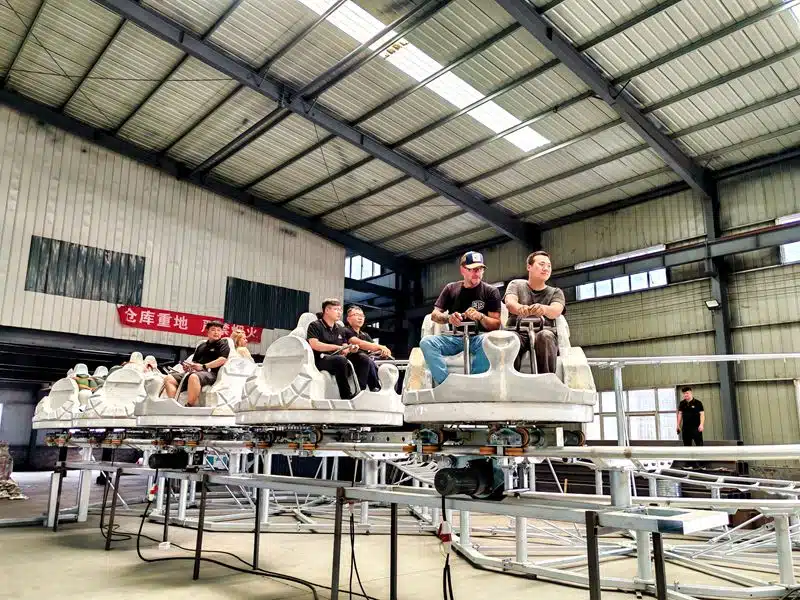
These include backyard roller coaster for sale, carnival roller coaster for sale, and compact indoor layouts.
- Typical Cost: USD 10,000 – 200,000
- Ideal For: New parks / Indoor amusement centers / Secondary attractions
- ROI Reality: Often under 12 months if foot traffic already exists
A micro-case worth noting: compact family coasters deployed by Sinorides-style configurations in Southeast Asia often outperform expectations simply because queues stay full all day.

Family Roller Coasters
(The Most Underrated Profit Generator)
A Family Roller Coaster balances excitement and accessibility. No extreme fear barrier. High repeat rides.
- Typical Cost: USD 100,000 – 500,000
- Audience Coverage: Children, parents, mixed-age groups
- Key Advantage:Highest utilization rate per operating hour
In New Celosia (Indonesia), a family-oriented coaster delivered stable daily throughput without seasonal volatility—something thrill rides rarely achieve.

Thrill & Signature Roller Coasters
This category includes:
- Spinning Roller Coaster
- Suspended / Hanging Roller Coaster
- Overlapping Roller Coaster
- Indoor Roller Coaster (large-scale)
- Typical Cost: USD 1 million – 5 million
- Function: Brand positioning + marketing leverage
- Operational Reality:Lower rider frequency, higher marketing value
At Happy Land World (Saudi Arabia), a suspended coaster became the park’s primary visual icon—critical in a market where destination branding matters as much as ticket revenue.
Extreme & Landmark Roller Coasters
Large parks, national tourism projects, or IP-driven destinations.
- Typical Cost: USD 10 million – 50 million+
- Risk Profile: High
- Payback Cycle: Often 3–6 years
These rides are not about efficiency. They are about identity.
What Actually Drives Roller Coaster Cost?
Design Complexity & Customization
Theming, unique layouts, integrated lighting, storytelling elements—each adds cost. Customization is powerful, but it must justify itself commercially.
Materials & Engineering Standards
Steel intensity, fatigue calculations, seismic reinforcement, and climate adaptation all matter. Compliance with CE, SGS, ASTM, ISO, GOST is non-negotiable for global operations.
Space, Foundations, and Installation
Remote locations, limited access, or poor soil conditions quietly inflate budgets. This is where inexperienced buyers lose control fastest.
Operating & Maintenance Costs (The Hidden Reality)
Roller coasters do not end at purchase.
- Annual routine maintenance: ~3–5% of initial roller coaster cost
- Parts replacement: Wheels, sensors, braking components
- Downtime cost: Often ignored, but financially significant
Experienced operators plan maintenance before the ride opens. Not after something breaks.
ROI Logic: How Investors Should Really Think
A roller coaster does not generate revenue alone. It drives:
- Park entry justification
- Longer dwell time
- Higher secondary spend (F&B, merchandise)
Across Sinorides-supported parks such as Gorky Park (Russia) and Dushanbe Park (Tajikistan), family and mid-scale coasters consistently reached 1–3 year ROI, while extreme rides relied more on branding impact than direct payback.
Different tools. Different goals.
Choosing the Right Roller Coaster for Your Park
Step 1: Define Your Core Visitor
Families? Teenagers? Tourists? Local repeat visitors?
Step 2: Match Ride Scale to Space
Overbuilding is the fastest way to kill ROI.
Step 3: Budget Beyond Purchase Price
Think total lifecycle cost, not brochure price.
This is where professional manufacturers separate themselves from suppliers.
Why Experienced Buyers Work with Sinorides
Sinorides operates as more than a roller coaster manufacturer. It supports:
- Ride selection strategy
- Cost-performance balancing
- Compliance with international standards
- Global installation coordination
Projects across Indonesia, Saudi Arabia, Russia, Central Asia, and beyond confirm a simple truth:
Correct decisions at the planning stage save years of operational regret.
Frequently Asked Questions (FAQ)
What is the average roller coaster cost?
From USD 10,000 for compact units to USD 5 million+ for large thrill rides, depending on type and complexity.
Can indoor roller coasters be cost-effective?
Yes. Indoor roller coaster for sale options often outperform outdoor rides in malls and mixed-use developments due to weather immunity.
How long is the typical ROI period?
Most family and mid-scale roller coasters achieve ROI within 1–3 years.
Can investors buy roller coasters directly?
Yes. Professional roller coaster suppliers like Sinorides provide full-cycle support from design to operation.
Final Takeaway
A roller coaster is not a cost item.
It is a strategic investment decision.
When selected with clarity—audience first, space second, budget third—it becomes one of the most reliable profit engines in an amusement park portfolio.
For investors and operators seeking clarity, realism, and long-term value, Sinorides provides professional guidance tailored to global market realities.
The smartest investment starts with the right conversation.