Quick Answer
Another name for a pirate ship ride is a swinging ship ride. Viking ship ride is another common name, especially for a boat with Nordic-inspired decoration. “Pirate boat” and “swinging boat” also describe the familiar attraction in which a passenger gondola swings backward and forward beneath an overhead pivot. Names such as Galleon, Pharaoh’s Fury and Sea Dragon need more context: they can identify a manufacturer’s product or theme rather than a universal ride category. For a clear equipment description, use “non-inverting swinging ship ride,” then add the manufacturer, model, capacity and theme. A decorative name alone does not establish how the ride moves or who may ride it.
Pirate Ship Ride Names at a Glance
A name can help a visitor find an attraction, a designer select a theme, or a buyer identify a product. Those are different jobs. Confusion starts when a name written for one purpose is used for another. “Viking” may be enough for a park map, but it leaves important questions unanswered in a purchase specification.
The following table separates useful alternate names from terms that require qualification. It describes naming practice rather than ranking terms by search volume or claiming that every country uses them in the same way.
| Name | How to interpret it | What still needs checking |
|---|---|---|
| Swinging ship ride | Direct descriptive alternative for the conventional attraction | Exact model and operating limits |
| Viking ship ride | Common themed name for a ship-style attraction | Whether the equipment is a conventional swinging ship |
| Pirate boat ride | Nautical wording often used for the same family | Whether the listing describes an amusement machine or an actual boat |
| Swinging boat ride | Description of movement and vehicle shape | Powered park attraction versus other boat swings |
| Galleon | Ship-themed name; also a Zamperla product name | Manufacturer and configuration |
| Pharaoh’s Fury / Sea Dragon | Names used in Chance Rides product and theme material | Exact product generation and specification |
| Halve Maen | A particular park attraction name at Efteling | Park identity; it is not a universal model designation |
| Pendulum ride | Broader description of swinging motion | Passenger carrier, rotation and inversion behavior |
Why “Swinging Ship” Is the Clearest Direct Alternative
“Swinging ship” describes the two features that make the conventional attraction recognizable: a ship-shaped passenger carrier and a repeated backward-and-forward swing. It does not require the boat to have pirate flags, a dragon prow or a particular historical story. That makes it useful when explaining the ride to someone who remembers its movement but cannot recall its sign.
For example, a visitor might describe “the big boat that rises at each end.” A useful reply is “the swinging ship ride.” Once the visitor recognizes the attraction, the park’s own name can complete the directions. The generic description solves the identification problem; the attraction name solves the navigation problem. Both can appear on the same sign without competing with each other.
The phrase is also used by equipment manufacturers. Zamperla describes its Galleon as a swinging ship. This supports the descriptive term, but it does not mean every swinging ship is a Zamperla Galleon. The relationship runs from a particular product to a wider ride family, not from a generic label to a guaranteed manufacturer.
For commercial searches, adding “amusement ride” helps distinguish equipment listings from real vessels, playground equipment and decorative boats. Adding “non-inverting” further describes the intended motion. These extra words are particularly useful when a quotation is being translated or circulated among a park owner, architect and purchasing team.
Is a Viking Ship Ride the Same as a Pirate Ship Ride?
Often, the names refer to the same broad style of attraction. The conventional version has a suspended boat-shaped gondola that swings beneath an overhead pivot. “Viking” commonly describes the visual treatment: a Nordic-inspired prow, shields or other longship references. “Pirate” suggests a different nautical story. Neither word, by itself, specifies the drive system or the permitted operating cycle.
Sinorides uses Viking ship ride terminology alongside pirate ship terminology. Its Nordic-themed ship design provides a concrete example of a theme influencing the product description. This is a naming example, not evidence that every Viking-themed attraction has identical machinery or that a different decorative package can be fitted without engineering review.
For a designer, the theme may be the starting point. For an engineer, the starting point is the documented model and its limits. A drawing showing a dragon bow cannot answer questions about occupied clearance, passenger restraints or the support structure. Those details belong in the manufacturer’s specification and the project drawings.
Nor does “Viking” automatically mean larger, faster or more intense. A supplier could offer several sizes under the same theme, and a park could choose a mild or dramatic name for its own reasons. Compare the actual operating data before interpreting the name as a promise about the experience.

Galleon: a descriptive theme and a product name
A galleon-themed boat fits naturally into a nautical attraction. However, capitalization and context matter when reading a catalogue. Galleon is the title of a product offered by Zamperla. The manufacturer describes both its swinging motion and its theming options. When that product is intended, retaining the manufacturer name avoids confusing it with another supplier’s ship-themed ride. See the official source in the reference section.
The practical distinction is straightforward: “a galleon-themed swinging ship” describes a design idea; “Zamperla Galleon” identifies a manufacturer’s offering. Neither phrase should be silently substituted for the other in a parts request or technical comparison. Model-specific information must come from the supplier responsible for the actual machine.
Pharaoh’s Fury and Sea Dragon: read the current product material
Chance Rides’ Pharaoh’s Fury specification sheet explicitly presents Sea Dragon among its available themes. That is a useful primary-source example of how a product identity and a themed name can overlap. It is more precise than presenting both terms as universally interchangeable synonyms for every pirate ship ride.
The statement also has a boundary. A current specification sheet does not establish the configuration of every historical installation bearing one of those names. If an older ride appears in a used-equipment listing, request its nameplate, serial number, original documentation and modification history. A familiar title is a starting point for identification, not the end of it.
Park attraction names belong to the park context
Efteling calls its attraction Halve Maen and describes it as a swinging ship on the official attraction page. The example shows why a park map and a supplier catalogue may use different words without contradicting each other. One names the visitor experience; the other describes the equipment family or commercial product.
A practical record can preserve all three: park attraction name, generic ride type, and manufacturer/model. Keeping these fields separate helps marketing staff, operators and maintenance teams refer to the same asset. If the public name changes during a retheme, the technical identity should remain traceable in the records.
Identify the Ride by Movement Before Trusting the Name
The quickest identification method is to watch a complete operating cycle. A still photograph may show the boat decoration clearly while hiding the mechanism that determines the ride category. Look at what supports the passenger carrier, how it travels, and whether it adds rotation to the swing.
Check the support and the path
A conventional suspended swinging ship moves along an arc beneath an overhead pivot. The boat rises in one direction, returns through its low position, and rises in the other direction. The term “non-inverting” states that the operating cycle does not take passengers through a complete upside-down rotation. It is a useful qualification when that is the machine being discussed.
Check for additional movement
If the boat also whirls around, travels along a shaped track, or performs full inversions, describe those features explicitly. A nautical body shell can appear on machines with different motion patterns. The shell is easy to recognize, but the movement is what prevents two unlike attractions from being grouped together in a quotation.
Check the identification plate and documentation
Video can narrow the category; it cannot verify the exact machine. The nameplate, manufacturer documents and serial number provide the next level of identification. For an installed attraction, also establish whether the current decoration and operating settings correspond to the documented configuration. A supplier image with the same paint scheme is insufficient proof.
Related Terms That Need Extra Care
Pendulum ride is a broader category
A pirate ship is associated with pendulum-style swinging motion, but “pendulum ride” is not a precise replacement for “pirate ship” in equipment procurement. A pendulum ride may have a different passenger carrier, seating arrangement or additional rotation. Ask for a ship-shaped gondola if that is what the project needs, and state the required motion in plain language.
A rocking tug is not automatically a swinging ship
Zamperla describes Rockin’ Tug as combining rocking and whirling motion. That official description makes it a useful counterexample: a boat-shaped amusement ride can deliver a different movement pattern from the conventional suspended ship. “Boat ride” is therefore too broad to settle the comparison. A reference video and the intended category should accompany the written request.
Swing boat can be ambiguous
“Swing boat” is understandable in ordinary conversation, but it leaves room for different interpretations. Specify whether the request concerns a powered amusement attraction, a small manually operated swing, or another product. The purpose of this clarification is not to ban the term; it is to avoid making a short phrase carry more technical meaning than it contains.
Mini, portable and foundation-free describe different things
“Mini” suggests size or positioning, not a universal passenger age. Review the actual mini pirate ship specifications and rider requirements. “Portable” concerns transport and relocation arrangements. “Foundation-free” concerns the support concept. For portable pirate ship equipment, ask how transport, assembly, ground support and commissioning are documented. Do not assume one modifier guarantees the others.
What the Name Cannot Tell a Buyer
The same broad ride family can include different capacities, dimensions and electrical requirements. A useful comparison therefore begins with the exact product designation. Two Sinorides knowledge-base entries illustrate this point without turning the names into a performance ranking.
| Specification | 24P PIRATE SHIP — ID 39 | 32P FOUNDATION FREE PIRATE SHIP — ID 38 |
|---|---|---|
| Listed ride type | Stationary | Foundation-Free |
| Instant capacity | 24 passengers | 32 passengers |
| Total height | 10 m | 10.6 m |
| Listed footprint | 14 × 10 m | 18 × 9 m |
| Total power | 15 kW | 35 kW |
| Voltage and frequency | 380 V, 50 Hz | 380 V, 50 Hz |
| Listed theoretical capacity | 288 passengers/hour | 384 passengers/hour |
Source: Sinorides product records ID 39 and ID 38, updated 10 September 2026. These values apply to those entries only. The 24-seat pirate ship product page provides a relevant route for a model inquiry. Confirm the final supplied configuration and drawings before committing a site layout.
The footprint in a product record is not, by itself, a complete park-space allowance. A project also needs the documented operating clearance, perimeter, queue, access and maintenance provisions. Likewise, total height and maximum operating height are different fields; neither should be substituted for the other because a layout form asks simply for “height.”
Theoretical hourly capacity is also different from measured throughput. Loading, restraint checks, unloading and actual occupancy influence how many passengers are served. A name containing “32P” may identify seats, but it does not guarantee that every dispatch will fill them or that a particular park will achieve the catalogue’s theoretical hourly figure.
Does Another Name Mean a Different Price?
The name alone does not establish a price premium. A Viking-themed design and a pirate-themed design may differ in decorative scope, while two rides sharing the word “pirate” may differ substantially in size, support structure and electrical equipment. A price comparison is useful only after the supplied scope has been made comparable.
Ask the supplier to separate the documented equipment configuration from optional decoration, lighting and other selected features. Then identify what the commercial offer includes: packing, transport, site work, installation support, testing and any project-specific documentation. A low equipment-only figure cannot be compared directly with a wider ready-to-operate package.
No universal market price is assigned to “Viking,” “Galleon” or “swinging ship” here because the names do not define comparable offers. The pirate ship cost guide is a separate starting point for budgeting, but a current quotation and a written scope are still required for an actual project.
The same caution applies to return on investment. A memorable attraction name may support a park’s story, but it does not prove ticket demand or profitability. Those questions require the park’s operating assumptions and actual costs. Naming clarity helps prevent a specification error; it is not evidence of a particular financial result.
How to Describe the Ride in a Quote Request or Operating Record
Consider a hypothetical purchasing exchange. A park asks for “a Viking,” receives a decorative image, and forwards it to the site planner. The planner needs an operating envelope; the buyer has only a theme. The request has not yet identified a machine clearly enough to compare equipment or reserve space. One extra sentence can prevent this gap.
Use a description such as: “A non-inverting swinging ship amusement ride with a ship-shaped passenger gondola. Please identify the manufacturer, exact model, passenger capacity, support arrangement, operating envelope and applicable documentation; quote the requested Nordic theme separately.” This is an inquiry template, not a completed technical specification or an instruction to manufacture a ride.
For a used attraction, add the serial number, manufacture year, documented changes and available inspection records. For an operating attraction, retain the public name alongside the asset identifier. A maintenance request should say which machine is involved, even if the visitor-facing sign has changed several times.
The same principle helps with translation. In Russian, «Пиратский корабль» and «Викинг» can be useful visitor-facing descriptions, while «качающийся корабль» explains the movement. Preserve the manufacturer’s original model designation in procurement and service documents. Translating a commercial name into a different familiar name can accidentally erase the information needed to identify parts.
For signage, pair the park’s name with a short description of the motion and the approved rider information. Avoid promising an experience based solely on a dramatic word. “Family,” “mini” or “Viking” cannot replace the restrictions and instructions established for the actual attraction.
Safety Documents Follow the Machine, Not the Nickname
Ride naming is not a certification system. “Pirate ship,” “Viking ship” and “Galleon” do not establish compliance, a permitted age group or an operating approval. Review the model-specific documentation and the requirements applicable to the installation. A general article can explain this distinction; it cannot approve a machine or replace its operating instructions.
ASTM F2291 concerns the design of amusement rides and devices. ISO 17842-1 covers design and manufacture. EN 13814 is another amusement-device safety standards family encountered in project discussions. Establish the relevant scope and accepted edition for the destination project rather than treating the acronyms as interchangeable badges. The existence of a standard is not evidence that a particular ride complies with it.
If a supplier mentions CE, ask what product or component the statement covers and what documentation supports it. Do not convert a component-level statement into an unqualified claim about the complete installation. Similarly, a company’s management-system certificate does not identify the operating restrictions of an individual ride.
The UK’s Health and Safety Executive provides guidance for fairgrounds and amusement parks in HSG175. Its relevance here is the importance of documented responsibilities and safe practice, not a universal licensing rule. The actual park still needs its own competent review, operating procedures and inspection arrangements under the applicable local system.
Rider questions belong with the actual park’s published information. There is no universal height limit that can be safely inferred from a name. If two attractions share a nautical theme, their restrictions may still differ. Visitors should use the instructions for the attraction they intend to board.
About the Sinorides Examples and Evidence
Sinorides supplies ship-style amusement equipment and maintains model-specific product records. This article uses two such records to show why a generic name is insufficient for specification. Company case records also list Snober Land — Algeria — 2019 — Pirate ship among the equipment supplied. That identifies a recorded project example; it does not establish the attraction’s current condition, visitor numbers or financial performance.
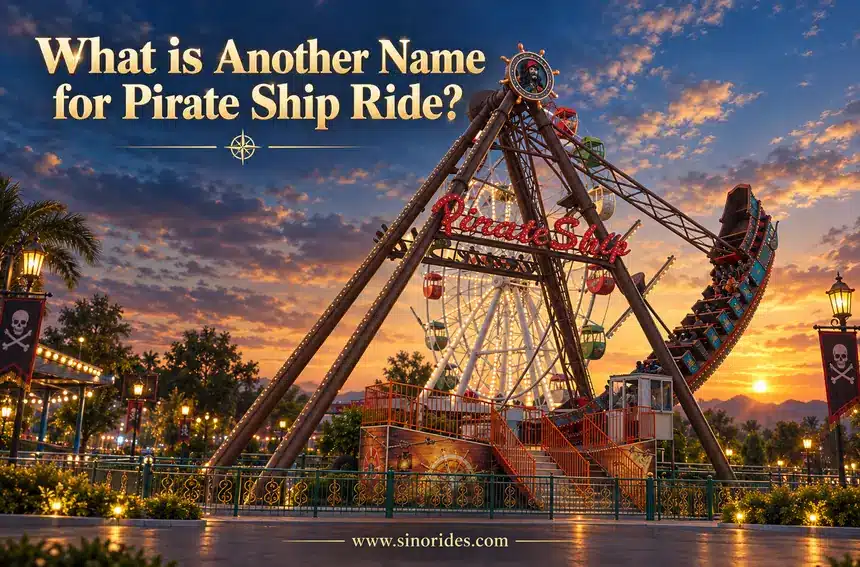
The naming examples below come from official manufacturer and park pages. Product parameters are attributed to the Sinorides records identified above. The purchasing exchange is explicitly hypothetical, and the illustration is a generated concept. No original-inventor claim, universal ride price or customer ROI story is presented as a verified fact. Final equipment selection requires documentation for the actual machine.
Frequently Asked Questions
What is another name for a pirate ship ride?
A direct alternative is “swinging ship ride.” “Viking ship ride” is another common name, especially with Nordic-themed decoration. For an equipment inquiry, add the manufacturer and model, because the alternate name alone does not establish capacity, dimensions or the permitted operating cycle.
Is a Viking ride a pirate ship ride?
Often it is the same broad ship-style attraction with a different theme. Verify that the machine has the intended swinging motion. The word “Viking” does not prove a particular size, speed or passenger restriction, and an attraction’s public name may differ from its manufacturer’s model name.
What is the big swinging boat ride called?
“Swinging ship ride” is a useful descriptive name for a boat-shaped gondola moving backward and forward beneath a pivot. A park may use its own attraction name. Watching the operating cycle helps distinguish it from a rocking boat that also spins or follows a track.
Is Galleon another name for a pirate ship?
It can be a nautical description, and Galleon is also a Zamperla product name. When discussing that manufacturer’s product, include “Zamperla.” A similarly themed boat from another supplier should be identified by its own model rather than assumed to be the same equipment.
Is Sea Dragon the same as Pharaoh’s Fury?
Chance Rides’ cited Pharaoh’s Fury specification sheet lists Sea Dragon among its themes. This establishes a relationship in that product material. It does not prove that every historical ride using either name has identical dimensions, capacity or components; check the specific machine’s records.
Are all pendulum rides pirate ships?
No. Pendulum describes a broader movement category. The passenger carrier may be a ship, another gondola shape or a different seating platform, and additional motion may be present. Specify a ship-shaped gondola and the required cycle when asking for a conventional swinging ship.
Does a pirate ship ride go upside down?
The conventional non-inverting swinging ship moves backward and forward without a complete inversion. Do not use a nautical name alone to decide whether another attraction inverts. Check the actual model and the park’s official description, especially when a listing mentions looping or full rotation.
Is Rockin’ Tug another pirate ship name?
It should not be treated as an interchangeable name for the conventional suspended swinging ship. Zamperla describes Rockin’ Tug as combining rocking and whirling motions. The boat theme is shared, but the movement distinction matters when identifying an attraction or comparing equipment.
Does “mini pirate ship” mean every child can ride?
No. “Mini” is a size or product-positioning term, not a universal rider eligibility rule. Follow the restrictions documented for the actual model and published by the operator. Neither a smaller appearance nor a family-oriented name replaces those requirements.
Does “foundation-free” mean the ride needs no site preparation?
No. The term describes a support concept, not an exemption from checking the site. Obtain the manufacturer’s ground-support requirements, layout and installation documentation. Do not assume that foundation-free equipment is automatically trailer-mounted or suitable for any surface.
Does a Viking ship cost more than a pirate ship?
The name alone cannot answer that. Compare the exact configuration, theme, capacity, installation scope and commercial terms. A decorative option may affect a quotation, but no standard price difference follows from the words “Viking” and “pirate.” Obtain comparable current offers.
Which name should appear in maintenance records?
Record the manufacturer, exact model, serial number and the park’s asset identifier. Add the public attraction name for convenience. If a ride is renamed or rethemed, keep its technical identity traceable so parts, inspections and service history remain associated with the correct machine.
Sources and Further Reading
HUSS Park Attractions. “Pirate Ship.” Official product page. Accessed 20 September 2026.
Zamperla. “Galleon.” Official product page. Accessed 20 September 2026.
Chance Rides. “Pharaoh’s Fury.” Product specification sheet, 2024. Accessed 20 September 2026.
Efteling. “Halve Maen Swinging Ship.” Official attraction page. Accessed 20 September 2026.
Zamperla. “Rockin’ Tug.” Official product page. Accessed 20 September 2026.
Health and Safety Executive. “Fairgrounds and Amusement Parks: Guidance on Safe Practice.” HSG175. Accessed 20 September 2026.
ASTM International. “F2291: Standard Practice for Design of Amusement Rides and Devices.” F2291-25c edition page. Accessed 20 September 2026.
International Organization for Standardization. “ISO 17842-1:2023.” Safety of amusement rides and amusement devices—Part 1: Design and manufacture. Accessed 20 September 2026.
Follow Sinorides
For product footage and company updates, visit Sinorides on LinkedIn, YouTube, Facebook and Instagram.