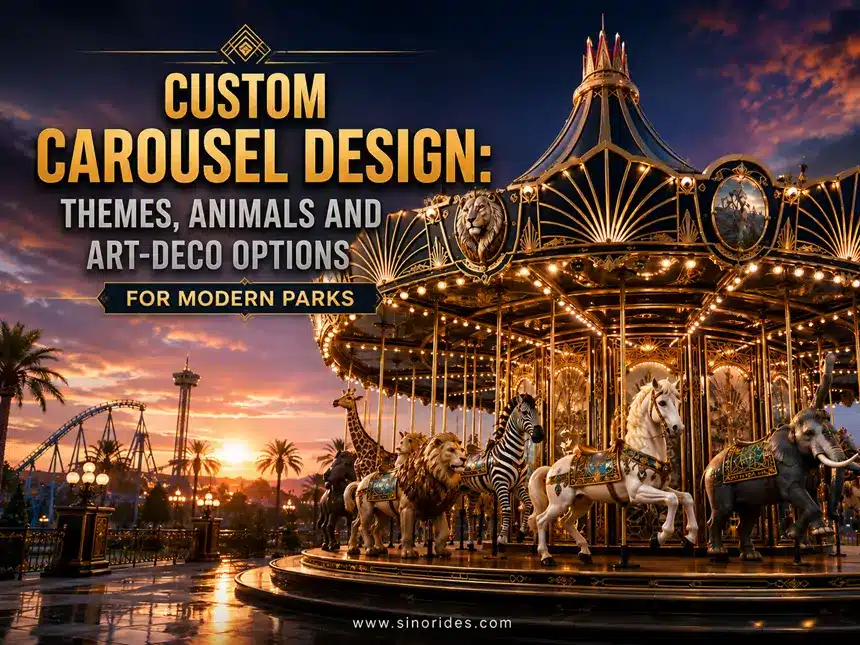
Custom carousel design means choosing a visual identity — theme, animal families, colors, lighting and trim — before the ride is built around it. The three main directions are heritage (traditional carved look), themed (zoo, ocean, fairy tale, brand mascots) and period style (Art Deco, Victorian, retro). Figures are the single biggest visual driver: horses, menagerie animals or custom creatures, sculpted and cast in fiberglass today instead of carved wood. A custom theme adds roughly 10–35% to the base price of an equivalent standard carousel, with Art Deco and fully bespoke sculpting at the top end, and adds four to ten weeks of design and tooling time. The park should decide theme and figure mix first, because they drive the canopy, floor, lighting and even the electrical layout. Every choice must still pass the same safety review — CE marking, EN 13814 or ASTM F2291 depending on market — because themed parts are load-bearing parts.
Sinorides designs and builds custom carousels in-house — theme concept, figure sculpting, molds, fiberglass production, painting, lighting and installation support. Send the brief and get a concept sketch plus a budget range before committing.
01 · Where Carousel Design Language Comes From
The word carousel comes from the French carrousel, a kind of tournament exercise for cavalry that became popular in the 17th century. The ride as we know it — a rotating platform with figures that rise and fall — took shape in the 19th century, first powered by hand or animals, then by steam, and finally by electric motors. In the United States, the first recorded patent for a carousel was granted to William Schneider of Davenport, Iowa in 1871. Since 2014, the National Carousel Association has marked July 25 as National Carousel Day in honor of that patent.
Between the 1870s and the early 1930s, the golden age of the wooden carousel, thousands of machines were built — estimates run as high as ten thousand — but fewer than two hundred complete antique carousels survive today. Three regional American styles still shape how buyers describe carousels:
- Coney Island style — elaborate saddles with faux jewels, mirrors and heavy decoration, pioneered by Danish immigrant Charles Looff in Brooklyn.
- Philadelphia style — more realistic painted animals and leather-style saddles, pioneered by German immigrant Gustav Dentzel and the Philadelphia Toboggan Company.
- Country Fair style — plainer, often without saddles, associated with Allan Herschell, Spillman and Charles Parker.
Named carvers such as Marcus Illions (a Looff protege) and Salvatore Cernigliaro (who carved for Dentzel) turned animal figures into collectible art. When the Great Depression ended the wooden era, builders moved to cast aluminum, then to fiberglass later in the 20th century. That shift matters for custom work: fiberglass figures can be sculpted from any reference, replicated from a single master mold, and finished to match a brand color chart — while a wood carver would need weeks per figure. A deeper look at how carousel types and history divide up sits in the Sinorides guide to the history and categories of carousels.
In the antique market, a restored Coney Island horse can outprice a modern ride. Design heritage is not nostalgia — it is the visual grammar guests already understand. A park does not need to copy a historic carousel; it needs to borrow the grammar: symmetry, a strong centerpiece, figures that read clearly from twenty meters.

02 · Theme Directions: From Heritage Marquees to Zoo Parades
A theme is a promise made in one glance. Guests should be able to name it from across the midway: that is the difference between a carousel that blends in and one that becomes a meeting point. The six directions below cover most of what parks actually commission. Each can be scaled up or down; the numbers in brackets are the color stories that define the look.
Mirrors, jeweled saddles, gold trim and horses as the stars. The closest a modern build comes to a restored antique. Fits heritage districts, traditional fairs, family zones in larger parks.
Geometric marquee, sunburst ceiling, chrome and mirror columns, stylized animals. Reads as luxury. Fits hotels, premium malls, casinos, winter gardens and city-center plazas.
Giraffes, elephants, tigers, zebras and rabbits instead of horses. Kid-first and endlessly photogenic. Natural fit for zoos, safari hotels, animal parks and children’s zones.
Seahorses, jellyfish, whales, dolphins and shells. Cool blues and corals that photograph well under LED light. Fits aquariums, beach resorts and coastal plazas.
Dragons, unicorns, castles on the canopy, story scenes on the floor. Works best with a narrated queue or a character zone around it. Fits family parks and indoor play centers.
Clean canopy lines, one accent color, geometric figures. Skews adult and urban. Fits rooftop bars, transit-oriented plazas and design-led mixed-use developments.
Cost effects are planning estimates from typical Sinorides projects, not quotes; see the budget section for the full caveat.
Two practical notes from project files. First, mixed themes rarely work on a single machine — a fairy-tale canopy over menagerie animals confuses the story. Pick one identity and let figures, canopy and floor repeat its cues. Second, the theme must survive maintenance reality: gold-trimmed heritage machines in coastal climates need more frequent touch-up, and light-colored floors show scuffs first. For compact family zones, the kiddie carousel range shows how a small footprint still carries a full theme. Parks that want a courtly European look without a full custom sculpt can start from the Carrousel européen de 16 places and restyle the trim.
03 · Animals: The Menagerie Question
The horse is the default figure for a reason: it is the animal guests associate with the ride, and its galloping motion matches the platform’s rise and fall. But menagerie machines — with rabbits, pigs, goats, ostriches, giraffes and even lions mixed in — have been part of carousel history since the golden age. The choice is not aesthetic only. It changes the demographic pull, the height of the queue, and the sculpting effort.
Here is how figure families compare in practice:
How a figure is actually made today follows a repeatable route. A sculptor models the animal — from photos, park illustrations or a 3D scan of a client’s mascot. A production mold is taken from the master, and each figure is hand-laid in fiberglass layers with a gel coat surface. After demolding, the figure moves to painting: primer, base color, airbrush shading, then a clear protective coat. Moving legs are assembled on a steel frame with bearings and linked to the drive system; fixed figures are simpler but still structurally rated. A single master mold means the whole row can share one animal, or the park can commission a full parade of different species.
For parks that want one family of sea-life figures without months of custom sculpting, ready tooling exists — the Sinorides manèges de méduses line is a worked example of an ocean theme built on existing molds with custom colorways.
Safety is where figure design stops being art. Every figure is a load-bearing component of the ride: it carries a rider, transfers forces into the platform, and must hold under dynamic load, braking and emergency stops. That is why themed carousels go through the same certification as standard machines — in Europe under EN 13814, in the US market context under ASTM F2291, with national third-party inspection where required. The practical consequence: a custom figure is not shipped from a sculpture studio and bolted on. It is engineered by the ride manufacturer, load-tested, and documented in the technical file. Buyers should ask for that engineering documentation together with the artwork approvals.
Ask the manufacturer to name which figures are moving and which are fixed, and to state the design load per figure in the offer. If the answer is a shrug, the design brief is not ready for production. The figure count also decides capacity: a 12-seat machine fits a plaza, a 24-seat machine covers a mid-size park’s weekend queue, and 36-seat machines are the workhorse of large family parks.

04 · Art Deco: A Design Option, Not a Theme
Art Deco takes its name from the 1925 Exposition Internationale des Arts Decoratifs et Industriels Modernes in Paris. The style that followed was built on geometry — sunbursts, chevrons, stepped arches, symmetry — and on materials that looked expensive under light: chrome, mirror glass, lacquer, polished wood and gold leaf. The ocean liner Normandie, launched in the early 1930s, is often cited as the era’s showpiece of the style. For a carousel, Art Deco is not a theme like “ocean”; it is a complete design system that changes the canopy, the figures, the lighting and the seating together.
What that means in practice on a modern build:
- Marquee and canopy — stepped, geometric rooflines; sunburst or fan motifs radiating from the center; gold trim on a deep navy or black field.
- Figures — stylized rather than naturalistic: streamlined horses, geometric saddles, chrome or gold accents, muted cream-and-black paint schemes instead of carnival brights.
- Columns and floor — mirror-finish or faux-chrome columns; chevron floor patterns; lacquered edge trim.
- Eclairage — warm white LED outlines along geometric lines rather than multicolor bulbs; restrained, which is the point.
- Seating — banquette-style benches with velvet-look upholstery are a period-accurate alternative to animal rows for the outer ring.
Where does it earn its keep? Venues that already trade on a period or luxury identity: hotels with event spaces, premium shopping malls, casinos, winter gardens, heritage districts and design-led plazas. The carousel becomes an installation piece, photographed for marketing collateral, rented for events. That positioning is exactly where a luxury carousel investment case gets stronger than ticket math alone suggests.
- The venue already has a period or luxury identity.
- Adult and event traffic matters more than toddler traffic.
- The ride will be photographed and rented (weddings, product launches).
- Indoor placement protects chrome and lacquer finishes.
- The main audience is children under six (they read bright themes faster).
- The site is fully outdoor in a dusty, salty or rainy climate.
- The budget cannot cover premium finishes and their upkeep.
- The surrounding park is loud and colorful — the contrast will feel random.
05 · Design Must Survive Engineering
Every design choice lands on an engineer’s desk eventually. Canopy ornament adds wind load, so tall stepped rooflines need structural validation before they are approved. Heavy fiberglass figures change the center of gravity and the drive torque. Mirror-finished columns show every fingerprint and need interior cleaning plans. Lighting must be IP-rated for outdoor use and wired so one failed LED string does not kill the whole canopy.
The reliable sequence is: brief, concept, engineering review, then production. When engineering review happens after production starts, the result is a redesign bill and a delayed opening. Three checks catch most problems early:
- Weight budget — confirm total ornament, figure and canopy weight against the drive and bearing design before sculpting starts.
- Wind and enclosure — outdoor machines with tall deco marquees need wind-load analysis; indoor machines skip that but add fire-rating requirements for fabric and upholstery.
- Access for service — LED strips and painted panels need reachable access; a beautiful canopy that takes a full day to relamp is a maintenance budget in disguise.
Capacity planning runs parallel to design. A 12-seat carousel suits a boutique plaza; 16- and 24-seat machines handle mid-size park queues; a 36-seat machine clears a busy family park’s line in a single cycle. For parks scaling up, the 36-seat carousel shows how a large platform still carries a full theme. Installation is a separate conversation: design choices that complicate craning, site access or foundation work add real cost. The Guide d'installation du carrousel covers the site-side checklist that a themed build inherits unchanged.
06 · What Custom Design Costs: Planning Numbers
Honest numbers first: published carousel price ranges are estimates, because the final figure depends on seat count, figure mix, finish level, lighting, canopy size, climate options and the supplier’s own cost base. What can be said with confidence is the structure of the price. Seat count drives the base price. Theme work sits on top: additional sculpting, molds, paint labor and finish materials. A premium period style such as Art Deco adds more than a colorway change over an existing standard mold, because it touches every surface of the machine.
Planning estimates only, compiled from typical Sinorides project ranges and industry practice. The carousel cost guide gives the full breakdown; a written factory quotation is the only number that should reach a budget.
What does the theme actually buy in revenue terms? Three effects, in the order parks report them. First, photo value: a distinct carousel becomes a social post, a meeting point and a landmark, which raises dwell time around the ride. Second, pricing power: a premium-look machine can carry a higher ride ticket than a plain one without raising complaints, because guests perceive the value. Third, merchandising and events: themed machines anchor rental packages, birthday zones and seasonal overlays. The classic comparison between a standard and a themed machine, and when the premium pays for itself, is worked through in the carousel versus merry-go-round investment guide.
Browse the Sinorides ride portfolio to compare standard and themed carousels side by side, then bring a reference image to the factory team for a concept draft.
07 · From Brief to Opening Day
A custom carousel project has seven gates. Each gate has a deliverable, and skipping one shows up later as a change order or a delay. Typical durations below are planning figures for a mid-size (16–24 seat) custom machine with several new figure sculpts.
Durations are estimates; they overlap in practice (painting starts while later molds cure). The buying-side playbook for choosing a partner is laid out in the carousel buying guide.
08 · What Works in the Field
Carousels leave the factory as part of mixed ride packages, which is how most park owners buy them. A few field examples from Sinorides projects show the pattern:
- Douala Amusement Park, Cameroon (2024) — a carousel delivered alongside a 30 m drop tower and a flying car; the themed carousel anchors the family zone at the entrance, while thrill rides pull the older crowd to the back of the site.
- Maxim Gorky Central Amusement Park, Russia (2023) — a double-decker carousel in a heritage urban park; the double-deck format doubles capacity on a small footprint and reads as an event piece in photos.
- New World Amusement Park, Tajikistan (2024) — a broad package including a carousel, pirate ship, pendulum, ferris wheel and coffee cup rides; the carousel theme ties the children’s cluster together while the bigger machines handle throughput.
- Firdavsi Park, Tajikistan (2019) — a carousel delivered with coffee cups, a mini shuttle and a bumper car line for a municipal park upgrade; proof that a single themed carousel can modernize a whole entry zone.
- Happy Land World, Saudi Arabia (2022) — a multi-ride package where the carousel runs as the soft-ride centerpiece beside a drop tower, flying chair and pendulum; the contrast between gentle and thrill rides inside one park is the operating model to copy.
The recurring lesson is placement. The carousel works as the visual anchor of the family zone, always near the entrance or the food court, always visible from the main path. Its theme should echo the zone’s identity, not fight it.
Questions fréquemment posées
Qu'est-ce que la conception personnalisée d'un carrousel ?
La conception sur mesure d'un carrousel consiste à définir l'identité visuelle de celui-ci avant sa fabrication : orientation thématique, familles de personnages, couleurs, auvent, éclairage, sol et finitions. Le fabricant conçoit ensuite l'attraction en fonction de cette conception, de sorte que les éléments thématiques restent des composants certifiés et porteurs.
Quel thème de carrousel est le plus populaire ?
Le style classique inspiré du patrimoine, avec des chevaux, reste le plus répandu, car il est immédiatement reconnaissable et convient à tous les âges. Les thèmes du zoo et de l'océan dominent dans les lieux destinés aux familles, tandis que les styles Art déco et minimaliste gagnent du terrain dans les hôtels, les centres commerciaux et les complexes à usage mixte, où la fréquentation des adultes et les événements jouent un rôle important.
Combien coûte un carrousel personnalisé ?
As a planning range, a 12–36 seat custom carousel runs roughly US$30,000–165,000 depending on size and finish, versus US$25,000–130,000 for a standard equivalent. The theme adds about 10–35% on top of the base machine. Only a written factory quotation should be treated as a real price.
Combien de temps faut-il pour créer un carrousel personnalisé ?
From approved concept to factory completion, a mid-size custom machine with new figure sculpts typically takes 10–20 weeks plus shipping and on-site installation of one to three weeks. Fully bespoke sculpts and Art Deco finishes sit at the top of that range.
Peut-on construire un carrousel dans le style Art déco ?
Yes. Art Deco is a complete design system applied to the whole machine: stepped geometric canopy, sunburst and chevron motifs, chrome or mirror columns, stylized figures and restrained warm-white lighting. It suits hotels, premium malls and heritage venues but adds roughly 20–35% over a standard carousel.
Les animaux en fibre de verre sont-ils aussi résistants que ceux en bois ?
Pour une utilisation commerciale en extérieur, la fibre de verre est généralement le choix le plus pratique : elle résiste à la pourriture et aux insectes, supporte les intempéries grâce à son gelcoat et peut être réparée localement avec des matériaux courants. Les manèges historiques en bois sont conservés pour leur valeur patrimoniale ; les figurines produites aujourd’hui sont, dans leur grande majorité, en fibre de verre.
Les clients peuvent-ils fournir leurs propres figurines représentant leur mascotte ou leur logo ?
Oui, et c'est courant dans les parcs d'attractions et les centres commerciaux de marque. Le client fournit des plans de référence ou un scan 3D, le fabricant sculpte une figurine qui respecte l'identité de la marque tout en répondant aux exigences de charge de l'attraction, et le contrat couvre les droits de conception, les phases de validation et la propriété des moules.
Quelle est la différence entre un carrousel composé uniquement de chevaux et une ménagerie ?
Horse-only machines are the classic layout, all figures galloping or standing. Menagerie machines mix species — giraffes, elephants, rabbits, sea creatures — which reads as playful and kid-first. Menagerie mixes need a new sculpt per species, which raises tooling cost and lead time.
Combien de figurines doit comporter un carrousel ?
Le nombre de figurines correspond généralement au nombre de places assises : 12, 16, 24 ou 36 sur les machines Sinorides, souvent avec des bancs ou des chars dans la rangée intérieure. Un nombre plus élevé de figurines permet d'augmenter le débit, mais implique également davantage de travail de sculpture et de peinture ; le nombre de figurines doit donc être adapté à la file d'attente prévue, et non à l'appétit visuel.
Les carrousels personnalisés nécessitent-ils une certification particulière ?
Les manèges à thème sont soumis aux mêmes procédures de certification que les manèges standard, car les figurines sur mesure sont des éléments porteurs. La conformité à la norme EN 13814 en Europe et à la norme ASTM F2291 sur le marché américain est requise, ainsi qu’un contrôle national effectué par un organisme tiers lorsque cela est nécessaire. Demandez la documentation technique relative aux figurines ainsi que les validations des visuels.
Peut-on installer un carrousel à l'intérieur ?
Oui, l'installation en intérieur est courante dans les centres commerciaux, les hôtels et les aires de jeux. Les installations en intérieur ne nécessitent pas d'analyse de la charge due au vent, mais imposent des exigences en matière de résistance au feu pour la toile de la verrière et les revêtements, ainsi que des plans de ventilation et d'entretien pour les finitions de couleur claire. Le cahier des charges doit préciser dès le départ le type d'environnement concerné.
Comment un parc d'attractions doit-il définir le cahier des charges à l'intention d'un fabricant de manèges ?
À fournir : photos du site ou ses dimensions, public cible, file d'attente prévue, images de référence illustrant le style souhaité, couleurs de la marque le cas échéant, emplacement à l'intérieur ou à l'extérieur, ainsi qu'une fourchette budgétaire. Un cahier des charges clair permet au fabricant de vous proposer un croquis conceptuel et une fourchette de prix réaliste, plutôt qu'un devis générique.
What maintenance do painted fiberglass figures need?
Wash with mild soap and water, avoid pressure washers and abrasive cleaners, re-wax gel coat surfaces once or twice a year, and touch up paint chips promptly so moisture cannot reach the laminate. Gold trim and mirror finishes need more frequent attention outdoors. The full schedule is in the kids carousel maintenance guide.
Is a themed carousel a better investment than a standard one?
The themed machine usually earns back its premium through stronger photo value, higher perceived value and event potential, especially in venues with adult traffic. In a crowded colorful park aimed at young children, a well-executed standard machine can outperform an over-finished one. Match the theme to the audience and the zone, not to the brochure.
Sinorides (Henan Swonder Amusement Rides Co., Ltd.) has built amusement rides since 1992 and supplies a product line from carousels to drop towers, pirate ships, ferris wheels and roller coasters. Carousel work is handled end to end in-house: theme concept, figure sculpting, mold making, fiberglass lay-up, painting, electrical and drive engineering, factory load testing and installation support. The company holds CE certification and ISO management systems, and reports more than 1,200 projects across 20+ countries since 2015–2024, including the carousel installations referenced above. For a given park, the design team works from reference images, site constraints and queue data, then returns concept renders and a budget range before any order is placed. This article’s field examples come from Sinorides project records; cost tables are planning estimates and should be confirmed with a factory quotation.
Verifiable: carousel history, patent date, golden-age and survival estimates, regional American styles and named carvers are drawn from the Wikipedia entry on carousels (2026 access); Art Deco naming and motifs from the 1925 Paris exposition and period materials; Sinorides project cases from company records as listed above. Estimates: price ranges, cost-effect percentages, lead times and audience judgments are planning estimates based on typical Sinorides projects and industry practice, not quotations. Nothing in this article should be read as a quote, guarantee of revenue, or substitute for a written technical specification and safety review.