Building an amusement park in Russia costs roughly $500,000–2 million (40–160 million RUB) for a compact seasonal park on leased land, $2–6 million (160–480 million RUB) for a small family park, $8–30 million (0.65–2.4 billion RUB) for a mid-size regional park, and $50–200 million+ (4–16 billion RUB+) for a destination project. Land takes 15–25% of capital, rides and attractions 30–40%, civil works and climate engineering 20–30%, design and permits 5–10%, and pre-opening operations 10–15%. Family rides cost $100,000–500,000 each, thrill rides $500,000–3 million, and landmark rides such as ferris wheels and roller coasters $1–20 million. Imported rides face the EAEU customs tariff, 20% VAT and TR EAEU 038/2016 certification. Because the outdoor season runs only 5–6 months across central Russia, season economics shape every budget: small parks typically break even in 2–4 years, destination parks in 8–12.
Daftar Isi
Pendahuluan
Russia is the largest country on earth by area, with a population of roughly 146 million and a domestic market that supports everything from small municipal parks to the biggest indoor theme park in Europe. That spread is the first thing to understand about budgets here: a park that costs half a million dollars and a park that costs one and a half billion dollars are both real, both operating, and both “amusement parks.”
The second thing is climate. Moscow sits at the same latitude as Edmonton, and most of the country gets five to six months of comfortable outdoor operating weather a year. So the real planning question is not just what a park costs, but what a park costs per operating day — which is why indoor projects like Dream Island and winterized landmarks like the Sun of Moscow wheel matter so much in this market.
This guide is written for investors, operators and procurement teams planning a project in Russia. Figures are indicative 2026 ranges in USD and rubles, converted at roughly 81 RUB per USD (the market rate in August 2026). Treat them as planning bands, not quotations. Where you see a link to wahana taman hiburan, hal ini mengacu pada kategori peralatan yang dibahas dalam bagian tersebut.
In project experience, equipment is rarely the reason a Russian park opens over budget. The usual culprits are land and permit timelines, foundation surprises in freezing and heaving soils, currency swings on imported rides, and underestimating the working capital needed to survive the first winter. Budget at least 10–15% contingency and settle your season plan before you order steel.
1. Total Investasi Berdasarkan Ukuran Taman
Cara tercepat untuk menetapkan anggaran adalah dengan memilih format. Tabel di bawah ini mengelompokkan biaya modal yang realistis untuk tahun 2026 — persiapan lahan, wahana, pekerjaan sipil, desain, izin, dan persiapan operasional pra-pembukaan — berdasarkan ukuran taman. Anggaran per wahana lebih penting daripada angka totalnya: dua taman dengan total biaya yang sama bisa terlihat sangat berbeda jika salah satunya membeli sepuluh wahana murah dan yang lain lima wahana berkualitas.
| Format taman | Typical site | Wahana | Capital (USD) | Capital (RUB) |
|---|---|---|---|---|
| Taman musiman yang ringkas | 0.5–1.5 ha | 5–8 | $500K–2M | 40–160M ₽ |
| Taman keluarga kecil | 2–5 ha | 8–15 | $2–6M | 160–480M ₽ |
| Taman regional berukuran sedang | 5–10 ha | 15–30 | $8–30M | 0.65–2.4B ₽ |
| Taman wisata | Lebih dari 20 ha | 30+ | $50–200M+ | 4–16B+ ₽ |
| Indoor flagship (Moscow scale) | ~100 ha site | 35+ | ~$1.5B | ~120B ₽ |
Russia’s published projects illustrate these bands well. Dream Island in Moscow, opened in February 2020, is the largest indoor park in Europe: a 300,000 m² main building with 35 rides in nine themed zones on a site of about 100 hectares, built for roughly $1.5 billion with a 37 billion ruble loan from VTB. Sochi Park, opened in 2014 after the Winter Olympics, covers 25 hectares with more than 20 rides themed around Russian folklore. At the other end, regional cities regularly launch compact seasonal parks for well under $2 million.
- Dream Island, Moscow — indoor park, opened February 2020; 300,000 m² building, 35 rides; ~$1.5B investment.
- Sochi Park, Sirius — 25 ha themed park opened 2014; 20+ rides including a fairy-tale drop tower and roller coaster.
- Sun of Moscow, VDNKh — 140 m ferris wheel, the tallest in Europe, opened September 2022.
- Aquaparadise, Vladivostok — indoor water park, hotel and entertainment complex on Russky Island; ~$70.7M, announced 2021.
- Eurasia Park, Bishkek — Russian-funded park in Kyrgyzstan: 10 ha, ~30 rides, $35M, opened August 2025.
- Magical World of Russia, Kaluga — $4B proposal announced in 2016 for a 540-acre site 180 km from Moscow; it did not reach construction as announced.
How does that money split? Across the projects Sinorides has priced for cold-climate markets, the practical allocation runs roughly: land 15–25%, rides and attractions 30–40%, civil works and climate engineering 20–30%, design and permits 5–10%, and pre-opening operating setup 10–15%. Indoor projects tilt the balance toward the building; seasonal parks tilt it toward rides and site works.
2. Tanah & Lokasi
In Russia, most parks do not buy their land. They lease it from the municipality or the region, usually for decades, and land with a recreation zoning designation can be auctioned at terms far below commercial rates. Foreign investors face an additional constraint: agricultural land is closed to foreign ownership and strategic plots face approval hurdles, so lease structures are the standard route for international park operators.
Location choices follow population and tourism, not just land price. Moscow (roughly 13 million residents) and St. Petersburg (about 5.4 million) anchor the demand curve. Novosibirsk, Yekaterinburg, Kazan and Nizhny Novgorod each add a million-plus catchment and far lower land costs. Sochi and Krasnodar offer the longest outdoor season in the country, which is why the market’s resort projects cluster there.
| Market | Catchment | Outdoor season | What works there |
|---|---|---|---|
| Moscow / St. Petersburg | 13M / 5.4M | 5–6 months | Indoor parks, year-round FEC, landmark rides |
| Million-plus regional cities | 1.2M–1.6M | 5–6 months | Mid-size seasonal parks, family rides |
| South (Sochi, Krasnodar) | Tourist inflow | 7–9 months | Destination parks, water parks, resort rides |
Land cost is the least predictable line item in the budget because it depends so heavily on city, zoning and lease terms. Moscow municipal land close to the center is effectively unavailable for new outdoor parks; regional auctions can run a fraction of that. The practical rule Sinorides applies in planning: treat land as a 15–25% share of capital in Moscow-class cities and 10–20% elsewhere, and never assume purchase when a 49-year lease with a development clause is on the table.
3. Wahana & Atraksi
Rides are the heart of the budget and the one area where a buyer can actually control quality, timeline and price. The price bands below are FOB-style factory prices for new equipment, in USD and rubles at the August 2026 rate; they do not include freight, customs, foundations or installation.
| Kategori | Typical rides | Price (USD) | Price (RUB) |
|---|---|---|---|
| Wahana anak-anak | Mini carousels, teacups, mini planes | $20K–100K | 1.6–8M ₽ |
| Wahana keluarga | Komidi putar, kereta tanpa rel, mobil tabrak-tabrakan, kursi terbang | $100K–500K | 8–40M ₽ |
| Wahana yang mendebarkan | Pirate ships, drop towers, pendulums | $500K–3M | 40–240M ₽ |
| Perjalanan ikonik | Bianglala, roller coaster | $1M–20M | 80M–1.6B ₽ |
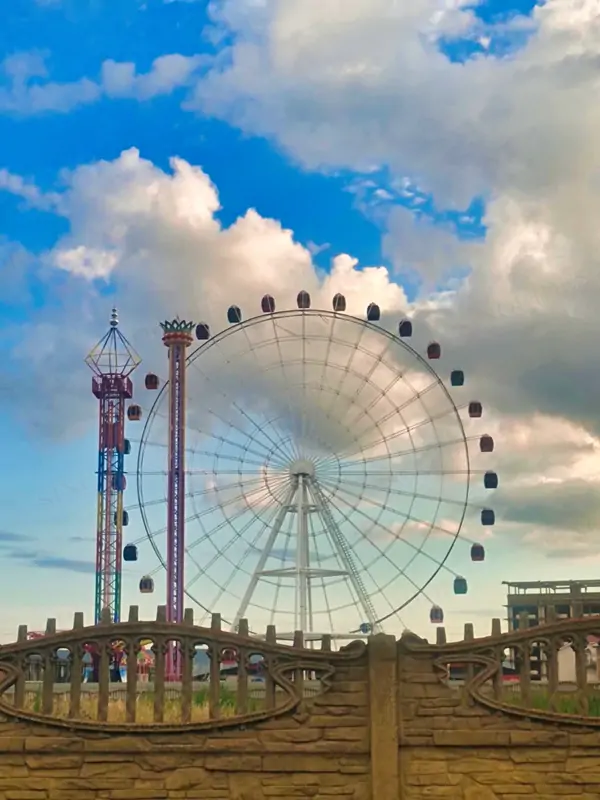
The landmark segment deserves special attention in Russia. A ferris wheel is the classic anchor: the Sun of Moscow, at 140 metres the tallest wheel in Europe, opened at VDNKh in September 2022 with 30 climate-controlled cabins carrying up to 15 guests each and a throughput of about 1,435 people per hour. A wheel of that class is a seven-figure investment, but it also changes a park’s identity and extends the season because cabins operate year-round between −10 and +40 °C.
Chinese manufacturers typically price 30–50% below comparable European equipment at similar CE/ISO compliance levels, which is why they supply a large share of new rides in Russia’s regional markets. Sinorides itself delivered a double-decker carousel, a pirate ship, a 30 m drop tower and an energy storm to Maxim Gorky Central Amusement Park in Russia in 2023 — a typical mix of family anchors and thrill rides for a city park.
For cold climates, ask suppliers for the operating temperature range in writing. Steel grades, lubrication, control electronics and cabin heating all behave differently below −20 °C. The Sun of Moscow wheel was wind-tunnel tested for gusts up to 44 m/s before approval — that is the level of engineering documentation Russian regulators expect, not a marketing brochure.
4. Pekerjaan Sipil & Rekayasa Iklim
Civil works in Russia cost more than the same scope in warmer markets, and the gap is almost entirely climate. Foundations must reach below the frost depth — roughly 1.4–1.6 metres in the Moscow region — and deal with freeze-thaw heaving, which is why ride foundations here are designed, not guessed. How ride foundations are designed matters even more in a market where the soil freezes every year.
Snow load and wind load follow Russian building codes, and utilities have to be sized for winter peak demand. Outdoor parks need drainage and power runs rated for snow removal equipment; indoor parks need the opposite problem solved — heating a large glazed volume. Dream Island’s glass dome covers 8,000 m² and is the largest of its kind in Europe, with 28,000 m² of total roof glazing. That engineering is a big part of why the project carried a $1.5 billion price tag.
Water parks are the extreme case. Most of the capital in a water park goes into pool shells, water treatment, HVAC and humidity control rather than slides. The Aquaparadise complex planned for Russky Island in Vladivostok illustrates the scale: an indoor water park, shopping and entertainment area, sports complex and a Novotel-branded hotel, budgeted at about $70.7 million when announced in 2021.
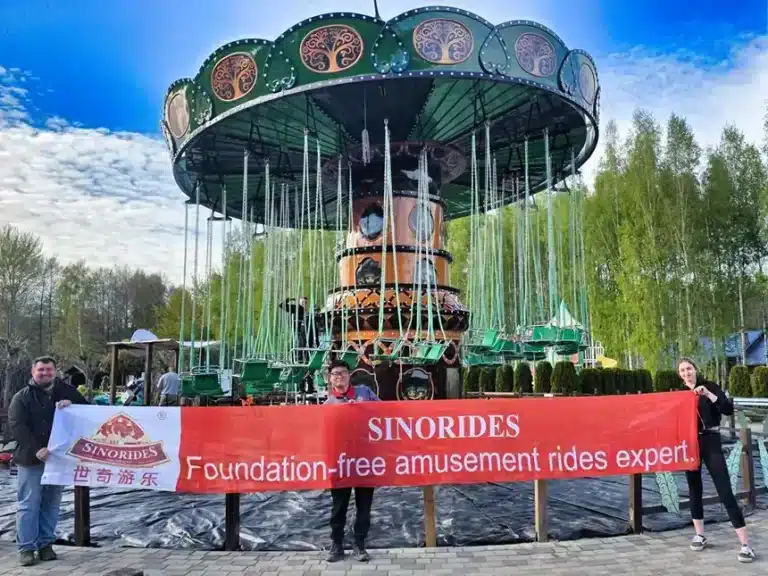
A simple way to control climate risk is to keep outdoor infrastructure light. Foundation-free rides sit on pre-built ballasted platforms and can be relocated or reconfigured between seasons, which cuts site works, shortens permitting and protects the investment if a lease changes. For a leased seasonal park in a regional city, this can reduce the civil-works line by half.
5. Desain & Tema
Theming is where Russian parks spend money differently. Sochi Park built its identity on Russian folklore — the Zhar-Ptitsa drop tower, the Zmey Gorynych coaster, the Vechny Dvigatel pendulum — turning recognizable fairy tales into ride names and sets. Dream Island went the licensed-IP route: nine themed zones built around Smurfs, Hello Kitty, Teenage Mutant Ninja Turtles and Hotel Transylvania, designed by international firms such as Chapman Taylor and Land Milano.
Both strategies carry real costs. Licensed theming adds royalties and approval processes to every design drawing; original folklore theming adds design and fabrication time but no royalties. As a planning range, heavy theming typically adds 10–30% to ride capex, and international design fees can add several percent more on top.
For a first project, the pragmatic middle ground is phased theming: open with clean, branded zones and strong lighting, then deepen the sets as revenue allows. Foundation-free and modular rides make this easier, because the layout is not locked to poured concrete from day one.
6. Import, Customs & Certification
Russia is part of the Eurasian Economic Union (EAEU) together with Belarus, Kazakhstan, Armenia and Kyrgyzstan, and that single market runs on its own safety rulebook. The technical regulation TR EAEU 038/2016 “On the safety of attractions” has been in force since April 2018. Under it, imported rides need an EAC conformity assessment before they can operate — certification for attractions with high biomechanical risk, and a lighter declaration route for lower-risk equipment.
Equipment built to international safety standards gets through faster. CE documentation plus design compliance with EN 13814, ISO 17842 or ASTM F24 gives the certification body a familiar basis for review, which shortens approval time and reduces surprises. Expect to provide a technical passport, operating and maintenance manuals in Russian, and a documented inspection schedule.
On the tax side, imports face Russia’s 20% VAT plus customs duty under the EAEU common tariff; rides manufactured inside the EAEU avoid the duty but not the VAT. With freight across borders, customs brokerage, certification and commissioning, Sinorides advises budgeting 15–30% of the FOB price on top of the equipment invoice. The range is wide because routing matters: delivery to Moscow or St. Petersburg is cheaper than delivery to Vladivostok, and Mengapa harga wahana hiburan bervariasi antar penyedia? goes well beyond the factory price tag.
Since 2022, several European ride makers have suspended deliveries to Russia, and the gap has been filled by Chinese manufacturers and domestic production. For buyers this means two things: verify that the supplier actually ships to Russia today, and check EAC certification readiness before signing — a factory that has already cleared EAEU projects will have the documents ready.
7. Biaya Operasional & Kondisi Ekonomi Musiman
Once the park opens, the monthly bill decides whether the model works. The table below gives in-season operating cost bands — staff, power, heating, maintenance, insurance and lease — for three park formats in 2026 rubles.
| Format taman | Monthly opex in season (USD) | Monthly opex (RUB) |
|---|---|---|
| Small seasonal park | $25K–60K | 2–5M ₽ |
| Taman regional berukuran sedang | $100K–300K | 8–24M ₽ |
| Taman wisata | $1M+ | 80M+ ₽ |
The cost structure is consistent across formats: staff takes 35–45% of opex, power and heating 15–25%, maintenance 3–5% of equipment value per year, and the rest goes to insurance, lease and marketing. A maintenance checklist that extends ride life is not an expense line to trim in a country where equipment sits idle for half the year — winter storage and restart procedures are part of the operating plan, not an afterthought.
Season economics is where Russian parks live or die. An outdoor park in central Russia gets roughly May to September — five months, sometimes six in a warm year. Southern parks in Sochi and Krasnodar stretch to seven to nine months. Indoor parks break the calendar entirely: Dream Island runs year-round under its dome, and the Sun of Moscow wheel operates down to −10 °C, capturing the city’s New Year holiday traffic when outdoor parks are closed.
Ticket pricing gives a sense of the revenue per guest. Dream Island opened with adult tickets at 2,900 RUB and children at 2,600 RUB, with a paid fast-pass option around double that. The Sun of Moscow charges from 1,350 RUB per ride. A seasonal park that prices lower but runs five months has to move far more guests to reach the same annual revenue.
8. ROI & Payback
Payback in Russia follows the same law as everywhere else: the shorter the season, the harder the math. Well-located small parks on leased land typically break even in 2–4 years. Mid-size regional parks run 4–7 years. Destination projects and indoor flagships run 8–12 years or more — Dream Island’s $1.5 billion price tag was always a long-horizon bet on Moscow’s catchment, not a quick return.
Revenue mix is the lever operators control. Tickets and ride passes anchor the model, but food and beverage typically carries 25–30% margins and smooths per-visitor spend. Corporate events, birthday packages, school programs and annual passes fill the shoulder months. In winter markets, renting the park for New Year festivals and private events can convert an idle asset into a second season.
The most reliable ROI strategy in Russia is phased development. Open with six to eight strong wahana keluarga, prove the catchment for a season, then add thrill rides and a landmark wheel or coaster as revenue and visitor data justify it. Each phase self-funds the next, and the park keeps a fresh marketing story every year.
9. How to Cut Costs Without Cutting the Park
A Russian park budget can be compressed by 30–50% without changing the guest experience much — the savings come from structure, not from buying worse rides. The levers that work in this market:
- Lease municipal land at auction instead of buying commercial plots.
- Build in phases; open with a core mix, add annually.
- Pilih wahana bebas alas bedak to cut civil works and speed permits.
- Source directly from factories and standardize ride platforms.
- Combine indoor and outdoor zones to extend the season.
- Design for energy efficiency: LED lighting, heat recovery, winterized cabins.
- Bundle installation, certification and staff training into the supply contract.
The cheapest square metre in any Russian park is the one you do not build. A seasonal park that rents marquees and uses foundation-free rides can open a full season of operation for a fraction of a permanent construction budget — then reinvest the difference in the rides guests actually remember.
Pertanyaan yang Sering Diajukan
Dapatkan perkiraan biaya khusus untuk lokasi Anda
Sinorides helps park developers across Russia and the EAEU plan ride mixes, budgets and phased rollouts — from a single ferris wheel to a complete wahana taman hiburan Paket. Kirimkan luas tanah, kota, dan anggaran yang Anda targetkan untuk mendapatkan rencana perlengkapan gratis.
Tentang Sinorides
Sinorides (Henan Swonder Amusement Rides Co., Ltd.) has manufactured amusement rides since 1992 and delivered projects for more than 1,200 parks worldwide, including operators across Russia, Central Asia and other cold-climate markets. The range covers family rides, thrill rides, ferris wheels, roller coasters, trackless trains, bumper cars and kids’ rides, with CE certification, ISO systems, custom theming, installation guidance and after-sales support. Foundation-free solutions cut installation time by 40–60% — an important option for leased and seasonal sites. This article is educational content; ride prices and project budgets vary by specification, site and market conditions, and final costs should always be confirmed with suppliers and local authorities. See bagaimana Sinorides memproduksi dan memasang wahana untuk referensi proses dan proyek.
Verifiability note: Russia project figures (Dream Island, Sochi Park, Sun of Moscow, Aquaparadise, Eurasia Park Bishkek, Magical World of Russia) come from published sources: Daily Sabah (2019), Blooloop (2021), Global Construction Review (2016), The Times of Central Asia (2025) and Wikipedia. The exchange rate was taken from public market data in August 2026 (about 81 RUB per USD). Park cost bands, ride prices, opex shares, VAT treatment and payback periods are industry planning ranges based on supplier experience; VAT, duties and certification requirements should be confirmed with customs brokers and certification bodies before budgeting. Estimates and judgment are marked as such in the text.