Building an amusement park in Kyrgyzstan costs roughly $300,000–1.5 million (26–131 million KGS) for a compact seasonal park on leased land, $1.5–5 million (131–438 million KGS) for a small family park, $6–25 million (525 million–2.2 billion KGS) for a mid-size regional park, and $50–300 million+ (4.4–26 billion+ KGS) for a destination project on the scale of the announced Tokmok theme park. Land takes 15–25% of capital, rides and attractions 30–40%, civil works, climate and seismic engineering 20–30%, design and permits 5–10%, and pre-opening operations 10–15%. Family rides cost $100,000–500,000 each, thrill rides $500,000–3 million, and landmark rides such as ferris wheels and roller coasters $1–20 million. Imported rides face Kyrgyzstan’s 12% VAT, the EAEU common customs tariff and TR EAEU 038/2016 safety certification. The outdoor season in Bishkek runs roughly seven months, April to October; small parks on leased land typically break even in 2–4 years, destination projects in 8–12 or more.
İçindekiler
Introduction: The Mountain Republic’s Price Question
Ask three consultants what it costs to build an amusement park in Kyrgyzstan and you will get three different answers. That is normal. The honest answer is a range, not a number. The country has just over 7.4 million people, with Bishkek close to 1.2 million and Osh, the southern anchor, around 320,000. Family demand is real, but the gap between a rented seasonal park and a 50-hectare destination project is more than a hundredfold in capital.
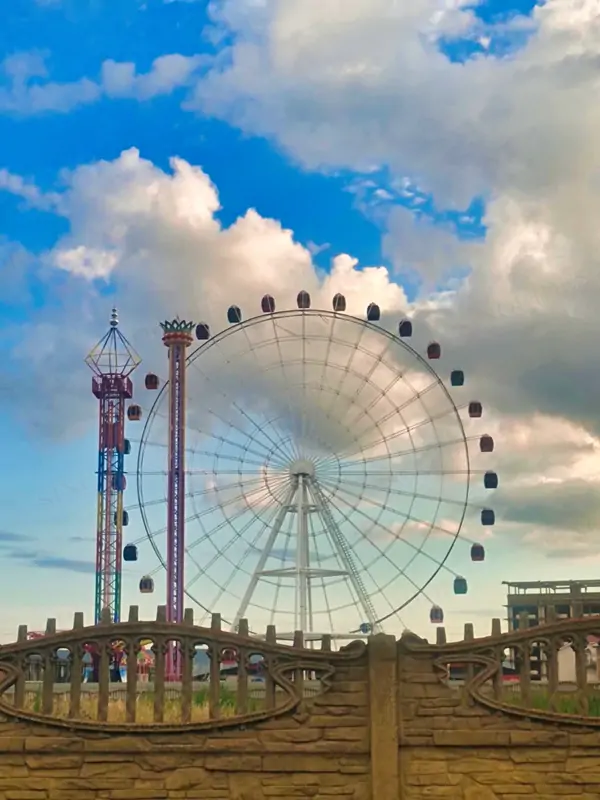
Tourism is the tailwind. The State Agency for Tourism Development reports arrivals climbed from 8.5 million in 2023 to almost 10 million in 2025, and the president has spoken publicly of 13 million. Issyk-Kul pulls the summer crowds; Bishkek and Osh carry the year-round population. Two public projects frame the price spread. In Tokmok, about 60 kilometers east of Bishkek, a memorandum signed in August 2025 allocates a 50-hectare plot for a theme park developed by the U.S. firm IdeAttack, with themes built on the Epic of Manas and the Great Silk Road. At the other end, a Chinese supplier documented an 8,000 m² non-powered family park delivered in Kyrgyzstan in late 2025. Same country, completely different budgets.
What drives the price? Four variables matter more than anything else: land strategy, ride mix and quality tier, scale, and how much you build at once. In Kyrgyzstan a fifth one sits on top: the terrain. This is a mountain republic in the seismically active Tien Shan belt. Earthworks, seismic foundations and winterization change both the build cost and the calendar. And because foreign investors generally cannot own land here, the lease model shapes every budget from day one. Figures in this guide are planning ranges in USD and som, converted at roughly 87.5 KGS per USD (the August 2026 market rate). They are bands for budgeting, not quotations. Where you see a link to Lunapark Ekipmanları, it points to the equipment category discussed nearby.
In project experience, equipment is rarely the reason a Kyrgyz park opens over budget. The usual culprits are land and permit timelines, mountain-terrain earthworks, seismic foundation surprises, currency swings on imported rides, and underestimating the working capital needed to survive the first winter. Budget at least 10–15% contingency as a line item, and settle the season plan before you order steel.
1. Park Büyüklüğüne Göre Toplam Yatırım
The fastest way to anchor a budget is to pick a format. The table below groups realistic 2026 capital costs — land preparation, rides, civil works, design, permits and pre-opening setup — by park size. The per-ride budget matters more than the headline number: two parks with the same total can look completely different if one buys ten cheap rides and the other five solid ones.
A few observations from delivered projects in the region. Compact parks on leased land open fastest and test the market with the least risk; the trade-off is a short season and a ceiling on ticket revenue. Mid-size parks are where most serious regional investors land — enough rides to justify marketing spend, small enough to build from one financing round. Destination parks in Kyrgyzstan are a different animal entirely: they depend on tourism flows, resort infrastructure and policy backing, not just weekday footfall. The Tokmok project is being planned in exactly that logic.
Build time deserves the same respect as capital. A small park that misses its opening season loses a full year of revenue, not a quarter. In Kyrgyzstan, where the outdoor window is roughly April to October in Bishkek, a nine-month build started in autumn often means waiting until the following spring to open — the extra months are cheaper than a rushed winter install.
2. Land & Location: Bishkek, Osh, Issyk-Kul or the Regions
Start with a legal fact that surprises most first-time investors: under Kyrgyz law, foreign persons generally cannot own land in the country. They can lease and use non-residential land, in permitted cases for periods up to 50 years. That is why almost every modern park project in Kyrgyzstan runs on a lease model — municipal or state plots at auction, private leases near city limits, or government-backed allocations for strategic tourism projects.
Where you sit in the country changes the whole equation. Bishkek and the Chui Valley carry the deepest catchment: a city of 1.2 million plus a dense commuting ring, and a culture of weekend family outings that shopping malls already monetize. Osh anchors the south with a younger, fast-growing urban population and access to the Fergana Valley market. Issyk-Kul offers something different again — not year-round population but a concentrated summer tourism season that a resort-format park can capture, with hotel partners and day-trip buses. Regional towns such as Jalal-Abad and Karakol come in with the lowest land costs and the longest wait for traffic to build.
What does land actually cost? State and municipal lease rates are set by auction and are modest in regional areas — the expensive line is not the rent but the site work. Leveling mountain foothills, bringing water and power to a plot, building access roads and parking can add $200,000–2 million to a mid-size project, and that range sits squarely inside the 15–25% of capital that land and site development typically absorb in this region’s park budgets. Verify zoning for amusement use before bidding, not after.
For a first project, negotiate a lease with a renewal clause and an exit option. A well-located seasonal park that can be moved or scaled beats a permanent site that eats the whole budget before the first ticket is sold. Leased land is also the natural fit for foundation-free rides, which can relocate if the lease changes.
3. Rides & Attractions: Where the Money Goes
Rides are the heart of the budget and the biggest single line: typically 30–40% of total capital. The table below gives planning ranges per ride type, in USD and som. The spread within each tier is real — a 30-meter drop tower and a 50-meter ferris wheel are both “thrill” or “landmark” rides, but they sit at opposite ends of the price scale.
A balanced Kyrgyz park follows the same logic as parks across Central Asia: a handful of family rides to carry weekday traffic, one or two thrill rides for young adults and evenings, and a signature landmark — usually a ferris wheel or a family coaster — that gives the park a skyline and a reason to visit. The landmark does not need to be the most expensive option; a 36-seat flying chair or a 30-meter drop tower can play the anchor role in a compact park.
Cold-climate and Central Asian operators are a familiar reference point. Sinorides supplied Firdavsi Park in Tajikistan in 2019 with a carousel, bumper cars, a mini shuttle and family flat rides, and in 2024 supplied New World Amusement Park in Tajikistan with a 40-seat pirate ship, a 23-car pendulum and a ferris wheel. In Mongolia, a shopping-mall park took a wacky worm roller coaster in 2018. These are the ride mixes and delivery patterns that work in markets with short summers and strong family demand.
One budgeting habit separates good projects from bad: never price rides on the FOB figure alone. Freight to a landlocked country, customs, certification and commissioning add 10–25% on top of the factory price, and that add-on behaves differently for a 500-kilogram kiddie ride than for a 50-meter wheel. More on this in the import section below.
4. Civil Works, Mountain Terrain & Seismic Engineering
This is the section where Kyrgyz projects differ most from flat-country parks. The country sits in the seismically active Tien Shan belt, so foundations for large rides follow engineering practice for dynamic and seismic loads — the same load philosophy behind EN 13814 and ISO 17842 on ride safety, applied to local construction codes. Site terrain matters as much as the seismicity: foothill plots need leveling and retaining walls, and mountain-valley sites can face drainage and groundwater questions that a flat greenfield site never asks.
Climate adds the second layer. Bishkek has a continental climate with July highs around 31°C and January highs near 3°C — cold enough to demand winterization of mechanical rides, frost-depth foundations and snow-load calculations, but milder than Astana or Siberian markets. Utilities are part of the same story: power supply for rides, lighting and heating has to be confirmed with the local grid operator early, because rural and foothill connections can be slow.
These shares are planning ranges, not fixed rules. A compact park on a flat municipal plot may spend far less on civil works; a foothill site with rock and slope problems can blow past 30%. The reliable move is to get a geotechnical survey before the master plan, and to see how ride foundations are designed for different soil and load conditions.
Seismic and frost design is not a place to save money. Under-specified foundations on heaving or unstable ground are the classic reason a mid-size park’s opening slips a full season. For leased or seasonal sites, foundation-free ride systems avoid poured concrete entirely and relocate with the lease — a practical hedge in a market where most foreign investors lease.
5. Design, Theming & Engineering
Kyrgyzstan has a storytelling advantage most markets would pay for. The Epic of Manas, the Silk Road and nomadic culture give any park an instant, locally rooted theme — the Tokmok project is explicitly built on them, with themed zones, live shows and master classes in yurt-making and felt crafting. Theming like that is not decoration; it is what separates a park from a parking lot with rides.
Budget for design and theming at 5–10% of capital, and spend it in the right order: master plan first, then ride layout and circulation, then theming that can be staged. A modest first phase with strong signage, shade, planting and a landmark ride reads far more professional than a bare field with ten unthemed rides. Every extra hour a family stays in the park adds food and beverage spend — which means shade, seating and queue design are revenue decisions, not costs. A themed indoor hall doubles as winter capacity and a rainy-day offer, which matters in a country with a short outdoor season.
Engineering is the less glamorous half of the design budget: structural design for seismic loads, electrical planning for rides and lighting, drainage and landscaping, and accessibility. International ride suppliers deliver equipment certified to CE, EN 13814, ISO 17842 or ASTM F24 standards; local engineering then adapts foundations and site work to Kyrgyz codes and site conditions.
The parks that struggle in this region are rarely the ones with the wrong rides. They are the ones with dead zones: paths that lead nowhere, queuelines in full sun, a food court at the far end of the park. A good master plan costs a few percent of the budget and decides the other ninety-five.
6. Import, VAT, EAC Certification & Logistics
Kyrgyzstan is a member of the Eurasian Economic Union (EAEU) since 2015. For an importer that means two practical consequences. First, goods from outside the union — including China, the main source of amusement equipment — pay the EAEU common customs tariff, and the Kyrgyz market applies its standard VAT of 12% on imports. Second, amusement rides fall under the union’s technical regulation TR EAEU 038/2016 on the safety of rides, which requires EAC conformity assessment before the equipment can operate.
The certification path deserves planning, not surprise. Rides built and documented to EN 13814, ISO 17842 and ASTM F24, with CE files in order, have a materially shorter route to EAC approval because the technical evidence already exists. Ask suppliers which of their export models carry EAC documentation already — several Chinese manufacturers certify their standard models for the EAEU market, which saves both time and money.
Logistics is the third line item. Kyrgyzstan is landlocked: sea freight from Chinese ports is followed by rail or truck through Kazakhstan or China’s western gateways to Bishkek. Plan for 10–25% above FOB price covering freight, customs duty, VAT cash-flow, certification and commissioning, and remember that large rides arrive as multiple containers and need cranes and assembly crews on site. If you are comparing factory prices, look at the delivered, certified, installed cost — that is the number that matters. See why Eğlence parkı atraksiyonlarının fiyatları tedarikçilere göre değişiklik gösterir before you choose.
Put certification and documentation into the supplier contract. A package that includes EAC documentation support, installation supervision and spare parts is worth more than a lower FOB price with none of it. And keep a 10–15% customs and clearance buffer in the schedule — border clearance surprises happen in every landlocked market.
7. Seasonal Economics & Operating Costs
Season is the hidden variable in every Kyrgyz budget. In Bishkek, the outdoor operating window runs roughly seven months, April to October; Issyk-Kul concentrates most of its visitors into the summer months; winters are for indoor entertainment. That calendar forces two decisions early: how much of the year the park will earn, and what the park does with the months it cannot.
Operating costs follow the same shape. A small seasonal park pays its team and power only across the season; a park with an indoor hall carries year-round staff and heating but earns year-round revenue. Monthly planning ranges below are in-season figures for parks in the Kyrgyz market context — the same order of magnitude as comparable Central Asian parks, scaled to local wage and utility levels.
Maintenance deserves its own line: 3–5% of equipment value per year is the working standard for mechanical rides, more in the first season while crews learn the equipment. Winter storage is a real cost too — covers, lubrication, battery and hydraulic winterization, and a spring commissioning round before opening. A disciplined maintenance regime is the difference between a ride that runs ten seasons and one that fails in the third. See the eğlence ekipmanları bakım kontrol listesi used by operators to extend ride life.
An indoor hall is the standard winter hedge in this market, but it does not have to be a full indoor park. A themed family hall with a carousel, soft play and a food court can carry 30–50% of annual revenue in the off-season, and it doubles as the rainy-day offer in summer. It also keeps key staff employed year-round, which protects the maintenance program.
8. ROI, Revenue Models & Financing
Profitability in Kyrgyzstan follows a simple pattern: location and repeat visits decide everything. A well-run compact or small park on leased land in Bishkek typically reaches break-even in 2–4 years. Mid-size regional parks run 4–7 years. Destination projects on the Tokmok scale operate on tourism and resort economics and are usually judged over 8–12 years or more — the ride tickets are only part of the story, with hotels, retail, events and adjacent development carrying the long-term return.
A planning model for a Bishkek family park might look like this — and these are assumptions to test, not market data. Say 150,000–350,000 visits in a season, an average spend of 500–900 som per visitor across tickets, food and small retail, and a season that runs April to October. That yields a revenue band of roughly 75–315 million som (about $0.9–3.6 million) per season before costs. The levers that move this number are dwell time, annual passes, school programs, corporate events and the indoor hall — not the price of the ferris wheel.
Financing shapes the plan as much as revenue does. The U.S. State Department’s investment climate report for the Kyrgyz Republic notes dollar loan rates in the 10–20% range and a domestic lending rate that has hovered near 20% — expensive money by any standard, which pushes developers toward staged builds and milestone payments. A common payment schedule with Chinese suppliers is 30% at order, 40% during production, 20% before shipment and 10% after installation. That structure reduces upfront strain and ties payments to progress. Development funds and government-backed tourism programs add options for larger, policy-aligned projects.
Revenue diversity is not optional. Ticket income alone rarely covers a park in a seven-month season; food and beverage margins of 25–30%, annual passes, school and birthday programs, and event rental fill the gap. That is why the ai̇le gezi̇leri̇ range anchors most weekday traffic — the equipment mix and the revenue model are designed together, not separately.
Build the financial model around weekend peaks, school holidays and Nowruz in March. A park that hosts 3,000 visitors on a Saturday but only 300 on a Tuesday needs pricing, passes and programs that shift demand — not more rides.
9. Government Support & Tourism Policy
Kyrgyzstan treats tourism as a national priority, and the numbers back the policy: arrivals nearly doubled from 8.5 million in 2023 to close to 10 million in 2025, and the president has publicly claimed 13 million. The government has backed this with visa-eased entry for dozens of countries, tourism infrastructure programs and a Tourism Development Support Fund — the same fund that signed the memorandum for the Tokmok theme park alongside the district administration and IdeAttack, with a 50-hectare plot allocated for the project.
For a private investor, government support shows up in three practical forms: land access for strategic projects, co-investment or development funds for tourism-aligned ventures, and policy signals that keep tourism growth on the national agenda. Regional administrations want projects that create jobs and anchor tourist zones, and a park that fits that frame has a better negotiating position on lease terms and approvals.
Hidden costs to budget from day one, regardless of support: land registration and notary fees, VAT cash-flow during construction, utility connection charges, pre-opening payroll and marketing for the first season, and the 10–15% contingency that should be a line item, not a rounding error.
Policy support accelerates projects, but it does not replace due diligence. Treat every government commitment as a starting point for negotiation, not a guaranteed timeline, and keep the financial plan viable without it.
10. Eight Ways to Cut Costs Without Cutting Quality
The spread between a $1.5 million park and a $5 million park with similar rides is mostly decisions, not luck. These eight levers are the ones operators actually use in this region:
Municipal leases cut upfront capital dramatically and keep cash for rides. Verify zoning for amusement use before bidding.
Open with 6–8 core rides, then add one signature attraction every 12–18 months from cash flow.
No concrete curing in cold ground, 40–60% faster installation, and equipment can relocate if a lease ends. See vakifsiz sürüşler.
Direct exporters undercut intermediaries by 15–30% at similar CE/ISO compliance levels. Ask for certifications and references.
Fewer ride models mean shared spares, simpler staff training and cheaper maintenance contracts.
An indoor hall carries winter revenue and extends the season without a full indoor-park budget.
LED lighting, inverter drives and insulated buildings cut the power bills that eat 15–25% of opex.
Installation supervision, EAC documentation support, training and spares vary widely between suppliers — get them in writing.
Used together, these levers typically cut initial capital by 30–50% compared with a one-shot, turnkey, all-land-owned approach. They do not cut quality; they cut waste, timing risk and financing cost.
11. What Kyrgyz Projects Tell Us
The announced and delivered projects point to three distinct market tiers. The Tokmok theme park shows the destination tier: a 50-hectare, government-backed project with cultural theming, resort ambitions and international design input. The 8,000 m² non-powered family park documented by Sinorides shows the community tier: compact, low-maintenance, built for families and resorts. And the urban tier — shopping-mall entertainment centers and city parks in Bishkek and Osh — shows what year-round formats look like in a market with a short outdoor season.
For an investor entering Kyrgyzstan, the pattern is encouraging: demand is growing, policy is supportive, and the supply of modern family parks remains thin. The parks that win will be the ones that match scale to catchment, respect the terrain and the season, and buy equipment that can be certified, installed and maintained locally — not the ones that spend the most. The same logic has played out in neighboring markets; see the cost guide for Özbekistan’da bir eğlence parkı inşa etmek for a close regional comparison.
12. Sıkça Sorulan Sorular
Mekana özel bir maliyet tahmini alın
Sinorides helps park developers across Kyrgyzstan and Central Asia plan ride mixes, budgets and phased rollouts — from a single ferris wheel to a complete eğlence parkı ekipmanları paket. Ücretsiz bir ekipman planı almak için arsa büyüklüğünüzü, şehrinizi ve hedef bütçenizi bize bildirin.
Sinorides Hakkında
Sinorides (Henan Swonder Amusement Rides Co., Ltd.) has manufactured amusement rides since 1992 and delivered projects for more than 1,200 parks worldwide, including operators across Central Asia and cold-climate markets. The range covers family rides, thrill rides, ferris wheels, roller coasters, trackless trains, bumper cars and kids’ rides, with CE certification, ISO systems, custom theming, installation guidance and after-sales support. Foundation-free solutions cut installation time by 40–60% — an important option for leased and seasonal sites. This article is educational content; ride prices and project budgets vary by specification, site and market conditions, and final costs should always be confirmed with suppliers and local authorities. See Sinorides’nin lunapark oyuncaklarını nasıl ürettiği ve kurduğu süreç ve proje referansları için.
Verifiability note: Kyrgyzstan figures (population, tourism arrivals, exchange rate, EAEU membership, land rules, loan rates, Tokmok and non-powered park projects, Bishkek climate) come from published sources cited in the knowledge-base archive. Park cost bands, ride prices, opex shares, season lengths and payback periods are industry planning ranges; confirm with suppliers and local authorities before budgeting.