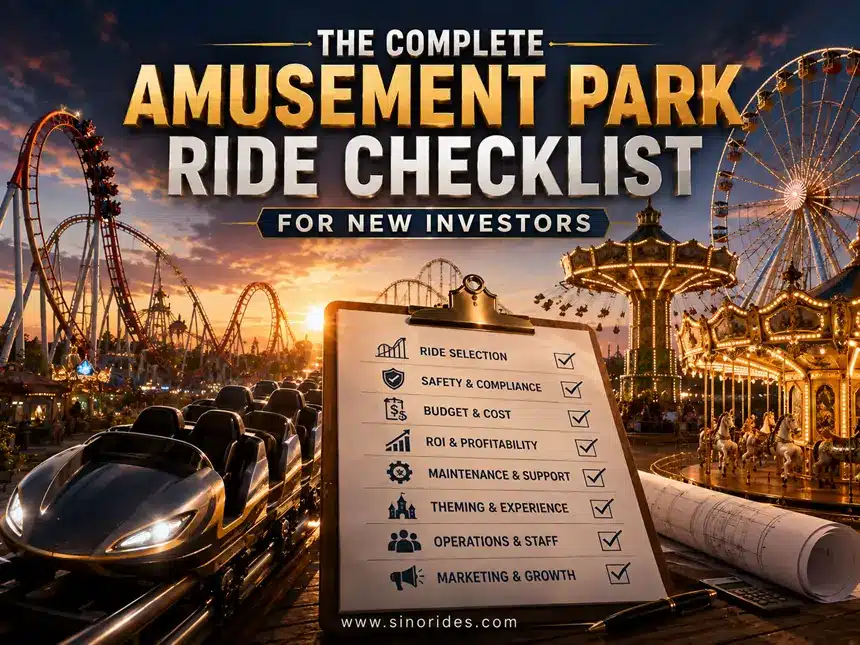
A new amusement park typically needs three ride layers: family anchor rides (carousel, ferris wheel, trackless train, flying chairs), thrill rides for teenagers and adults (drop tower, pendulum, pirate ship, roller coaster), and kids’ rides (bumper cars, self-control planes, small coasters). A small outdoor kids’ park runs on roughly $80,000–$300,000 of equipment, a medium urban park $300,000–$1,200,000, and a large park $2,000,000 or more. Every ride should carry CE or equivalent certification, a documented maintenance plan, and a supplier that provides installation drawings and after-sales support. Start with high-capacity, low-maintenance rides, and leave 15–25% of the equipment budget for shipping, installation, foundations, and spare parts.
1. Why an Ride Checklist Matters More Than a Shopping List
Most new park investors start with a wish list: the biggest ferris wheel they can afford, a roller coaster that looks spectacular on video, and a few classics. Then reality arrives in three forms — the budget, the site, and the operating cost.
Ride is not one purchase. It is a chain of purchases: the ride itself, the shipping, the foundation or base frame, the installation crew, the electrical connection, the spare parts, the operator training, and the maintenance program that keeps the ride safe for the next fifteen years. Miss one link and the chain breaks — usually at the worst moment, like a permit that holds up a crane, or a missing spare part that takes a ride offline for two weeks in peak season.
A checklist exists to catch those links before money moves. It forces decisions in the right order: what kind of park, for which guests, at what budget, with what standards, from which supplier. This guide follows that order, and it is written for Themenpark-Fahrgeschäfte of every scale — from a mall kids’ corner to a destination park.
Industry insight: across more than a thousand delivered projects, the parks that open late are rarely the ones that bought “wrong” rides. They are the ones that skipped a step — a site survey, a certification check, a spare-parts order, or an installation plan — and paid for it later.
Treat this article as a decision tool, not a template. Park conditions differ by country, climate, and audience, so use the checklists to ask sharper questions of every supplier you talk to.
2. Start With Park Type, Not Rides
The Ride list follows from the park type. A mall indoor playground, an outdoor family park, and a thrill-focused destination need completely different mixes. Defining the type first also sets the budget band and the guest profile, which is what suppliers use to recommend equipment.
1) Who are the main guests — families with young kids, teenagers, or mixed? 2) How many visitors per day does the business plan need to break even? 3) Does the site have indoor space for rainy or cold months?
Mixed parks usually out-earn single-audience parks. Families come for the kids’ rides, stay for the train and carousel, and the teenagers drag parents toward the drop tower. A balanced mix creates multiple ticket and F&B touchpoints.
The budgets above are market ranges from recent small and medium park projects, not quotes. Final numbers depend on ride sizes, themes, and supplier terms — the point of the ranges is to size the plan before you start negotiating.
3. The Core Ride Mix, Category by Category
A workable first park usually runs 6–12 rides. Fewer than six and the park feels thin; more than twelve and the operations, maintenance, and staffing load grows faster than revenue. The mix below is the standard pattern across successful small and medium parks.
The rides everyone can ride. They drive the largest share of riders and are the easiest to operate and maintain.
Carousel (24–40 seats), ferris wheel, trackless train (16–24 seats), flying chair (24–36 seats).
The visual and emotional hooks. One or two thrill rides give a park its identity and photo moment.
Drop tower (18–30 m), pendulum, pirate ship (36–40 seats), family or thrill roller coaster.
Low-cost, high-occupancy rides that keep younger guests busy while parents watch siblings on bigger rides.
Bumper cars, self-control planes, small coasters, spinning cups, kangaroo jump, mini ferris wheels.
3.1 Family anchor rides
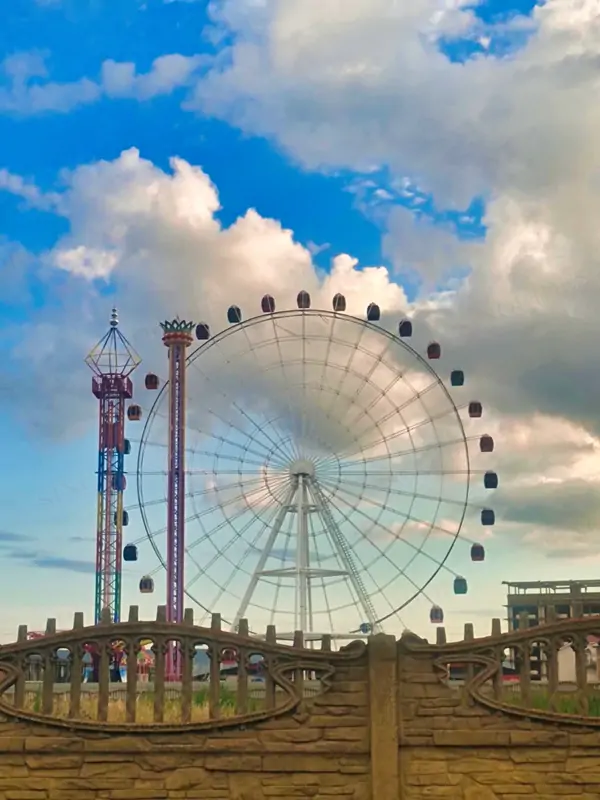
Family anchors are the revenue backbone. A carousel is cheap to run, quiet on maintenance, and photogenic — three qualities that explain why it appears in almost every successful family park. A Riesenrad adds a skyline landmark that works as a marketing asset from kilometers away. Schienenlose Züge double as transport between zones, which keeps guests inside the park longer. Fliegender Stuhl rides are the bridge between family and thrill — gentle enough for most guests, exciting enough to fill a plaza.
For capacity planning, think riders per hour, not just seats. A 36-seat flying chair cycling every 3–4 minutes moves roughly 500–700 riders per hour; a carousel similar. Multiply by ticket price and you get the real revenue story — this is where Familienausflüge usually out-earn thrill rides on a per-dollar basis.
Field note: a 2024 Tajikistan project — New World Amusement Park — opened with a ferris wheel, carousel, bumper cars, and a self-control plane alongside its bigger pendulums. The classic family units carry the daily crowd; the thrill rides carry the weekend buzz.
3.2 Thrill rides
Thrill rides sell tickets to teenagers and young adults — the group that otherwise leaves a family park after an hour. One signature ride is enough for a first park. A Freifallturm in the 18–30 m range gives a strong visual and a short queue time. Fahrten mit dem Pendel und Seeräuberschiffe deliver the same crowd with lower height requirements and simpler foundations. A family Achterbahn stretches the age range from eight-year-olds to grandparents.
The honest advice on thrill rides: add them after the park has a proven crowd, or start with one. They cost more per rider, demand stricter inspection, and consume more power and maintenance hours than classics. Their real job is differentiation and marketing, not daily volume.
3.3 Kids’ rides
Kids’ rides are the entry point of the whole business — parents follow their children. A compact Kinderfahrgeschäfte zone with bumper cars, mini planes, and a small coaster gives the youngest guests ownership of the park, which converts into repeat visits. Autoscooter deserve a special mention: they are high-capacity, easy to operate, and one of the fastest-payback rides in the industry.
Check the height and age restrictions of every kids’ ride before buying — they must match the local market’s family profile. A park that serves mostly families with toddlers needs more gentle units; a park near a school district can push toward slightly bigger thrills.
3.4 Non-ride Ride people forget
Ticket booths and gates, queue fencing, lighting, sound systems, benches, shade structures, waste bins, first-aid points, CCTV, and a small workshop for daily checks. These are 5–10% of the Ride budget and they decide whether a park feels organized or chaotic. Operators who skip them end up buying them at retail prices mid-season, under time pressure.
4. Ride Selection Criteria That Decide Revenue
Beyond “do guests like it,” five criteria separate a profitable ride from a costly one. Run every candidate through them.
Tipp vom Experten: ask for the ride’s technical file before purchase — power draw, noise level, operating temperature range, and swept-area drawings. If a supplier hesitates on the technical file, that is a signal. The documents are part of the product, not a favor.
Climate deserves special weight for export projects. A park in Central Asia or Russia needs Ride specified for sub-zero winters — low-temperature hydraulic fluids, insulated seals, cold-resistant paint — while a tropical park needs heat and humidity-rated electrical components. The same model from the same factory can differ in spec; make the climate requirement part of the contract, not a conversation.
5. Budget and Cost Checklist
Ride prices vary widely by size, theme, and supplier — the same family coaster can quote $10,000 and $100,000 depending on length, theme, and certification level. Below are typical market ranges for common units, followed by the costs every new investor forgets.
Prices are market estimates compiled from recent small and medium park projects; exact quotes depend on size, theme, certification, and shipping distance. Read more on Warum die Preise für Fahrgeschäfte je nach Anbieter variieren before comparing offers.
The hidden 15–25%
Sea freight, port handling, customs duties, inland trucking, and oversized-load permits for tall or wide rides.
Typically 5–15% of Ride price, more for complex rides — cranes, crew, and commissioning included.
Concrete, rebar, anchor bolts, electrical supply, and drainage — significant for big rides unless you choose foundation-free designs.
First-year spare kits, lubricants, lights, and themed paint touch-ups. Order spares with the ride, not after a breakdown.
A safe rule for first-time investors: plan the Ride budget, then add 15–25% on top for everything above. Parks that respect this buffer open on time; parks that don’t borrow mid-project at bad rates.
6. Safety, Certification, and Documentation Checklist
Certification is not paperwork — it is the difference between a supplier that designs for safety and one that designs for price. For export Ride, the standards that matter most are CE (EU conformity), EN 13814 (fairground and amusement ride safety), ASTM F24 (the U.S. committee standards such as F2291 and F1193), ISO 17842, und GOST/EAC for the Russian and Eurasian markets. A deeper reference is available in the ASTM and EN 13814 amusement ride safety standards guide.
CE declaration or equivalent certificate; test and inspection reports; structural and electrical drawings; operation and maintenance manuals; warranty terms; and the ride’s technical file.
Third-party inspection (SGS, TÜV, or local authority), load and safety-device testing, electrical verification, staff training records, and the local operating permit.
Daily pre-opening checks, periodic inspections per local rules, maintenance logs, and incident records kept for the ride’s entire service life.
Warnung: certificates travel with the Ride, not with the salesperson’s promises. Ask for the certificate number, the issuing body, and the exact model it covers, then verify it with the issuing body or a third-party inspector before you pay in full.
Local rules always win. The same ride may need different documentation in the EU, the Gulf states, Russia, or Southeast Asia. Ask your supplier for a compliance checklist for your specific destination market, and have a local lawyer or inspector review it.
7. Installation and Site Readiness Checklist
Installation planning starts at purchase, not at delivery. The full process — site survey, foundations, lifting, assembly, wiring, and commissioning — is covered in depth in the how to install amusement rides guide. For the checklist, lock down these items before the first crate arrives:
Soil report, drainage, underground utilities, and access for delivery trucks and cranes. Verify dimensions against swept-area drawings.
Fixed rides need engineered concrete with anchor bolt templates; curing takes 7–28 days. Fahrten ohne Fundament sit on flat hard ground and can cut installation time by 40–60%. See the Leitfaden zum Fundamentbau for soil and concrete parameters.
Crane reach and capacity for towers and wheels; clear route from port to pad; oversized-load permits booked in advance.
Power supply sized for peak load, water/drainage where needed, and all construction and operating permits approved before the crew arrives.
A simple test of installation readiness: can a delivery truck reach the ride pad on the day the crane is booked? In field experience, missed crane windows and foundation rework are the two most common reasons parks open late — rarely the Ride itself.
Ask the supplier who supervises installation, what training they provide, and whether the quote includes on-site supervision. For first-time investors, manufacturer-supervised installation is worth the cost on any ride taller than ten meters.
8. Maintenance, Spare Parts, and Lifecycle Checklist
The purchase price is the entrance fee; maintenance is the membership. A structured program — daily pre-opening checks, weekly inspections, monthly greasing and torque checks, and annual third-party inspection — keeps rides safe and extends their working life. The Checkliste für die Wartung von Fahrgeschäften breaks the full routine down by interval.
Buy a first-year spare kit with each ride: bearings, seals, belts, lights, and control-board spares. Lead times for international shipping can stretch to weeks.
Two or more operators trained per ride, plus one local technician who understands the electrical cabinet and safety devices.
A cheap ride with no spare support can cost more in downtime than a well-built ride with a documented parts network. Judge price over 10 years, not 10 minutes.
Keep every manual, certificate, inspection report, and maintenance log from day one. Insurers and inspectors ask for them, and a complete file adds resale value if the park is ever sold.
9. Supplier Evaluation Checklist
For a first park, the supplier is almost as important as the Ride . Use this eight-question checklist on every shortlisted manufacturer:
Reference projects matter more than brochures. Ask for parks in your region or climate band, then verify the Ride actually runs there — a delivered ride is proof; a rendering is not. For insight into how a manufacturer builds and ships, see how Sinorides produces and installs amusement rides.
Beware the “everything included” quote that arrives with nothing specified. A professional offer itemizes Ride , shipping, installation, training, spares, and warranty. If a quote cannot be itemized, the risks are simply hidden in the price.
10. A Three-Phase Purchase Plan
Buying everything at once maximizes risk and cash-flow pressure. The pattern below staggers purchases so the park opens complete but the investor keeps control:
Family anchors plus two kids’ rides. This set defines the park’s identity and generates the cash flow that funds Phase 2.
One signature thrill ride and one high-capacity classic (drop tower or pendulum plus bumper cars), added after demand is proven.
Larger coaster, second thrill unit, water attraction, or indoor zone — funded by operating profit, timed to the next season.
Why this works: parks earn more per ride in year two, when the operating team knows the Ride and marketing has built a repeat audience. Staging purchases converts early learnings into better buying decisions — and avoids financing idle rides.
For a complete lineup of units across all three phases, browse the Vergnügungsfahrten zu verkaufen catalog and compare options against this checklist.
11. What the Checklist Looks Like in Real Projects
The mix changes by market, but the logic stays the same. These delivered projects show how first-time investors actually assembled their Ride :
Fun Valley opened with a self-control plane, small pendulum, and Disco Tagada — a compact first set that kept capital low while covering both family and thrill segments.
Happy Land World combined an 18 m drop tower, 36-seat flying chair, 360-degree pendulum, carousel, and a snail coaster — the classic three-layer mix for a family-plus-thrill audience.
Maxim Gorky Central Amusement Park added a double-decker carousel, pirate ship, 30 m drop tower, and energy storm — upgrading a heritage park with modern, high-capacity classics.
Peko’s Multiparque opened a spinning roller coaster and a 50 m ferris wheel — a destination play where one thrill unit and one landmark carry the marketing story.
Fabrikus World chose a 40-seat pirate ship and a self-control plane — proof that a lean two-ride first phase can anchor a new park’s opening season.
The common thread: every project matched the ride mix to its budget, its audience, and its season. None of them bought the catalog. The checklist is a filter, not a menu.

12. FAQ: Amusement Park Ride for New Investors
Need help building your ride list?
Sinorides has delivered amusement Ride to 20+ countries since 1992, with planning support, custom themes, and installation guidance from a single supplier. Tell the team your park type, budget, and target market — get a recommended ride mix and a ride catalog that fits the numbers.
Über Sinorides
Sinorides (Henan Swonder Amusement Rides Co., Ltd.) has manufactured amusement rides since 1992. The company holds CE certification and ISO quality management systems, and its product range covers pirate ships, drop towers, pendulums, flying chairs, ferris wheels, family roller coasters, trackless trains, bumper cars, carousels, and family and kids’ rides. Projects span 20+ countries from 2015–2024, including parks in Russia, Saudi Arabia, India, Algeria, France, and Argentina.
Sinorides supports custom themes, foundation-free designs, installation guidance, and after-sales service, with project references available on request. Ride prices and delivery terms are market estimates in this article and should be confirmed with written offers before any commitment.
Verifiability note: company history, certifications, and project cases are based on Sinorides’ published records. Cost ranges, payback periods, and installation percentages are industry estimates drawn from recent project experience and competitor public pricing; they vary by size, market, and supplier and are not quotes.