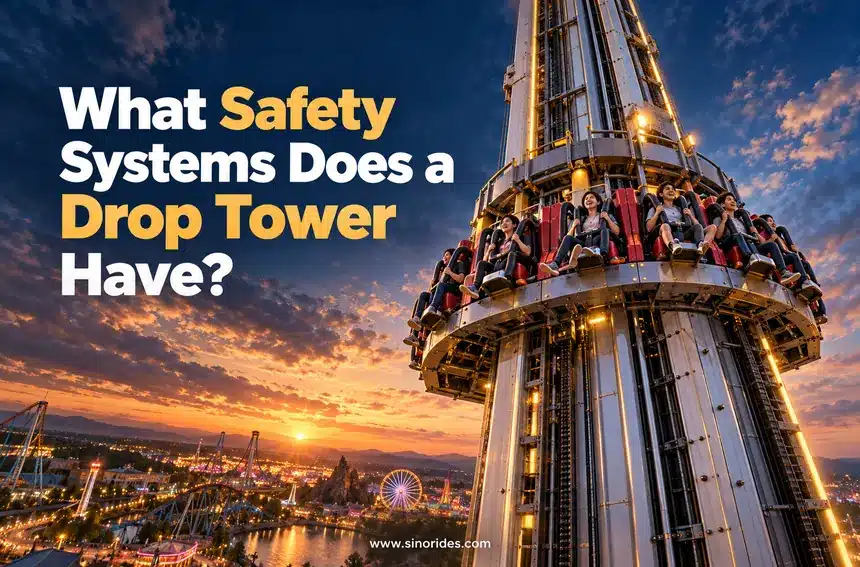
What are the four Sinorides drop tower safety systems?
Sinorides combines a dual-cylinder hydraulic power system, four wire-rope traction and pulley sets, shoulder restraints with safety belts, and two gondola descent buffer dampers. This configuration protects both the moving gondola and the riders inside it.
The systems perform complementary tasks. The hydraulic system provides power, the rope-and-pulley assemblies provide traction with additional redundancy, the restraints and belts secure passengers, and the two dampers provide the final cushioning reserve beneath the gondola. Component count alone does not establish independence or a rated fault capacity; the supplied drawings and test records define those details.
This article describes the configuration confirmed by Sinorides for this update. Buyers should match the ordered model and serial number to the supplied technical documents. Do not assume that generic descriptions of magnetic brakes, spring-applied holding brakes or pneumatic systems describe this Sinorides configuration.
How do Sinorides hydraulic cylinders, wire ropes and dampers protect the gondola?
Dual-cylinder hydraulic power system
The Sinorides drop tower uses a hydraulic power system with two cylinders. The dual-cylinder arrangement is a central part of the specified safety configuration and supports the gondola drive system. It should be assessed together with the hydraulic circuit and the operating procedure, rather than described as a magnetic braking system.
During acceptance and scheduled maintenance, qualified personnel should check the condition and operation of both cylinders, their mountings, the hoses and connections, and the specified pressure and movement limits. The manufacturer defines the acceptance criteria. Two cylinders alone do not prove that either cylinder can carry the full load independently, so buyers should request the relevant design and test evidence.
Four sets of wire-rope traction and pulley assemblies
Four sets of steel wire-rope traction and pulley assemblies provide additional safety redundancy in the gondola traction arrangement. These assemblies are a distinct part of the Sinorides safety package, alongside the dual-cylinder hydraulic power system.
Inspection must cover all four sets, including rope condition, terminations, pulley grooves, alignment and mountings, using the supplied inspection instructions. The number of rope sets must not be turned into an unsupported claim that the ride can operate with damaged or missing ropes. Any defect requires the response specified by the manufacturer.
Two gondola descent buffer dampers
Two descent buffer dampers beneath the gondola provide the final cushioning safety reserve. The dampers absorb energy during their designed compression stroke and add a final protective layer at the bottom of the gondola travel.
The dampers supplement the normal motion-control and traction systems. They do not replace those systems or the rider restraints. Check both damper units, their mountings, clearance and condition against the manual. Stroke, energy capacity, triggering conditions and replacement criteria must come from the model-specific documentation; this article does not assign unverified ratings.
how drop tower rides work - naik menara ayun

How do shoulder restraints and safety belts secure Sinorides drop tower riders?
Sinorides uses over-the-shoulder safety restraints together with safety belts to keep passengers secured inside the gondola. The shoulder restraint contains the rider at the upper body, while the belt provides an additional restraint element. Both must be correctly fitted and fastened before a cycle begins.
Before dispatch, trained attendants must check every occupied seat in the sequence required by the operating manual. Confirm the rider meets the stated eligibility limits, sits correctly, and has a properly closed shoulder restraint and a correctly routed, fastened belt. Clothing, bags and loose items must not prevent the restraint from fitting.
Inspect shoulder restraint pivots, locking mechanisms, belt webbing, buckles and attachment points at the intervals specified for the supplied ride. Remove a seat or the ride from service whenever the manual requires it. A belt is not permission to operate with a defective shoulder restraint, and a closed shoulder restraint is not permission to omit the belt.
Where the supplied model includes restraint sensors and interlocks, test those functions as documented. A lock-position signal cannot confirm correct passenger posture or belt routing. Manual rider checks remain necessary. The supplied electrical drawings establish the actual interlock arrangement; no sensor count or lock architecture is inferred here.
Testing: from factory acceptance to annual NDT
Brakes and restraints are only as good as the evidence that they work. Testing on a tower happens in four distinct phases, and a supplier who can only describe the last one has not finished the machine.
Factory acceptance testing
Before a tower is dismantled for shipping, it should be assembled, powered and cycled at the works. The useful tests are the ones that measure something. Empty-load cycles confirm the lift, release and brake sequence. Loaded cycles with representative test weights confirm that the brake stack performs with riders aboard, not just with a bare gondola. Restraint locks are tested seat by seat, both for locking and for the signal each seat sends. Brake performance is measured, not observed: stopping distance and peak deceleration against the design figure. Electrical work is insulation-tested and the earthing checked. On towers with a safety circuit, individual faults are injected deliberately to confirm that the ride stops and reports rather than continuing.
Ask for the records for the exact unit you are buying. A test report for a different tower of the same height is not the same document.
Pemasangan dan pengoperasian awal
On site, the tests shift from components to the assembled system. Anchor bolt torque and base level are verified against the drawing. Tower verticality and guide rail alignment are measured. Both hydraulic cylinders, all four wire-rope traction and pulley sets, and both buffer dampers are checked against the supplied drawings and acceptance criteria. Lift tension or chain tension is set, the safety circuit is proven end to end, and the emergency stop is tested at every position an operator can occupy, including the ones that are awkward to reach.
Commissioning should finish with a full cycle at rated load and a documented evacuation drill. If the site crew can lower a gondola from height manually, they should have done it once, in daylight, with the manufacturer watching, long before they need to do it with guests aboard.
Watch a tower being installed and tested
The clip above follows a Sinorides drop tower through assembly and its first test runs on site. It is worth watching for the sequence rather than the hardware: structure first, then alignment, then electrical checks, then empty cycles, and only then a tower handed over as ready to operate.
The pre-opening routine
Every operating day starts the same way. Isolate and lock out the drive. Walk the base of the tower and the platform. Clear anything that has blown in overnight. Confirm the traction pulleys are undamaged and dry. Confirm the buffers are in their normal position and not bottomed out. Run at least one empty cycle and listen to it. Test the emergency stop. Test one restraint on each seat type by hand, and inject a sensor fault to confirm the panel still refuses dispatch. Record the wind reading and the weather decision. Sign the sheet.
That routine takes twenty to forty minutes on a typical tower. It is also the only test in the whole schedule that happens on a day when a fault would actually matter.
Periodic and annual work
Monthly work is where things get measured. Hydraulic cylinder condition and wire-rope wear, guide roller and wheel wear, lift rope or chain elongation, structural bolt torque, lubrication points, restraint latch engagement, sensor alignment. Each of these has a wear limit in the manual, and the trend matters more than the individual reading: a recorded change in rope wear or hydraulic condition can identify a developing problem before a limit is exceeded.
Annual work is a teardown. The gondola comes off, the restraint assemblies are opened, and the structure is inspected by a competent person using non-destructive methods: visual inspection, magnetic particle or dye penetrant testing on welds, ultrasonic thickness measurement where corrosion or fatigue is a concern, and bolt torque verification across the tower base and ring connections. Where the market requires it, a third-party inspection body certifies the ride as fit for another period of operation. The wider schedule for heavy rides is set out in the guide to maintaining major rides for safety and service life.

| Interval | What is tested | Evidence produced | Who does it |
|---|---|---|---|
| Factory | Empty and loaded cycles, brake performance, restraint locks seat by seat, fault injection, electrical and earthing checks | Test report for that serial number | Produsen |
| Komisioning | Anchor and base verification, verticality, rail alignment, magnet-fin gap, safety circuit, emergency stops, evacuation drill | Commissioning record and handover file | Manufacturer and site engineer |
| Setiap hari | Lockout, base and platform walk, traction pulleys and buffers, empty cycle, emergency stop, restraint hand check, sensor fault test | Signed daily log | Ride operator and duty technician |
| Bulanan | Magnet-fin gap, roller and wheel wear, rope or chain elongation, bolt torque, lubrication, latch engagement | Measured readings against wear limits | Trained maintenance technician |
| Tahunan | Teardown, weld inspection by magnetic particle or penetrant testing, ultrasonic thickness checks, torque verification, brake re-verification | Inspection report and certificate where required | Competent inspector, often third party |
Intervals above are a structural outline, not a substitute for the manual that ships with your machine or for local regulation. Where the two disagree, the stricter document wins.
What should operators do if a Sinorides drop tower stops or loses power?
A power loss or unexpected stop requires the emergency procedure for the supplied Sinorides model. The dual-cylinder hydraulic system, four rope-and-pulley sets and two buffer dampers must not be used as grounds for promising that every outage automatically ends with the gondola at the platform.
Keep the shoulder restraints and safety belts secured, communicate with riders, and have trained personnel follow the documented recovery or evacuation sequence. Do not improvise a hydraulic release, bypass an interlock or restart the ride before the fault has been assessed. Confirm the actual loss-of-power response during commissioning under the manufacturer’s approved test procedure.
Record the fault, the gondola position and the actions taken. Return the ride to service only after the prescribed checks and authorization. Weather limits and evacuation arrangements remain model- and site-specific.
Standards and the approval gap
Three families of standard appear on tower documentation, and buyers who confuse them tend to discover the difference at the worst possible moment.
In Europe, the EN 13814 series is the reference for amusement ride and device safety, and it is deliberately split: one part covers design and manufacture, another covers operation and use, another covers inspection and maintenance. That split is the reason a European purchaser ends up with two different documents — a manufacturer’s conformity package for the machine, and an operating regime for the park.
In the United States, ASTM Committee F24 writes the amusement ride standards. F2291 deals with the design of amusement rides and devices, and F770 covers ownership, operation, maintenance and inspection. The ASTM F24 framework is worth reading before you commission anything, because it makes the split responsibilities unusually explicit. If your market is in Europe or you are buying against a European project specification, the companion guide to ASTM and EN 13814 requirements explains how the two systems line up. China applies its own GB standards for large-scale amusement devices, and a Chinese-built tower for the domestic market is certified against those instead.
The gap to watch is this. CE marking and equivalent declarations are statements about a product and its conformity assessment. They travel with the machine. Permission to operate a specific installation, on a specific site, with a specific maintenance regime, belongs to the park and to the local authority that inspects it. Almost every unpleasant surprise in this industry sits in that gap, and it is filled with paperwork you should specify in the purchase contract: design and manufacture documentation, a risk assessment, general arrangement and foundation drawings, the operation and maintenance manual, a spare parts list, factory test records, the conformity certificate, and a training handover.
Ask for all of it in the language of the site where the tower will run. A manual nobody on your team can read is a compliance risk, not a document.
What the spec sheet reveals about safety margins
Published tower specifications are usually read for height and capacity. Read them for the speed columns instead, because those say more about how the machine brakes.
Take the Sinorides crown drop tower family. The 30 m model has a maximum ascent speed of 2 m/s, a maximum descent speed of 5 m/s and a maximum operating height of 22.5 m. A gondola in true free fall from 22.5 m would arrive at roughly 21 m/s, about four times the published descent figure. The 12 m model pairs a 1.5 m/s ascent with a 4 m/s descent; the 36 m model pairs 2 m/s with 6 m/s.
That is not a marketing number. It tells you the descent is regulated throughout rather than released, which changes three things a buyer should care about: the peak g-load a rider experiences, the energy the brake stack has to absorb on every cycle, and the maintenance interval on the braking components.
| Model | Total height | Jejak kaki | Max ascent / descent | Capacity and power |
|---|---|---|---|---|
| 12M Crown Drop Tower | 12 m | 6 × 6 m | 1.5 m/s / 4 m/s | 12 riders, 144 pph, 35 kW |
| 20M Crown Drop Tower | 20 m | 8 × 8 m | 1.5 m/s / 4 m/s | 12 riders, 144 pph, 55 kW |
| 25M Crown Drop Tower | 25 m | 10 × 10 m | 2 m/s / 5 m/s | 16 riders, 192 pph, 80 kW |
| 30M Crown Drop Tower | 30 m | 10 × 10 m | 2 m/s / 5 m/s | 16 riders, 240 pph, 100 kW |
| 30M Foundation-Free Crown Drop Tower | 30 m | 10 × 10 m | 2 m/s / 5 m/s | 16 riders, 240 pph, 100 kW |
| 36M Crown Drop Tower | 36 m | 10 × 10 m | 2 m/s / 6 m/s | 16 riders, 240 pph, 100 kW |
The foundation-free variants deserve their own safety note. Removing the concrete foundation moves the load path into a modular steel base, which means the engineering effort shifts to the base geometry, the ground bearing and the verification of the surface the tower stands on. It is a legitimate and well-established solution, but it makes the site survey more important, not less. Details for the foundation-free range, including the 30 m and 36 m versions, sit alongside the 30 m foundation-free crown drop tower specification.
Installed towers and their records
Safety claims are easier to assess against machines that are actually running. The following drop tower projects appear in Sinorides’ installation records between 2018 and 2024. They are listed as project facts, not as performance claims.
| Taman | Country | Tahun | Equipment |
|---|---|---|---|
| U-WORLD LUGE Theme Park | Korea Selatan | 2018 | Drop tower with spiral jet and small pendulum |
| Snober Land | Aljazair | 2019 | Drop tower with 360° pendulum, pirate ship and top spin |
| Swan Lake Park | Cina | 2021 | 30 m drop tower |
| Dunia Tanah Bahagia | Arab Saudi | 2022 | 18 m drop tower with 360° pendulum and top spin |
| Maxim Gorky Central Amusement Park | Rusia | 2023 | 30 m drop tower with double-decker carousel and pirate ship |
| Taman Hiburan Bangalore | India | 2023 | 30 m drop tower |
| Taman Fantasi | India | 2023 | 30 m drop tower with 36-seat flying chair |
| Taman Hiburan Douala | Kamerun | 2024 | 30 m drop tower with carousel and flying car |
| Zona Petualangan Karapuzha | India | 2024 | 30 m drop tower |
One pattern is worth noting for anyone budgeting a maintenance programme. The 30 m tower dominates this list, and the 30 m class is also where the operating economics are easiest to defend. It is tall enough to be the visual landmark of a mid-sized park and short enough that the braking energy per cycle stays modest, which shows up in wear rates rather than in the purchase price.
Seven questions for a supplier
These are the questions worth putting in writing before a deposit. A supplier who answers them with documents is a different proposition from one who answers them with adjectives. A longer version of the same idea appears in the list of questions to ask before buying a drop tower.
- Which braking layers are fitted, and which of them still functions with the site power off?
- Is the restraint a main lock plus an independent secondary device, and what exactly is the independent part?
- What does the factory test report for this serial number contain, and will you send it before shipping?
- What are the documented wear limits for the wire-rope and pulley condition, the lift rope or chain, the guide rollers and the restraint latches?
- What is the manual lowering or retrieval procedure, and which spare parts are needed to execute it?
- Which standards is the tower designed and manufactured against, and which document proves it for this unit?
- What training comes with the machine, and in what language is the operation and maintenance manual delivered?
If you are still comparing quotations, the buyer’s guide on choosing drop tower rides puts the commercial and the engineering criteria side by side, which is where most of these decisions actually get made.
Four mistakes that keep repeating
Treating the certificate as the finish line. A conformity certificate describes the machine. It says nothing about whether your attendants know the dispatch sequence, whether the log is genuine, or whether anyone has read the fault codes. The operating regime is the park’s product, and it is the part regulators inspect.
Checking the restraint and not the rider. Sensors confirm locks, not passengers. The check that prevents incidents is the one that looks at where the body is, whether a jacket or bag is under a belt, and whether a child has slid out of the seat envelope. That takes seconds per seat and it is not optional on a busy day.
Skipping the pre-opening cycle because the park is late opening. Empty cycles are not a formality; they are the only opportunity to hear a new noise, see a buffer out of position or notice that a traction pulley has been damaged overnight. A park that shortens this routine under time pressure has decided that schedule matters more than the ride.
Storing records in a drawer. Trend data is the most underused safety tool on a tower. Gap measurements, latch engagement and rope elongation are only useful as a sequence. A single number inside limits tells you the machine is fine today. Six months of numbers tells you which component is going to stop the ride next season.
Tentang Sinorides
Sinorides is the export brand of Henan Swonder Amusement Rides Co., Ltd., a Chinese amusement ride manufacturer established in 1992. The company builds thrill rides, family rides and kiddie rides, including the crown drop tower range from 12 m to 36 m in stationary, rotating and foundation-free configurations.
Manufacturing follows CE and ISO requirements, and the company provides customised design, themed cladding and lighting, installation guidance, operator training materials and after-sales support. Installation records cover more than 1,200 projects internationally, with drop tower installations in China, South Korea, Algeria, Saudi Arabia, Russia, India and Cameroon.
For safety work specifically, the relevant part is not the project count. It is that the specification, the test records and the maintenance intervals are documented per model and handed over with the machine, so the park can build its own operating regime on top rather than reconstruct it from guesswork.
Pertanyaan yang Sering Diajukan
What safety systems does a Sinorides drop tower have?
A Sinorides drop tower in the configuration described here has a dual-cylinder hydraulic power system, four sets of steel wire-rope traction and pulley assemblies, over-the-shoulder restraints with safety belts, and two descent buffer dampers beneath the gondola. The hydraulic system supplies drive power. The four rope-and-pulley sets add traction redundancy. The shoulder restraints and belts secure riders in their seats. The two dampers provide a final cushioning reserve at the bottom of travel. These functions complement each other, but the hardware list does not establish specific fault ratings. Buyers should check the supplied model drawings, commissioning results and maintenance instructions before approving operation.
Does the Sinorides drop tower described here use magnetic brakes?
The Sinorides configuration confirmed for this article is described by its dual-cylinder hydraulic power system, four wire-rope traction and pulley sets, shoulder restraints with safety belts, and two gondola descent buffer dampers. Magnetic braking should not be listed as installed equipment without model-specific confirmation. Other drop tower designs may use eddy-current brakes, but a general explanation of magnetic braking does not establish the hardware or emergency response of a Sinorides unit. The correct procurement check is to request the hydraulic circuit, traction arrangement and operating manual for the exact model. Any additional braking equipment must be identified in those documents and verified during acceptance.
Why does the Sinorides drop tower use shoulder restraints and safety belts?
The Sinorides drop tower uses shoulder restraints and safety belts together to secure passengers inside the gondola. The shoulder restraint provides upper-body containment, and the safety belt adds a further restraint element. Operators must close and check both devices for every occupied seat before dispatch. Neither device makes correct seating, rider eligibility checks or inspection optional. Attendants should confirm that the restraint fits the rider, the belt follows the prescribed route and the buckle is fastened. Maintenance personnel should inspect locks, hinges, webbing, buckles and anchors according to the supplied manual. A defective restraint component requires the response specified by the manufacturer, rather than reliance on the other component.
Do restraint sensors replace a manual check?
No. Seat sensors confirm whether a lock is in position; they cannot see a rider sitting on a closed lap bar, a bag under a belt, or a small child who has slid sideways in the seat. The manual check catches what the sensor cannot, which is why good operations require a hand on every restraint on every cycle.
What should a factory acceptance test include for a tower?
Empty-load cycles, loaded cycles with representative weights, measured brake performance against the design figure, restraint lock testing seat by seat including signal output, deliberate fault injection into the safety circuit, insulation and earthing checks, and a documented record for that specific unit. A report for another tower of the same model is not a substitute.
How often does a drop tower need inspection?
Daily before opening for the visible and functional checks, monthly for measured items such as wire-rope and pulley condition, rope or chain elongation and bolt torque, and annually for a teardown with non-destructive weld inspection. Your model manual and local regulation set the binding intervals; many operators add cycle-count triggers on top.
What is non-destructive testing on a tower, and when is it used?
Non-destructive testing checks a structure without cutting into it. Visual inspection covers the obvious, magnetic particle testing finds surface and near-surface cracks in welds, dye penetrant testing does the same on non-magnetic material, and ultrasonic methods measure thickness loss or detect internal defects. On towers it is applied to base welds, ring connections and other high-stress joints during the annual teardown.
Does a CE certificate mean the park can start operating?
No. CE marking and similar declarations describe the product and its conformity assessment, and they travel with the machine. Permission to operate a specific installation on a specific site depends on local approval and inspection. The park still owns the operating procedures, staff training, daily checks and records.
Why is the published descent speed lower than free fall?
Because the descent is regulated rather than released. On the Sinorides 30 m crown drop tower, the maximum operating height is 22.5 m and the published maximum descent speed is 5 m/s, where an unregulated fall from that height would arrive at roughly 21 m/s. A capped descent reduces the peak g-load on riders and the energy the brake stack absorbs on every cycle.
What are the wind limits for a drop tower?
They are set per model in the operation manual, and they are lower than most operators expect because guests are exposed at the top of the tower. The practical rule is to define a shutdown threshold in writing and read it from an anemometer, rather than deciding at the platform on a gusty afternoon.
Do foundation-free towers have different safety requirements?
Different, not lower. Removing the concrete foundation moves the load path into a modular steel base, so base geometry, ground bearing capacity and verification of the surface the tower stands on become more important. Site survey work increases rather than decreases, and the manufacturer’s ground-condition requirements should be met exactly.
What documents should come with a new tower?
A design and manufacture conformity package, a risk assessment, general arrangement and foundation drawings, the operation and maintenance manual with wear limits, a spare parts list, factory test records for that unit, and a training handover. Ask for all of it in the language used on site, because documentation nobody can read does not reduce any risk.
Is a taller tower inherently less safe?
Height raises the energy the system has to manage and the consequence of an error, so taller machines attract more engineering scrutiny and usually more regulatory attention. But the safety of a tower depends far more on the braking stack, the restraint design, the maintenance regime and the operating discipline than on its height. A well-run 36 m tower is a sounder proposition than a neglected 12 m one.
Sources and verification notes
Configuration source: Sinorides technical information confirmed by the site owner on 27 October 2026: dual-cylinder hydraulic power system; four sets of steel wire-rope traction and pulley assemblies; over-the-shoulder restraints and safety belts; and two gondola descent buffer dampers. No unverified load-sharing ratio, damper energy rating or single-failure capability is claimed.
The hydraulic, traction, rider-restraint and cushioning systems described here refer to the confirmed Sinorides configuration. The Sinorides model parameters in the specification table are taken from the company’s published product data for each model and are quoted with the model name attached; they are not interchangeable between models.
The installation list comes from Sinorides’ own project records covering 2018 to 2024. The standards references correspond to the EN 13814 series and to ASTM Committee F24 documents. Inspection intervals and wear limits in this article are given as a structural outline only. Your machine manual and your local regulator set the binding figures, and where they differ from anything written here, they take precedence.
Ikuti Sinorides
Factory test runs, installation footage and maintenance material are published first on Sinorides’ own channels. They are useful if you want to see how a tower behaves through assembly and commissioning before you plan a service schedule around one.
LinkedIn: Wahana Hiburan Sinorides
YouTube: Saluran Sinorides
Facebook: Sinorides di Facebook
Instagram: sinoridesamusement
If a restraint on your tower has started closing with a softer click, or a traction pulley gap has moved since the last measurement, that is the moment to write it down. Send the model and the readings, and the answer usually arrives before the downtime does.