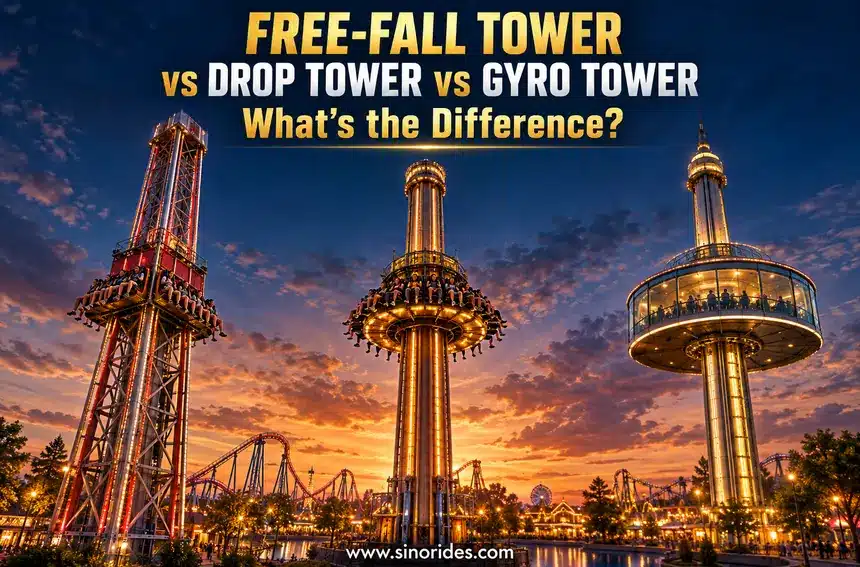
Are a free-fall tower, a drop tower and a gyro tower the same thing?
No. Two of the three are the same ride under two names, and the third is a different product category.
The industry definition of a drop tower is a ride built around a central tower structure with one or more gondolas attached. In the standard modern layout, each gondola is lifted to the top of the tower and released to fall back towards ground level, which produces a feeling of weightlessness followed by rapid deceleration. A magnetic braking system, or a version that relies on pistons and air pressure, brings the gondola to a stop. Nothing in that description mentions the word free fall, but the motion is exactly what the name free-fall tower describes.
A free-fall tower, then, is a drop tower described from the rider’s point of view rather than the engineer’s. The two labels appear side by side in the same catalogues, which is the practical proof. Intamin, the Swiss manufacturer that pioneered the modern drop tower, lists free fall towers, sky jumps, giant drops, parachute towers and gyro drop towers as separate models under one vertical rides heading. The company is not selling two different physics packages; it is using model names to describe different capacities, seat layouts and rotations of the same vertical thrill. Sinorides follows the same convention, publishing a Freifallturm range alongside its drop tower models.
A gyro tower is not part of that family. It is a revolving observation tower with a vertically moving platform. The cabin is not released and does not fall. It climbs at a sightseeing pace and rotates around the supporting mast, either once at the top or continuously while travelling, so passengers get a full panorama. Drop tower riders feel the floor disappear for a few seconds. Gyro tower riders feel the park turn slowly underneath them.


Where the three names come from
The names are historical rather than technical, and that is the reason for most of the confusion.
The drop tower as an Vergnügungsfahrt traces back to a parachute ride that debuted at the 1939 New York World’s Fair, which was itself inspired by paratrooper training devices used in the Soviet Union during the 1920s. Those machines were about descent, not about the sensation of falling, and riders descended on parachutes at a controlled rate.
The modern thrill version arrived later. Intamin released an early free-fall iteration in the 1980s and refined it in the 1990s with magnetic braking, which allowed larger towers such as the Giant Drop and the Gyro Drop. S&S Sansei modified the concept with pneumatics, using pistons, air pressure and steel cables to control the gondola at all times. That variation can move the gondola faster than free fall and can also accelerate it upward, which is where the space shot and double shot names come from. Record chasing followed the technology, and the tallest drop towers in the world now sit between roughly 120 and 145 metres of structure.
Europe kept calling the ride a free fall tower while North America settled on drop tower. Both names travelled with exported equipment, so an operator in Southeast Asia may see a European supplier’s free fall tower and a North American supplier’s drop tower quoted against each other when the machines are identical in principle. The naming difference is a market difference, not a design difference.
Gyro tower comes from a different lineage altogether. The ride was developed as an observation attraction for parks and world fairs, and the word gyro refers to the rotation of the cabin around the mast. It has been used in Europe and Asia for decades, and a few of these towers have outlived the parks that built them, which is a useful reminder that the structure is a slow sightseeing machine rather than a thrill ride.
What a gyro tower actually is
A gyro tower, also called a panoramic tower, is a revolving observation tower with a vertically moving platform. The observation deck is not simply raised to give passengers a view; it also rotates around the supporting mast, either once at the top or while travelling up and down the mast. That combination is the whole product, and everything else about the ride follows from it.
These towers turn up in permanent parks far more often than at travelling fairs, because they need a substantial mast and a steady flow of visitors rather than peak-hour crowds. Well-known installations include the Kissing Tower at Hersheypark, the Carolina Skytower at Carowinds, the Euro-Tower at Europa-Park, the Sky Trek Tower at Six Flags Great America, Panoraama at Linnanmäki in Helsinki and the Taming Sari Tower in Malacca. The Space Tower on top of the Euromast in Rotterdam is a less typical version, because the tower underneath it already existed for another purpose.
Capacity is the most obvious operational difference. A travelling gyro tower built for the German fair circuit carries a large circular gallery rather than a row of seats. The Top of the World tower in Geiselwind, Germany is recorded as a 95 metre gyro tower, the tallest transportable amusement ride in the world, with a cabin that can hold up to 132 people and is raised to 72 metres. A drop tower with 132 riders at once would be an unusually large machine, because drop tower capacity is normally quoted in the tens.
The clearest proof that the two ride types are not interchangeable is a conversion. The Lisebergstornet at Liseberg in Sweden was a gyro tower. It closed in 2010 and reopened in 2011 as AtmosFear, a drop tower. The park did not relabel the ride. It rebuilt the machine, because turning a rotating observation cabin into a falling gondola is a structural change, not a marketing decision.

Why the three names get mixed up
Three habits in the market keep the terms tangled, and each one has a practical consequence for buyers.
The first is the word gyro itself. Drop tower gondolas rotate. Intamin’s Gyro Drop rotates a ring of 30 or 40 seats while it rises to the top of the tower, then drops. The rotation is a ride experience and a capacity device, since a ring of outward-facing seats can hold more riders than a single row. Sinorides takes a similar approach: its crown drop towers add forward and reverse rotation to the lift, so passengers see the view while ascending and then experience the drop.
The second habit is catalogue shorthand. Suppliers describing a rotating drop tower to a search engine audience often write gyro drop tower, or list a drop tower as a free fall tower and a gyro tower in the same paragraph. That is how a buyer ends up comparing an observation ride against a thrill ride without noticing. Sinorides publishes separate pages for its Kreiselturm und Turmfahrgeschäfte offers, and the specifications on a quotation still matter more than the page a buyer landed on.
The third habit is translation. German-speaking markets say Freifallturm, which becomes free fall tower in English. Chinese manufacturers, including Sinorides, describe the drop tower family as a rotating tower because the rotation is a visible selling point. A purchasing officer reading a translated specification can easily end up with a document that uses three different English names for one machine and one name for a machine it does not describe.
The practical test is to ignore the name and ask what moves. If the cabin is lifted and released, it is a drop tower, whatever it is called. If the cabin climbs slowly and rotates, it is a gyro tower. If it does both, it is a rotating drop tower, and the specification should say so in the first line.
Free-fall tower vs drop tower vs gyro tower: the comparison
The table below compares the three terms on the criteria a park project actually has to decide.
| Kriterium | Freifallturm | Free-fall tower | Gyro-Turm |
|---|---|---|---|
| Fahrkategorie | Vertical thrill ride | Vertical thrill ride, the same machine | Revolving observation ride |
| Typical naming market | North America, international catalogues | Europe, manufacturer model names | Europe and Asia, observation attractions |
| What the cabin does | Rises, releases, falls, decelerates | Identical | Rises slowly while rotating, then descends slowly |
| Rider sensation | Weightlessness followed by strong deceleration | Identical | Calm, panoramic, low intensity |
| Drehung | Optional, on rotating gondola models | Optional, on the same models | Core function of the ride |
| Typical capacity | Roughly 8 to 40 riders per cycle | Same range | Often 50 to 130 passengers per trip |
| Cycle length | Short, measured in seconds plus loading | Identical | Longer, because the view is the product |
| Ride height on the market | From around 10 m to more than 100 m | Same range | Usually 50 m to 100 m, occasionally higher |
| Typical location | Thrill zone, skyline position | Identical | Park landmark, gateway or scenic viewpoint |
| Who it suits | Teen and adult thrill visitors | Identical | Mixed-age visitors, families, sightseeing guests |
| Cost drivers | Height, capacity, drive and brake type, foundation, site works | Identical | Mast height, cabin size, rotation drive, viewing deck |
One line in that table decides most projects. Free-fall tower and drop tower are two entries in the same column of the market. Gyro tower is a different purchase. A park that needs a signature thrill will not solve the problem with a gyro tower, and a park that wants a quiet panoramic attraction for older visitors and families will not solve it with a drop tower.
Inside the drop tower family: what is actually moving you
Once the naming question is settled, the useful question is which drop tower variant a park should buy. Four mechanisms and layouts cover most of the market.
Magnetic and friction braking
The pure drop tower lifts the gondola and releases it, with little resistance, then brakes magnetically at the bottom of the run. Magnetic braking is the system that made very tall towers practical from the 1990s onwards, because the braking force does not depend on a cable that can wear. Riders feel a long moment of near weightlessness and then a firm, progressive stop.
Pneumatic and hydraulic drive
Air-powered towers use pistons, air pressure and cables to control the gondola throughout the cycle. The advantage is that the machine can be pushed faster than gravity alone would allow, which is how space shot and double shot rides blast the gondola upward before dropping it. Hydraulic drive is common on mid-height towers where a park wants smooth, repeatable motion and straightforward maintenance.
Seating and rotation
Seat layout changes the experience more than most buyers expect. Sit-down, stand-up, floorless and tilting gondolas are all produced, and tilting models rotate riders to face the ground before the release, as Falcon’s Fury does at Busch Gardens Tampa Bay, where riders fall about 102 metres and reach roughly 100 km/h. Rotating gondolas spread the same capacity around a ring, which improves the view and lets more riders watch each other. Both Sinorides crown tower models add 360° rotation to the lift for that reason.
Height and capacity pairing
Height and capacity are separate purchases, and the market proves it. The tallest towers recorded today sit between 100 and 145 metres, but a park does not need a record to make money. A 30 metre tower with a clean cycle and a visible drop line will out-earn a taller tower that loads slowly or sits behind a building.
The video above shows a Sinorides 36 m drop tower during factory testing. It is included because a specification table cannot show the two things buyers ask about most: how fast the gondola rises and how the release actually reads from the ground.
Tower rides as a category are wider than drop towers, and a park comparing options should know which motions it is choosing between. A Schaukelturmfahrt raises passengers and swings them outward on chains or arms, which is neither a drop nor an observation ride, and it draws a different audience again. The free fall tower and the gyro tower are the two that get confused; the swing tower is the third option buyers usually discover later.
What riders actually feel, and why the paperwork says free fall
The free-fall label is a fair description of the first part of the ride and an exaggeration of the rest, which matters when a park is writing signage, height rules and marketing copy.
Riders are not in a vacuum and the gondola runs on guides, so the descent is close to free fall rather than an exact copy of it. On a magnetic tower the gondola accelerates under gravity until the brake fins engage, and the weightless sensation is the phase before braking. Physics teaching resources that instrument these rides describe roughly three seconds of near weightlessness on a free fall tower before magnetic brakes bring the car down smoothly. A taller tower buys a longer version of that single sensation, not a different one.
Pneumatic towers work the other way. Because the machine controls the gondola at all times, it can exceed the speed gravity alone would produce and can reverse the direction of travel. Space shot and double shot rides launch upward and drop, and the acceleration phase is what generates the strongest forces. On towers like these, riders may feel more than their own body weight during the launch and less during the drop, and the sequence is scripted rather than simply released.
Tilting towers add a third variable. Falcon’s Fury rotates its gondola to face the ground before the release and returns riders upright as the brakes take over, which changes the fear factor without changing the physics. The drop height and speed are comparable to an upright tower of the same size; the difference is entirely in what the rider sees on the way down.
The practical takeaway for a park is that the word free fall should be used carefully in signage. It is accurate enough for the initial drop, and it is not a promise of zero gravity for the whole descent. Marketing that overstates the sensation creates an expectation the ride cannot meet, and guests notice.
What a buyer should specify: height, capacity and footprint
Drop tower specifications are decided in a fixed order, and the published data from a current catalogue shows why the order matters.
| Sinorides model | Total height | Fußabdruck | Operating height | Riders per cycle | Theoretische Kapazität | Total power |
|---|---|---|---|---|---|---|
| 12m rotating tower | 12 m | 6 × 6 m | 7.5 m | 12 | 144 pph | 35 kW |
| 20m rotating tower | 20 m | 8 × 8 m | 15 m | 12 | 144 pph | 55 kW |
| 25m rotating tower | 25 m | 10 × 10 m | 19 m | 16 | 192 pph | 80 kW |
| 30m crown drop tower | 30 m | 10 × 10 m | 22.5 m | 16 | 240 pph | 100 kW |
| 36m crown drop tower | 36 m | 10 × 10 m | 30 m | 16 | 240 pph | 100 kW |
| 30m foundation-free crown tower | 30 m | 10 × 10 m | 22.5 m | 16 | 240 pph | 100 kW |
These are catalogue figures for Sinorides tower models and should be confirmed against the final drawing for the model quoted, because decoration, lighting and site conditions can change the envelope. Three patterns are worth reading out of the table.
The first is that ascent and descent speeds are not symmetrical. On the 30 m model the published maximum ascent speed is 2 m/s while the maximum descent speed is 5 m/s, and the 36 m model descends at up to 6 m/s. The slow climb is deliberate: it gives riders the view, and it reduces the installed drive power. The descent is where the product is sold.
The second is that operating height is well below total height. A 36 m tower releases from about 30 m, and a 12 m ride releases from 7.5 m. Buyers who plan a sightline or a photo position from the structural height will be disappointed; the drop starts lower than the mast ends.
The third is that footprint does not grow with height above 20 m. The 25 m, 30 m and 36 m models all sit on a 10 × 10 metre base. That makes height a comparatively cheap upgrade once the site and the electrical supply allow it, while capacity, at 16 riders per cycle from 25 m upwards, is set by the gondola rather than by the tower.
Die 30 m crown drop tower und die 36 m crown drop tower make the point cleanly: the same base, the same gondola and the same installed power, with six metres of extra tower and a faster descent between them.
Riders per hour: the number that decides the business case
Published capacity is the number of people on the ride at one moment. The number that affects revenue is riders per hour, which is the cycle capacity multiplied by the number of cycles the crew completes.
Riders per hour = riders per cycle × cycles per hour
Cycles per hour = 3600 ÷ (ride time + loading time + unloading time), in seconds
A 16 seat tower on a 60 second cycle would move around 960 riders per hour in theory. Sinorides publishes 240 riders per hour for its 30 m and 36 m crown drop towers, which reflects the real cycle: a full ascent at 2 m/s, a hold at the top, the release, the braking run, and a loading sequence with restraint checks. The gap between the two numbers is the ride time, and it is not negotiable on a drop tower, because the ascent and the pause at the top are part of the product.
That is why drop tower throughput is improved by loading discipline rather than by buying a bigger gondola. Standardising the seating order, checking restraints during the hold rather than after boarding, and keeping a second group ready at the gate are the levers a park controls. A realistic operating figure is 70 to 80 per cent of the published theoretical capacity on a good day, with weather and downtime taking more.
For planning purposes, a 30 m crown drop tower with a published 240 riders per hour should be treated as roughly 170 to 190 riders per hour in normal operation. If the park needs 400 riders per hour at peak, one tower will not deliver it and the answer is either a second tower or a ride mix that spreads the crowd.
Site, foundation, power and lightning protection
Tower rides fail at the site stage more often than at the specification stage, and the details that cause the trouble are predictable.
Ground conditions decide the base. A conventional drop tower needs a reinforced concrete foundation sized for the tower and the dynamic loads of the drop. Where the site is paved, leased, temporary or simply not ready for excavation, a foundation-free design avoids that work. Sinorides builds foundation-free versions of its 30 m and 36 m crown towers on a modular steel base, which the company states can be installed on concrete, asphalt and similar surfaces; the 30 m foundation-free crown tower is the version most often quoted for that situation. The published footprint stays at 10 × 10 metres, so the saving is in civil works and schedule rather than in ground area.
Power is the second constraint. The Sinorides crown drop towers are published at 100 kW, and the smaller rotating towers range from 35 kW at 12 m to 80 kW at 25 m, all at a three-phase 380 V supply in the catalogue. A park importing equipment has to confirm that the local supply matches the machine and that the incoming cable, protection and earthing meet local code, because the ride’s own control system cannot correct a supply that is out of tolerance.
Lightning protection is the third, and it is the one operators of tall rides most often discover late. Tall vertical rides are exposed structures. Chinese practice for a rotating tower treats the ride as a protected structure under GB 50057, the national code for lightning protection of buildings, with local guidance for large amusement sites; the working target for impulse grounding resistance is 10 ohms or less. Practical requirements include lightning rods at the top of the structure, the steel structure used as a natural down conductor with bonded joints, a ring earth electrode formed from the foundation reinforcement, and vertical earth electrodes bonded with hot-dip galvanised flat steel. Testing is annual, before the storm season, and the report has to come from a qualified third party.
Whatever the destination market requires, the principle is the same on every site: equipotential bonding between the structure, the motor housings and the control cabinet, a measured earth resistance inside the design limit, and a documented test. Buyers should ask for the earthing design with the quotation rather than after delivery.
What actually drives the price
There is no defensible universal price for a drop tower, and any figure quoted without a scope is not usable for planning. A published drop tower cost guide is a reasonable starting point for setting a budget range, provided it is read alongside the scope that produced it. What can be compared properly is the structure of the cost, which is consistent across the market.
| Budget layer | Was ist abgedeckt? | Question to ask |
|---|---|---|
| Structure and drive | Tower sections, gondola, drive system, brake system, controls | Which drive and brake type is quoted, and at what descent speed? |
| Foundation or base | Concrete works, reinforcement, or a foundation-free modular base | What does the geotechnical report allow, and who designs the base? |
| Electrical scope | Installed load, cabling, protection, earthing and lightning protection | What is the installed load, and who supplies the cable and protection? |
| Lighting and theming | Tower lighting, cabin decoration, signage, music | What is standard and what is a priced extra? |
| Freight and import | Transport, insurance, customs and local delivery | Which trade term, and at which named place? |
| Installation and commissioning | Erection, alignment, testing, inspection support, training | How many days on site, and who provides the crane? |
| Operation | Spares, consumables, energy, staffing | What are the recommended spares, and what is the lead time? |
Two asymmetries catch buyers out. The first is height. Because a taller tower can sit on the same 10 × 10 metre base, the structural cost rises more slowly than most buyers expect, and the constraint shifts to the electrical supply and the local approval. The second is the foundation. An EXW price and a delivered-and-installed price are not comparable, and on a site where excavation is difficult, the foundation-free option can change the total cost more than a supplier discount.
Standards, documents and the approval gap
Tower rides carry passengers at height, and the documentation behind them is part of the purchase rather than an afterthought.
Two frameworks are referenced most often in international procurement. ASTM F2291, Standard Practice for Design of Amusement Rides and Devices, is maintained under ASTM Committee F24 and is the design reference commonly cited in North America. EN 13814 is the European series for the safety of amusement rides and amusement devices, prepared by CEN/TC 152, and it is published in three parts: Part 1 covers design and manufacture, Part 2 covers operation and maintenance, and Part 3 covers inspection. The current edition of Part 1 is EN 13814-1:2019 with amendment A1:2024.
Neither standard is a certificate that travels automatically with a machine. A manufacturer’s declaration, a design review and a test report support a submission to the local authority; they do not replace the operating approval, which depends on local rules, site inspection and the operator’s own arrangements. That gap is the most common cause of delay for imported rides, and it is worth closing before the order, not after the container arrives.
Documents worth requesting with any tower quotation: model drawings with static and dynamic dimensions; the load and support conditions for the foundation design; the electrical schedule including installed load; the list of applicable standards with conformity documentation; the earthing and lightning protection design; the inspection and maintenance schedule; the recommended spare parts list; and the operating and training material handed over at commissioning.
One further point applies specifically to towers. Restraint systems, height and age rules, and the procedure for stopping the ride are set partly by the manufacturer and partly by local regulation, and they need to be written into operating documentation before opening day. Sinorides supplies operation and maintenance documentation with its tower rides, and the company states that its rides are produced to European standards with CE, BV, ISO, GOST and SGS certification across the range. Buyers should confirm against the final model sheet which certificates apply to the machine they are ordering.
Which one should the park buy?
Applied to real projects, the comparison reduces to a short set of rules.
- If the park needs a signature thrill with a short cycle and a strong skyline presence, buy a drop tower. The name on the invoice can be free-fall tower; the specification should describe the release and the braking system.
- If the site has height restrictions or a residential boundary nearby, buy a lower tower and rely on lighting, theming and position rather than height.
- If the park wants a slow panoramic attraction for mixed-age visitors, the requirement is a gyro tower or an observation tower, and a drop tower will not satisfy it.
- If the park wants both the view and the thrill, buy a rotating drop tower and check that the rotation happens on the ascent rather than only at the top.
- If the ground cannot take excavation or the site is leased, ask for a foundation-free tower and compare the civil works, not just the equipment.
- If the audience is mostly children, choose a smaller tower with a lower operating height and check the restraint and height rules before the order.
- If the park already has a tall tower attraction, check the sightline first; two towers competing for the same silhouette reduce the impact of both.
For a buyer who wants the decision structured against a specific site, Sinorides publishes guides on how to buy the best drop tower rides for an amusement park and on how drop tower rides work, which cover the engineering and purchasing questions in the order they arise.
Park layout is where most of these decisions become cheap or expensive. Fixing the tower position, the queue line, the sightline and the service access while the path network is still on paper costs nothing; moving them after the concrete is poured costs a season. Sinorides provides theme park design support for projects that want the tower position settled before the equipment is specified.
Reported installations in different markets
Sinorides case records list tower rides in several markets, which is useful evidence that the equipment travels across very different operating conditions and naming conventions.
| Park | Country | Jahr | Equipment recorded |
|---|---|---|---|
| U-WORLD LUGE Theme Park | Südkorea | 2018 | Drop tower within a mixed ride package |
| Snoberland | Algerien | 2019 | Drop tower alongside a pendulum, pirate ship and top spin |
| Swan Lake Park | China | 2021 | 30 m drop tower |
| Happy land world | Saudi-Arabien | 2022 | 18 m drop tower within a larger outdoor package |
| Maxim Gorky Central Amusement Park | Russland | 2023 | 30 m drop tower |
| Bangalore Vergnügungspark | Indien | 2023 | 30 m drop tower |
| Fantasy Park | Indien | 2023 | 30 m drop tower with a 36P flying chair |
| Karapuzha Abenteuer Zone | Indien | 2024 | 30 m drop tower |
| Vergnügungspark Douala | Kamerun | 2024 | 30 m drop tower within a ride package |
Two observations follow from the list rather than from marketing. The 30 m tower is the volume product across Africa, Asia and Europe, which suggests that mid-height capacity, not record height, is what most parks actually buy. And tower rides are frequently purchased as part of a mixed package, so the tower has to work alongside a pendulum, a pirate ship or a flying chair rather than standing alone.
These are installation records. They are not evidence of attendance, revenue or payback, and no performance figures should be inferred from them.
Six mistakes that cost tower ride buyers money
- Buying a gyro tower and expecting a drop tower, or the reverse, after reading a catalogue that used the names loosely.
- Specifying height instead of throughput, and discovering the queue problem the tower was bought to solve has not moved.
- Planning the site from the structural height rather than the operating height, and losing the sightline the design depended on.
- Leaving the foundation decision to the contractor instead of settling it with the equipment specification.
- Treating the manufacturer’s conformity documents as the operating permission, and meeting the local approval gap late in the schedule.
- Omitting tower earthing and lightning protection from the budget, then paying for it as a variation before the storm season.
Each of these is cheaper to fix before the order than after erection. The sequence that avoids most of them is: ride experience, ridership target, site and foundation, capacity, then supplier and model.
Über Sinorides
Sinorides has manufactured amusement rides in Henan, China for more than three decades and supplies parks, family entertainment centres, resorts and fairground operators internationally. The tower range covers rotating and crown drop towers from 12 m to 36 m, including foundation-free versions of the 30 m and 36 m models for sites where conventional excavation is impractical.
The published data for the range is detailed rather than generic: a 12 m tower on a 6 × 6 m footprint with 12 riders per cycle at 35 kW, rising to a 36 m crown tower on a 10 × 10 m footprint with 16 riders per cycle, a 6 m/s maximum descent speed and 100 kW. Manufacturing is carried out in house, covering bending, cutting, machining and assembly, with quality control that includes magnetic flaw detection on critical components. Rides are tested before shipment, and the company reports installations in more than 1,200 parks worldwide across Africa, Asia, Europe, the Middle East and South America.
Support extends beyond the sale. Sinorides provides installation guidance, commissioning support and operator training, dispatches engineers where a project needs on-site assistance, and supplies documentation including drawings, electrical schedules, earthing design and maintenance guidance. For buyers comparing tower types, the useful starting point is the ride experience the park wants and the site it has, not the name at the top of a catalogue page.
For a model-specific recommendation, provide the available area, the ground conditions, the electrical supply and the target hourly ridership, and ask for a quotation that states the drive type, descent speed, cycle assumptions and the scope of the foundation.
Sinorides folgen
Sinorides publishes factory tests, installation footage and project updates from parks around the world. The official channels below are the ones the company maintains.
Häufig gestellte Fragen
Is a free-fall tower the same as a drop tower?
In almost every case, yes. Both describe a ride where a gondola is lifted up a tower and released to fall, with brakes slowing it before the platform. Drop tower is the general term and free-fall tower is the name used widely in Europe and by manufacturers such as Intamin, which lists free fall towers and gyro drop towers as separate models within one vertical rides portfolio. Compare the specification, not the label.
Is a gyro tower a drop tower?
No. A gyro tower, also called a panoramic tower, is a revolving observation tower. A circular cabin travels slowly up a mast while rotating around it, then descends, so passengers get a panoramic view rather than a thrill drop. The confusion arises because some drop tower gondolas rotate as they rise, which is why the word gyro appears in both contexts.
Why do some suppliers call a drop tower a gyro drop tower?
Because the gondola rotates. Intamin’s Gyro Drop carries 30 or 40 riders in a ring that turns while rising to the top of the tower, and Sinorides adds forward and reverse rotation to its crown drop towers. The rotation improves the view and allows more outward-facing seats, so suppliers market it. It does not change the fact that the ride is a drop tower.
What is the fastest way to tell the two ride types apart?
Ask what the cabin does after it reaches the top. If it is released and falls, it is a drop tower. If it rotates and comes back down slowly, it is a gyro tower. If it falls and rotates, it is a rotating drop tower and the specification should say so on the first line.
Can a gyro tower be converted into a drop tower?
Only by rebuilding it. The Lisebergstornet at Liseberg in Sweden operated as a gyro tower, closed in 2010 and reopened in 2011 as AtmosFear, a drop tower. The park did not relabel the ride; the machine was replaced because a falling gondola and a rotating observation cabin are structurally different. Treat a conversion as a new ride project.
How tall are the tallest drop towers today?
Recorded heights now run past 100 metres, with the tallest installations between roughly 120 and 145 metres of structure. Most parks buy far smaller towers. Sinorides case records show 30 m towers as its most common drop tower installation across Africa, Asia and Europe, and the published range covers 12 m to 36 m.
How many riders per hour does a drop tower move?
It depends on gondola capacity and cycle time. Sinorides publishes 240 riders per hour for its 30 m and 36 m crown drop towers at 16 riders per cycle, and 144 to 192 riders per hour for the smaller rotating towers. Real operations typically achieve about 70 to 80 per cent of that, so plan on roughly 170 to 190 riders per hour for a 30 m tower.
Does a taller tower always earn more?
No. Height buys a longer drop and a stronger skyline presence, but the ascent and the hold at the top take time that does not generate throughput, and a taller tower can raise structural and electrical costs without changing capacity. Above 20 m the Sinorides range keeps the same 10 × 10 m footprint, so the marginal cost of height is mostly structural, but the business case still comes from throughput and position.
What is the difference between operating height and total height?
Total height is the structure; operating height is where the gondola is released. The gap is significant. A Sinorides 36 m tower releases from about 30 m, and the 12 m model from 7.5 m. Plan sightlines, photo positions and clearance around the operating height, not the mast height.
Does a drop tower need a concrete foundation?
Not always. Conventional towers are anchored to a reinforced concrete foundation sized for the tower and the dynamic loads of the drop. For paved, leased or hard-to-excavate sites, Sinorides builds foundation-free versions of its 30 m and 36 m crown towers on a modular steel base that the company states can be installed on concrete, asphalt and similar surfaces, with the same 10 × 10 m footprint.
Which standards apply to drop towers?
ASTM F2291 covers the design of amusement rides and devices and is commonly cited in North America, maintained under ASTM Committee F24. EN 13814 is the European series: Part 1 for design and manufacture, Part 2 for operation and maintenance, and Part 3 for inspection. Sinorides states that its rides are produced to European standards and lists CE, BV, ISO, GOST and SGS certification across the range.
Does CE certification mean the ride can open to the public?
No. Conformity documentation supports a submission to the authority that issues the operating permit, but permission to operate depends on local rules, site inspection and the operator’s own arrangements. Closing that gap after delivery is the most common cause of delay for imported rides, so confirm the required documents and the responsible party before ordering.
Sources and verification notes
This article separates three kinds of information. The definition of a drop tower, its descent and braking systems, its origin in the 1939 New York World’s Fair parachute ride, Intamin’s 1980s and 1990s development and S&S’s pneumatic approach follow the Wikipedia entry on drop towers, which cites the ride histories and manufacturer documentation behind those claims. The definition of a gyro tower as a revolving observation tower with a vertically moving platform, the list of installations and the Space Tower on the Euromast follow the Wikipedia entry on gyro towers. Top of the World in Geiselwind is described as a 95 m transportable gyro tower with a cabin of up to 132 people raised to 72 m in the same source.
Manufacturer terminology is taken from Intamin’s own product portfolio, which lists free fall towers, sky jumps, multi and giant drops, parachute towers and gyro drop towers under vertical rides, and from the Intamin Gyro Drop model description of a 30 or 40 seat rotating passenger ring. The Lisebergstornet conversion to AtmosFear follows the public ride history of Liseberg. Falcon’s Fury figures, including the 102 m tower, the approximately five seconds of free fall and the speed of about 100 km/h reached by riders, follow the ride’s published documentation. The three seconds of near weightlessness before magnetic braking is described by physics teaching resources that instrument free fall towers.
Capacity, footprint, height, speed, power and rotation figures for Sinorides towers are taken from the company’s published product data for the 12 m, 20 m, 25 m, 30 m and 36 m models, including the foundation-free 30 m and 36 m crown towers. Earthing and lightning protection requirements, including the 10 ohm impulse grounding target, annual testing and third-party reporting, follow Chinese practice for rotating tower rides under GB 50057 and related guidance for large amusement sites. Installation records are taken from the Sinorides global project case list covering 2015 to 2024.
Rider-per-hour figures are worked illustrations using the stated assumptions and are not measurements of any specific installation. No verified universal price for a drop tower or gyro tower is quoted, and no attendance or revenue outcome is claimed for any installed ride. Competitor content reviewed for this article covered a forum discussion of notable drop towers, a ride review blog grouping drop tower types, a supplier explanation of how drop towers work, a supplier tower rides category page and the reference entries named above. None of them set out the free-fall tower, drop tower and gyro tower distinction in one place, which is the gap this article addresses.