Quick Answer:
Buying a professional amusement train typically costs between $8,000 and $70,000. Entry-level tracked trains range from $8,000 to $12,000, while small trackless trains for malls cost $9,800 to $25,000. Large-scale tourist trackless trains for resorts or parks are priced between $49,000 and $70,000, depending on battery specs and customization.
Are you staring at a vacant lot in your theme park or a high-traffic corridor in your shopping mall and wondering, “Is a train ride worth the investment?” It’s a question I’ve heard from hundreds of operators from Riyadh to Rio. You aren’t just buying steel and fiberglass; you are buying a revenue engine. But why does one quote say $10,000 while another demands $70,000?
The reality of the amusement industry is that “price” is a multi-layered concept. When you ask about the cost of train rides, you need to look beyond the sticker price. You’re navigating the waters of battery longevity, safety certifications like CE or GOST, and the crucial difference between a “toy” and a heavy-duty commercial vehicle. In this guide, I will pull back the curtain on the manufacturing costs, operational overheads, and the ROI secrets that Sinorides has mastered over three decades of global supply.
1. The Evolution: From Steam to Modern Electric Trains
The nostalgia of a train for kids is universal. Historically, park trains were miniature replicas of steam locomotives, requiring massive infrastructure and constant maintenance. Today, the industry has pivoted. Most modern kids train rides are sophisticated pieces of electrical engineering.
For a trackless train supplier, the challenge is balancing that “vintage” aesthetic with 2026-grade technology. We’ve seen the shift from lead-acid batteries to high-density lithium packs, and from simple DC motors to AC variable-frequency drives that allow for smoother starts and stops. Whether it’s a mall train or a sprawling park toy train ride, the goal remains the same: immersive passenger comfort and absolute safety.

2. Price Breakdown: Tracked vs. Trackless Trains
Let’s get into the numbers. As an investor, your first fork in the road is deciding between a fixed track or the freedom of tires. Here is the current 2026 market pricing for Sinorides equipment:
| Train Type | Typical Price Range (USD) | Best For… |
|---|---|---|
| Kiddie Tracked Train | $8,000 – $12,000 | Small indoor FECs, dedicated kids’ zones. |
| Mall Trackless Train | $9,800 – $25,000 | Shopping centers, narrow corridors, flat surfaces. |
| Large Tourist Trackless Train | $49,000 – $70,000 | Large theme parks, resorts, scenic spots, commuting. |
Why the wide range? A mini train ride for a mall often requires tighter turning radii and specialized non-marking tires. Conversely, a trackless train for sale meant for a mountain resort needs a high-torque motor and enhanced braking systems to handle slopes. I often tell my clients: don’t buy the price, buy the application.
3. Technical Variables: What Actually Drives the Price?
If you see a trackless train price that looks too good to be true, it probably is. In my 15 years in the factory, I’ve seen where the “savings” come from—and it’s usually where you can’t see it.
- Chassis and Structure: Is it galvanized steel or just painted iron? Sinorides utilizes high-grade national standard steel to prevent corrosion, especially important for coastal resorts.
- Fiberglass (FRP) Quality: A small fun train needs to withstand thousands of sticky hands and UV exposure. Professional grade FRP is thicker (4-6mm) and uses automotive-grade paint for that “showroom” shine that lasts years.
- Battery Technology: This is the big one. Traditional lead-acid batteries are cheaper upfront but require maintenance and have shorter lifespans. Modern lithium setups increase the trackless train cost but offer 8-10 hours of continuous operation and faster charging.
- Electrical Peripherals: Sound systems, smoke effects, and LED light packages. A fun mall train ride without a high-quality “Choo-Choo” sound chip and synchronized lighting is just a moving bench. These features drive “pester power” and ticket sales.
4. Operational Reality: Electric vs. Diesel Power
While 90% of our global clients opt for kids electric trackless trains due to zero emissions and low noise, there is still a niche for diesel. If you are operating in a massive safari park or a region with unreliable charging infrastructure, a diesel-powered trackless train for sale might be your only viable option.
However, consider the “Green Image.” Most mall train manufacturers won’t even offer diesel because of indoor air quality. Electric wins on maintenance—no oil changes, no filters, just simple motor checks. At Sinorides, we’ve optimized our electric drivetrains to handle inclines that were previously only possible with internal combustion engines.
5. Case Study: Sun Group’s Strategic Investment
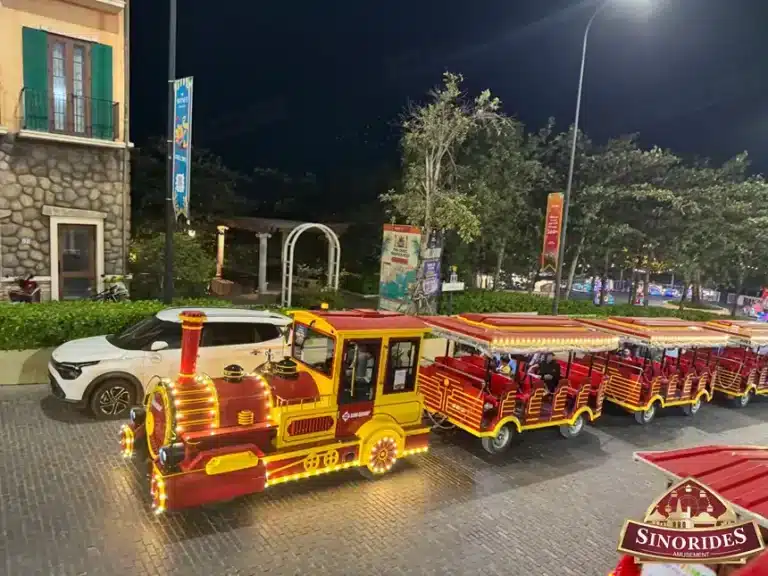
One of my favorite success stories is the Premier Village Phu Quoc Resort in Vietnam, managed by the Sun Group. They didn’t just want a kiddie train ride; they needed a reliable transportation solution that felt like part of the luxury experience.
They invested in Sinorides large-capacity trackless trains. By integrating these into their guest commute, they achieved two things:
1. Reduced reliance on individual golf carts (lower fleet maintenance).
2. Created a “scenic tour” vibe that guests loved.
It wasn’t just a trackless train supplier transaction; it was a transit infrastructure upgrade that paid for itself in guest satisfaction and operational efficiency.
6. ROI Analysis: How Fast Can You Break Even?
Let’s talk business. If you buy a mall train for sale for $20,000, what is the timeline for profit?
In a typical high-traffic shopping mall, a shopping mall kids electric trackless train can run 10 trips per hour. At $5 per ticket and a 10-person capacity (even at 50% occupancy), you are looking at $250 per hour. Run that for 6 hours a day on weekends, and the numbers start to look very attractive. Most of our clients in markets like India (Fantasy Park) or Algeria (Snober Land) report a full return on investment (ROI) within 6 to 10 months.
Remember, a small fun train in shopping mall also acts as a “parent trap.” It keeps families in the mall longer, increasing their total spend at other attractions like bumper cars or a carousel ride.
7. Choosing a Manufacturer: The Sinorides Advantage
When you are looking for a mall train manufacturer or a trackless train supplier, you are looking for a long-term partner. Since 1992, Sinorides has been the backbone for over 1,200 parks worldwide.
Sinorides don’t just ship you a train for kids and disappear. Our service includes site planning, installation supervision, and a robust spare parts supply chain. Whether you need a ferris wheel to anchor your park or a fleet of fun train rides at the mall, our engineering meets international standards like CE, ISO, and GOST.
Ready to Start Your Train Investment?
Get a customized quote and technical layout for your project today.
Explore more: Roller Coasters | Pirate Ships | Family Rides
Sinorides
30+ Years in Amusement Engineering & Park Operations
This guide is verified by Sinorides‘ team, ensuring all pricing, technical specs, and safety standards (ASTM, CE, GOST) reflect current 2026 global market conditions. Sinorides specialize in turning empty spaces into profitable landmarks.
Frequently Asked Questions About Buying Amusement Trains
1. What is the difference between a tracked and a trackless train?
A tracked train runs on a fixed railway system, which is ideal for dedicated children’s areas where you want a controlled environment. A trackless train uses rubber tires and can be driven on any flat, paved surface like mall corridors or park paths. Trackless trains offer much higher flexibility but require a skilled operator to steer.
2. How long does the battery last on an electric trackless train?
Most professional Sinorides electric trains are equipped with heavy-duty battery packs that provide 8 to 12 hours of continuous operation on a single charge. This typically covers a full day of park operations. Charging usually takes 6 to 8 hours overnight, though fast-charging lithium options can reduce this significantly.
3. Can a trackless train climb hills or inclines?
Yes, but it depends on the motor power and braking system. Standard mall trains are designed for flat surfaces. However, our tourist-grade trackless trains are equipped with high-torque AC motors and hydraulic braking systems capable of handling inclines of up to 10-15 degrees, making them suitable for hilly resorts.
4. What certifications should I look for when buying?
Safety is paramount. You should ensure the manufacturer provides CE certification for electrical components, ISO 9001 for manufacturing quality, and depending on your region, GOST (for Russia/CIS) or ASTM (for North America) compliance. Sinorides equipment meets these international standards to ensure operator peace of mind and passenger safety.
5. How many passengers can a typical amusement train carry?
Capacity varies by configuration. A standard kiddie train usually carries 12-16 children. A mall trackless train typically handles 18-24 passengers (kids and adults). Large-scale tourist trains can be expanded with additional carriages to carry 40 to 60 passengers, making them efficient for high-volume commuter use in resorts.
6. Is maintenance difficult for electric trains?
Actually, it is quite simple compared to diesel engines. Daily maintenance involves checking battery water levels (for lead-acid), tire pressure, and ensuring the braking system is responsive. Monthly checks focus on motor brushes and electrical connections. Sinorides provides a detailed maintenance manual and video tutorials for all clients.
7. Can I customize the appearance of the train?
Absolutely. Customization is one of our strengths. You can choose the theme (vintage, futuristic, animal-themed), the color scheme, and even add custom branding or logos. Sinorides can also integrate specific LED lighting patterns and sound effects to match your park or mall’s unique brand identity.
8. What is the lifespan of a Sinorides amusement train?
With proper maintenance and indoor storage when not in use, a high-quality amusement train can last 10 to 15 years. The fiberglass body is highly durable, and the main chassis is built to withstand heavy daily use. Batteries and tires are the only components that typically need replacement every few years.
9. How much space do I need for a trackless train?
Trackless trains require a turning radius of approximately 3.5 to 6 meters, depending on the number of carriages. For mall operations, a pathway width of at least 2.5 meters is recommended to ensure the train can pass safely through crowds without causing congestion or safety hazards.
10. Do you provide international shipping and installation?
Yes, Sinorides has exported to over 100 countries. Sinorides handle the complex logistics of sea freight and customs documentation. For larger train systems, Sinorides can send senior engineers to your site to oversee the assembly, conduct safety testing, and train your local operators and maintenance staff.(Trackless trains are usually transported as complete units, requiring no installation, just like cars.)